Why Is My Resume Not Getting Interviews? 7 Hidden Reasons

You've sent out 100 applications. Your inbox is empty—not even a rejection email. Sound familiar?
The brutal truth: 75% of resumes never reach a human recruiter. They're filtered out by Applicant Tracking Systems (ATS) within seconds. But it's not just ATS—there are 7 specific reasons your resume might be getting ignored, and all of them are fixable.
In this guide, you'll discover:
- The #1 reason resumes get rejected (it's not what you think)
- How to diagnose what's wrong with YOUR specific resume
- 7 fixable issues that are costing you interviews
- Free tools to test and fix your resume immediately
If you're feeling frustrated, you're not alone. The average job seeker sends 100-200 applications before landing one interview. But understanding what's going wrong is the first step to turning it around.
The Hard Truth About Resume Screening
Before we dive into the reasons, you need to understand how resume screening actually works.
Here's what happens when you hit "submit":
- ATS receives your resume - 98% of Fortune 500 companies use Applicant Tracking Systems
- ATS parses and scores it - Takes 7-10 seconds, looking for keywords and format compatibility
- 75% get rejected automatically - Never seen by a human
- Recruiters review the rest - Spend an average of 7 seconds per resume
- 2-4% get interviews - Out of 250 average applications per job
This isn't personal. It's a numbers game combined with an optimization game. Most rejections aren't about you—they're about how well your resume is optimized for this system.
The good news? Once you understand what's going wrong, you can fix it.
Reason #1: ATS Is Rejecting Your Resume
The Problem: Your resume never reaches a human because ATS filters it out first.
This is the #1 reason qualified candidates get zero responses. You could be perfect for the job, but if ATS can't read your resume or doesn't find the right keywords, you're automatically rejected.
Why It Happens:
- Missing keywords from the job description
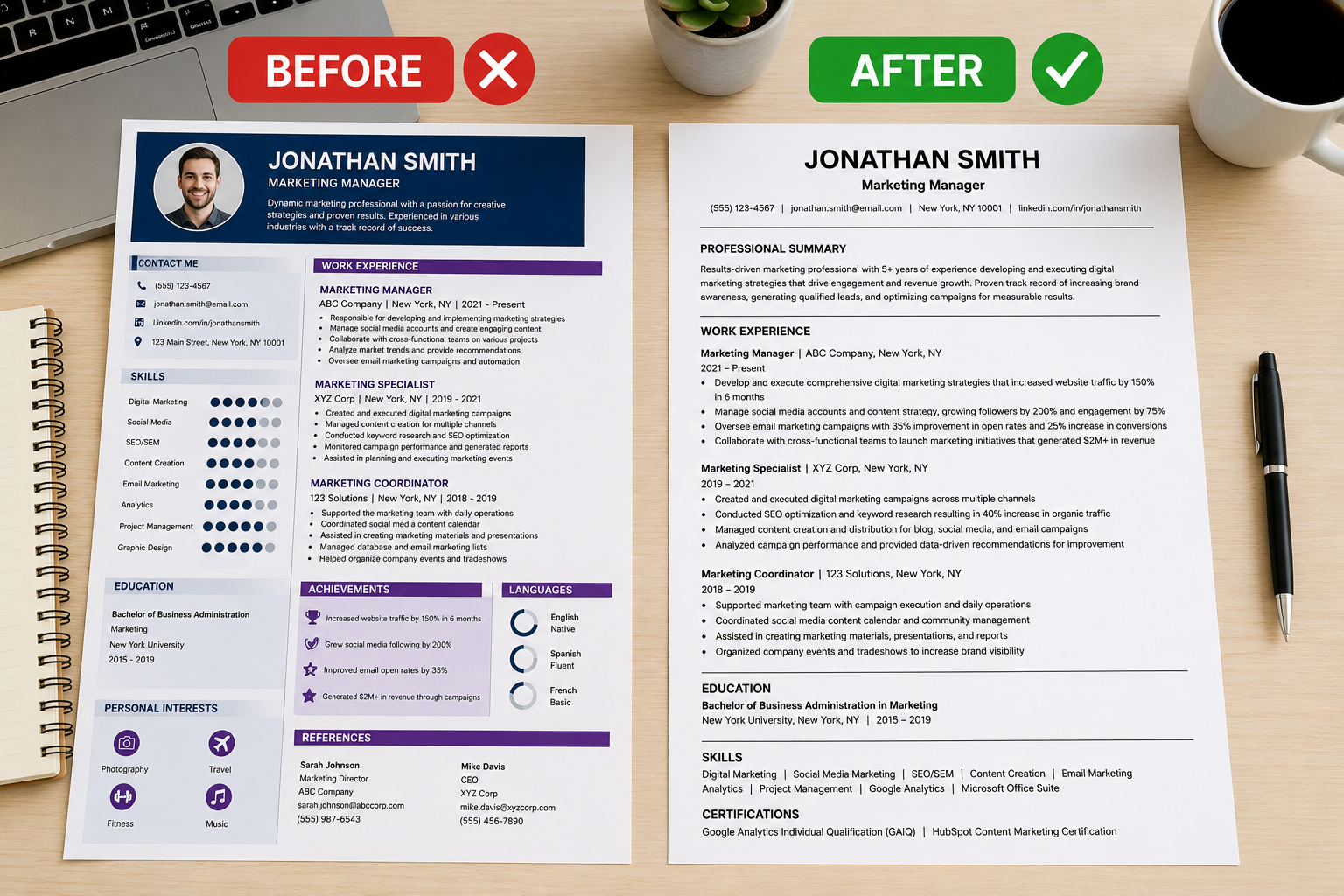
- Incompatible file format - Graphics, images, or complex formatting confuse the parser
- ATS can't parse your structure - Tables, text boxes, or multiple columns break the reader
- Headers and footers with contact information that the system can't process
How to Know If This Is Your Problem:
- You're applying to jobs you're clearly qualified for but hearing nothing
- Your resume has creative formatting, columns, or graphics
- You send the same resume to every job without tailoring it
- You're using a heavily designed template from Canva or similar tools
The Fix:
- Use ATS-friendly format - Simple, single-column layout with standard fonts (Arial, Calibri, Times New Roman)
- Include exact keywords from the job description throughout your resume
- Save as .docx or plain PDF - Test which format the company prefers
- Remove complex elements - No tables, text boxes, headers/footers with contact info
- Test your resume with a free ATS checker before applying
The fastest way to know if ATS is your problem? Use ResumeBold's free ATS checker to see exactly what the system reads and get your score instantly.
Related: How to Pass ATS Systems | ATS Resume Format 2026
Reason #2: You're Missing Critical Keywords
The Problem: Your resume doesn't match what the job description is asking for—even if you have the experience.
ATS systems and recruiters scan for specific keywords, skills, and requirements mentioned in the job posting. If those exact words aren't in your resume, you won't rank high enough to get noticed.
Why It Happens:
- You're using a generic resume for every application
- You use different terminology than the job description (you say "managed projects," they want "project management")
- You're missing specific tools or skills they mentioned
- You don't demonstrate required qualifications they listed
How to Know This Is Your Problem:
- You're qualified but consistently not hearing back
- You send the exact same resume to every job
- You don't read the full job description before applying
- You've never used an ATS keyword matching tool
The Fix:
- Read the ENTIRE job description - Don't skim it
- Circle every skill, tool, and requirement they mention
- Add those EXACT words to your resume (only if you genuinely have that experience—never lie)
- Mirror their language - If they say "project manager," don't say "project lead"
- Aim for 70-80% keyword match with the job description
Example:
❌ Generic: "Managed team projects and improved processes"
✅ Keyword-optimized: "Led cross-functional agile teams (5-8 members) using Jira and Scrum methodology to deliver enterprise software projects on time and 15% under budget"
The second version includes specific keywords employers search for: "agile," "Jira," "Scrum," "enterprise software"—and backs them up with quantified results.
Related: Resume Keywords by Industry | How to Tailor Your Resume
Reason #3: Your Resume Format Is Unreadable
The Problem: Even if your resume passes ATS, humans can't quickly scan it to find what they need.
Remember: recruiters spend 7 seconds on your resume. If they can't immediately see your qualifications, you're out.
Why It Happens:
- Dense paragraphs instead of bullet points
- No clear sections - Everything runs together
- Tiny font or no white space - Looks overwhelming
- Creative formatting that's pretty but hard to scan
- Important information buried at the bottom
How to Know This Is Your Problem:
- Your resume is text-heavy with long paragraphs
- You're using tables, text boxes, or multiple columns
- Font is smaller than 10pt
- There's no clear visual hierarchy
- You have to scroll to find your current job title
The Fix:
- Use bullet points, not paragraphs
- Clear section headers - Work Experience, Education, Skills, etc.
- Professional font at 11-12pt (Arial, Calibri, or similar)
- Plenty of white space - Don't cram everything in
- Most important info at top - Current role, recent experience, key skills
- Simple one-column layout - No fancy graphics or sidebars
The 7-Second Test:
A recruiter should be able to see these things in 7 seconds:
- Your current role and company
- Your years of experience
- Your top 3 skills
- A recent achievement with numbers
If they can't, your format needs work.
Related: Best Resume Format 2026 | ATS-Friendly Resume Templates
Reason #4: You're Overqualified or Underqualified
The Problem: Your experience level doesn't match what they're actually looking for.
This is tricky because the job description might say "3-5 years experience," but they have a specific candidate profile in mind.
Overqualified Red Flags:
- You have 15+ years experience for a mid-level role
- Your job titles are much more senior than the posting
- You've managed large teams for an individual contributor role
- They assume you'll want too much money or leave quickly
Underqualified Red Flags:
- You're applying to senior roles with junior experience
- You're missing required certifications or degrees
- Your job titles show you're 2+ levels below the role
How to Know This Is Your Problem:
- You're consistently rejected despite having an ATS-friendly resume
- The jobs you're applying to are significantly above or below your level
- Your experience is 5+ years more or less than what they're asking for
The Fix:
If you're overqualified:
- Remove experience older than 15 years
- Tone down senior titles if applying to mid-level roles
- Focus only on experience relevant to this specific level
- Address it briefly in your cover letter: "Seeking a role focused on hands-on work rather than management"
If you're underqualified:
- Only apply to stretch roles where you meet 70%+ of requirements
- Emphasize transferable skills prominently
- Show quick learning ability with examples
- Consider whether you need more experience before applying to that level
The hard truth: if there's a major experience mismatch, no amount of resume optimization will help. Apply to roles that match your actual level.
Reason #5: Your Summary Is Generic and Boring
The Problem: The first thing recruiters read tells them nothing specific about you.
Your resume summary (or objective) sits at the top of your resume. It's prime real estate. If it's generic, vague, or useless, you've wasted your best chance to grab attention.
Red Flag Summaries:
❌ "Motivated professional seeking opportunities to grow and contribute"
❌ "Hard worker with excellent communication skills and attention to detail"
❌ "Results-driven team player looking for a challenging position"
Why These Fail:
- Could apply to literally anyone in any field
- Say nothing specific about YOUR skills or experience
- Focus on what YOU want instead of what you offer
- Waste valuable space with meaningless buzzwords
The Fix:
Write a specific summary that includes:
- Your role or specialty
- Years of relevant experience
- Your top 2-3 skills or areas of expertise
- A quantified achievement or result
Good Examples:
✅ "Senior Data Analyst with 5+ years optimizing business metrics for SaaS companies. Increased revenue $2M through predictive modeling and customer segmentation. Expert in Python, SQL, Tableau, and A/B testing."
✅ "Certified Project Manager (PMP) with 7 years leading enterprise software implementations. Delivered 15+ projects on time and under budget for Fortune 500 clients. Specialized in Agile, Scrum, and cross-functional team leadership."
Notice how these summaries:
- State exactly what they do
- Include specific numbers
- List actual skills (not "excellent communicator")
- Show proven results
Related: Resume Summary Examples That Get Interviews | Resume Objective vs Summary
Reason #6: Employment Gaps or Red Flags
The Problem: Something on your resume raises concerns and makes recruiters hesitate.
Even if everything else is perfect, certain red flags can trigger automatic skepticism.
Common Red Flags:
- Unexplained employment gaps - More than 3-6 months between jobs with no explanation
- Job hopping - Multiple jobs lasting less than 1 year each
- Declining job titles - Going from "Senior Manager" to "Coordinator"
- Irrelevant experience - Nothing connects to the job you're applying for
- No recent work experience - Last job ended 2+ years ago
How to Address Each:
Employment Gaps:
- If gap is 6+ months, briefly address it (layoff, family care, health, freelancing, education)
- Use year format only (2023-2024) instead of months (Jan 2023-Mar 2024) if gap is small
- Show what you did during the gap if productive (courses, volunteering, freelance projects)
Job Hopping:
- Emphasize the project or contract nature of roles if applicable
- Consolidate short-term roles under one heading (e.g., "Freelance Consulting Projects")
- Focus on skills gained and results achieved, not just tenure
Declining Titles:
- Emphasize achievements over titles
- Address it in cover letter if there's a good reason (startup pivot, career change, work-life balance)
- Use a functional resume format highlighting skills over chronology
Related: Employment Gap on Resume: What to Say | Career Change Resume Guide
Reason #7: Basic Resume Mistakes That Kill Your Chances
The Problem: Small errors that immediately disqualify you—even if you're qualified.
These seem obvious, but they're shockingly common and lead to instant rejection.
Critical Mistakes:
- Typos and grammar errors - Shows lack of attention to detail; instant rejection
- Unprofessional email address - [email protected] or [email protected] ❌
- Missing contact information - No phone number or broken LinkedIn link
- Terrible file name - "resume_final_FINAL_v3_NEW.docx"
- Only listing job duties - Not showing accomplishments or results
- Lies or exaggerations - They WILL check, and you WILL be fired if caught
- Photo on resume (for US jobs) - ATS can't read it; also introduces bias
- "References available upon request" - Waste of space; obviously true
- Objective that's all about you - "I want a role where I can learn and grow" ❌
Quick Fixes:
- Proofread 3 times or use Grammarly to catch errors
- Professional email: [email protected]
- Clear contact info at top: Phone, email, LinkedIn (all clickable)
- File name: FirstName_LastName_Resume.pdf
- Add metrics: "Increased sales 25%" not "Responsible for sales"
- Remove photos, references, and personal info (age, marital status, etc.)
- Focus on what you can do FOR them, not what you want from them
Related: 10 Resume Mistakes That Get You Auto-Rejected | Resume Checklist 2026
How to Diagnose YOUR Resume Issues
Now that you know the 7 reasons, here's how to figure out which one (or more) is affecting YOUR resume.
Step 1: Test Your Resume for ATS
Before you apply to another job, you need to know if ATS can even read your resume.
🔥 Use ResumeBold's Free ATS Checker:
- Upload your resume in seconds
- Get an instant score (0-100)
- See exactly what ATS systems see
- Identify formatting issues automatically
- Check keyword match percentage
- Get specific recommendations to improve
Step 2: Run Through This Checklist
Go through your resume and honestly assess:
- Resume uses ATS-friendly format (single column, simple fonts, no graphics)
- Includes specific keywords from job descriptions I'm targeting
- Has clear, scannable format with bullet points and white space
- Summary is specific with years of experience and quantified achievement
- Shows accomplishments with numbers and metrics, not just duties
- Zero typos, grammar errors, or formatting inconsistencies
- Professional contact information (email, phone, LinkedIn)
- Tailored to each job, not a generic one-size-fits-all version
- Experience level matches the jobs I'm applying to
- No major red flags without explanation
If you checked fewer than 7 boxes, you've found your problem areas.
Step 3: Fix and Re-Test
- Make changes based on the ATS checker results and your checklist
- Test again until your ATS score is 80+
- Create a master resume with all your experience and achievements
- Tailor it for each specific application by emphasizing relevant keywords
Step 4: Track Your Results
- Keep a spreadsheet of where you applied, when, and which version of resume you used
- If you're still not getting interviews after fixing these issues, your target roles may not match your qualifications
- Adjust your job search strategy based on what's actually working
Frequently Asked Questions
How many applications should I send before getting an interview?
The average is 100-200 applications per interview in competitive markets. If you're over 150 with zero interviews, your resume likely has fixable issues. Focus on quality over quantity—a tailored, ATS-optimized resume sent to 20 well-matched jobs will get better results than sending 200 generic applications.
How do I know if ATS is rejecting my resume?
If you're qualified for jobs but getting zero responses, ATS is likely the issue. Test your resume with a free ATS checker to see exactly what the system reads. Common problems include complex formatting, missing keywords from the job description, or incompatible file types that ATS can't parse.
Should I apply to jobs even if I don't meet all the requirements?
Yes, if you meet 70%+ of the requirements. Most job descriptions list "ideal" candidates, but companies hire people who meet most qualifications and show potential. Focus on demonstrating transferable skills for missing requirements. However, if you're missing critical skills or multiple years of required experience, you may be better off applying to roles that match your actual level.
How long should my resume be?
One page for 0-5 years of experience, two pages for 5+ years. Never go over two pages. If your resume is longer, you're including too much detail or outdated experience. Focus on the last 10-15 years and your most relevant roles. Quality over quantity.
Does my resume need a cover letter?
Not always, but it helps. About 40% of recruiters say cover letters influence their decision. Use one when: changing careers, explaining employment gaps, showing genuine interest in a specific company, or applying to competitive roles. Keep it brief (250-300 words) and specific to the role—don't just repeat your resume.
How many keywords should be in my resume?
Aim for a 70-80% match with the job description's keywords. Include exact phrases from the JD where truthfully relevant—don't lie or exaggerate. Focus on skills, tools, qualifications, and terminology they use. Use an ATS checker to analyze whether you have enough keyword coverage before applying.
Can I use AI to write my resume?
Yes, but carefully. AI tools can help draft content and structure, but you MUST personalize, fact-check, and ensure accuracy. Generic AI-written resumes are obvious to experienced recruiters. Use AI for initial structure and ideas, then customize heavily with your real experience, authentic voice, and specific achievements.
What if I'm getting interviews but no offers?
That means your resume is working! The issue is interview performance, not your resume. Focus on: researching the company thoroughly, preparing STAR method answers for behavioral questions, practicing common interview questions out loud, asking thoughtful questions, and following up professionally after interviews.
Don't Give Up—Your Resume Just Needs Optimization
Getting zero interviews is frustrating, but in most cases, it's fixable. The main culprits are:
- ATS rejecting your resume before humans see it
- Missing critical keywords from job descriptions
- Poor formatting that's hard to scan
- Generic content that doesn't stand out
- Qualification mismatch with target roles
- Red flags or unexplained gaps
- Basic mistakes that signal carelessness
The good news? All of these issues can be diagnosed and fixed.
Your next steps:
- Test your resume with ResumeBold's free ATS checker right now
- Fix the specific issues the checker identifies
- Tailor your resume for each job you apply to
- Track your applications to measure improvement
Most people see interview requests within 2 weeks of optimizing their resume for ATS and fixing these common issues.
You're not the problem—your resume just needs optimization. Small changes can lead to big results. Start with the free ATS check, and you'll know exactly what needs to be fixed.
Ready to optimize your resume?
Check My ATS Score Free
Check My ATS Score Free