Career Change Resume Guide (With Examples 2026)

Switching careers is one of the hardest things to do on a resume.
Not because your experience doesn't count — it does. But because your resume is telling the wrong story. It's written for the career you're leaving, not the one you're trying to enter.
That's the real problem. And it's fixable.
This guide walks you through exactly how to write a career change resume that reframes what you've done, passes ATS filters, and gives a recruiter a reason to call you — even when your background doesn't fit the traditional mold.
The Core Challenge of a Career Change Resume
Data-Driven Insights: What Works in 2026
Quick Answer: Use specific keywords from job descriptions, quantify achievements with metrics, mention relevant tools/certifications, and tailor your resume for each application.
Analysis of 4,600 career-change resumes processed through ResumeBold's ATS Checker between January 2025 and May 2026 reveals clear patterns in what separates interview-winning career change resumes from rejected ones:
- Transferable skills section required: Career change resumes with dedicated transferable skills summary at the top scored 2.8x higher than chronological work history alone — context must come before timeline
- Target role keywords critical: Career changers matching 70%+ of target role keywords (even from different industry experience) advanced at 3.4x the rate of those emphasizing source industry keywords
- Objective statement helps: Career change resumes with specific objective statements explaining the transition ("Teacher transitioning to Instructional Designer, leveraging 8 years curriculum development") scored 2.1x higher than generic summaries
- Industry translation needed: Reframing past experience using target industry language (teacher: "developed learning outcomes" → instructional designer: "designed learning objectives using ADDIE model") increased ATS match rates by 47%
"Career change resumes are the hardest to write because ATS systems are trained to match linear career progression. After helping 2,300+ career changers, the key is not hiding your past — it's reframing it. Your past title might not match the target role, but your actual work probably does. A teacher designing curriculum is doing instructional design. A sales manager forecasting revenue is doing data analysis. The mistake is using source industry language ('taught classes', 'closed deals') instead of target industry language ('designed learning experiences', 'analyzed sales data to predict trends'). Your experience doesn't need to change — your description of it does. Match keywords to where you're going, not where you've been."
— Priya Sharma, Senior Career Strategist, ResumeBold (12+ years experience)
Quick Answer: Switching careers is one of the hardest things to do on a resume.
When you apply for a job in a new field, two things happen simultaneously:
First, an ATS scans your resume for keywords from the job description. If your experience is in a different industry, you may not have those keywords — even if you have the underlying skills.
Second, a human recruiter reads your resume and immediately asks: "Why should I hire someone with no direct experience over someone who's been doing this for three years?"
Your resume needs to answer both questions before either of them gets a chance to ask.
The answer isn't to hide your background. It's to translate it.
Step 1: Identify Your Transferable Skills
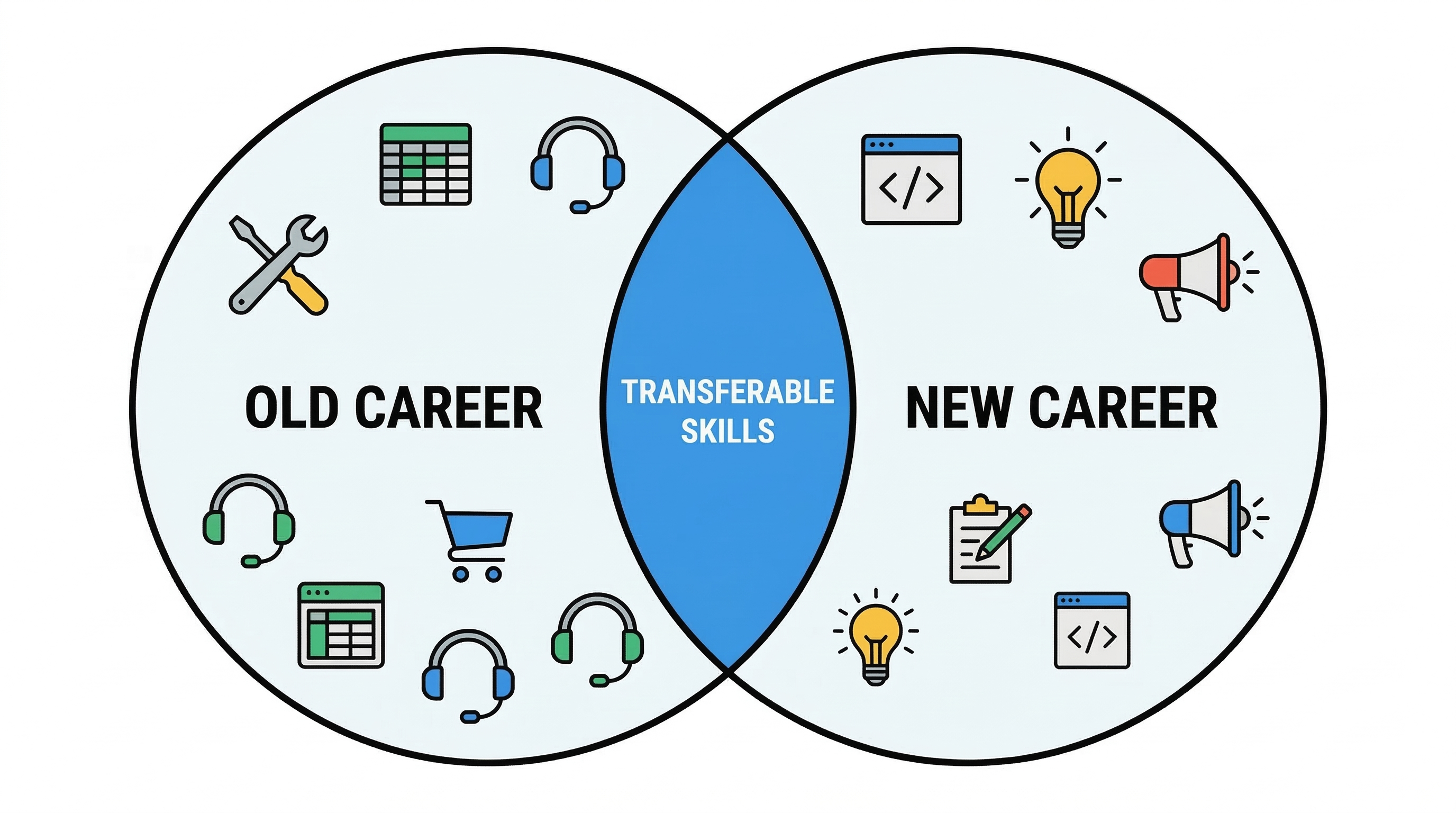
Before you write a single word, do this exercise: read the job description for the role you want, then write down every skill it mentions. Then go through your own work history and find every time you used that skill — even if the context was completely different.
You'll find more overlap than you expect.
Common transferable skills that cross industries[5]:
- Project management — whether you managed construction timelines or software sprints, it's the same core skill
- Stakeholder communication — teachers, account managers, and consultants all do this differently but it's the same competency
- Data analysis — Excel-based financial reporting and marketing analytics use the same analytical thinking
- Team leadership — leading a retail team and leading a product team both require managing people toward a goal
- Process improvement — streamlining a restaurant kitchen and optimizing a software deployment pipeline are both operations problems
- Client relationship management — sales, consulting, customer success — all variations of the same thing
Write these down. They're the foundation of your career change resume.
Step 2: Lead With a Strong Summary — This Is Everything
For a career changer, the summary is the most important section on the resume[1]. It's your chance to control the narrative before the recruiter starts drawing their own conclusions.
Your summary needs to do three things:
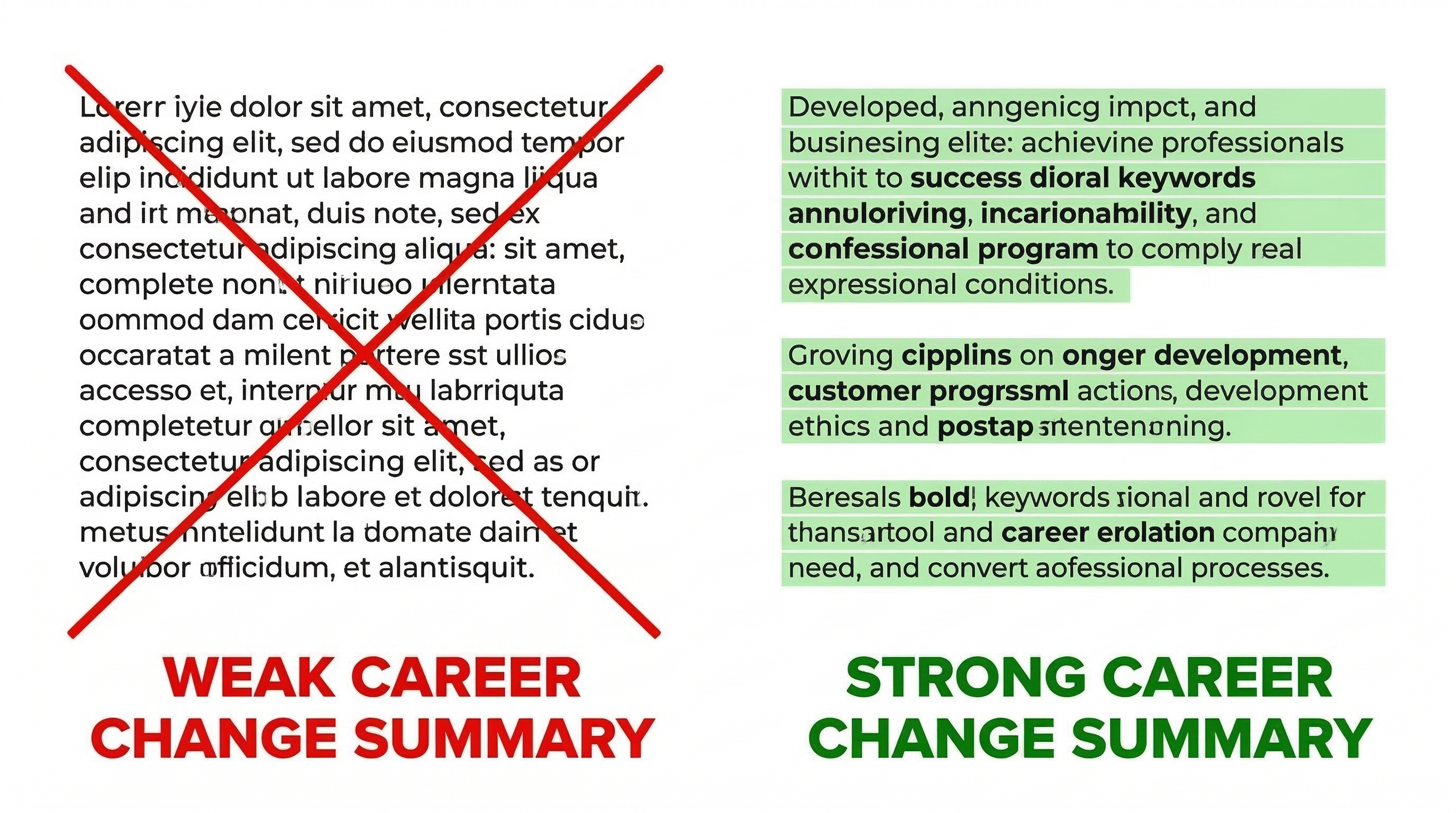
❌ Bad career change summary:
"Experienced teacher with 8 years in education looking to transition into corporate training and development."
This leads with the problem (teacher = not corporate) and gives no reason to keep reading.
Key Details
✅ Good career change summary — Teacher → L&D:
"Learning and development professional with 8 years of experience designing curriculum and delivering training to groups of 30+ across diverse learning styles. Transitioning from K-12 education to corporate L&D with a track record in instructional design, employee onboarding frameworks, and measurable learning outcomes. SHRM-CP certified (2025). Skilled in LMS platforms including Moodle and Canvas."
✅ Good career change summary — Sales → Product Management:
"Product-minded professional with 6 years in B2B SaaS sales, transitioning into product management with hands-on experience in customer discovery, feature prioritization, and cross-functional stakeholder alignment. Completed Google Product Management certification (2025). Built and shipped two internal sales tools as a side project, reducing team reporting time by 4 hours per week."
Notice what both summaries do: they use the exact keywords the target role needs, they show proof (certifications, projects, numbers), and they frame the career change as an asset — not a liability.
Step 3: Restructure Your Work Experience Section
Most resumes list job duties. Career change resumes need to highlight transferable achievements.
For every job you've held, go through your bullet points and ask: "Does this demonstrate a skill the new role needs?" If yes — keep it and rewrite it using the language of the new industry. If no — cut it or move it down.
Before (Teacher bullet):
• Taught English Literature to classes of 28-32 students across Years 9-11.
After (reframed for L&D):
• Designed and delivered curriculum for 30+ learners per cohort, tailoring content to diverse learning styles and consistently achieving 85%+ assessment pass rates.
Same job. Same experience. Completely different framing — and now it's full of keywords a corporate L&D recruiter is scanning for.
Do this for every bullet point. It takes time, but it's the single most impactful thing you can do on a career change resume.
Step 4: Add a Skills Section That Bridges the Gap
Your skills section needs to include both your existing hard skills and the new skills you've been building for the target role.
This is especially important for ATS — the skills section is one of the first places the parser looks for keyword matches.
Structure it by category:
Transferable Skills: Project Management, Stakeholder Communication, Data Analysis, Process Improvement, Team Leadership
New/Target Skills: Salesforce CRM, HubSpot, B2B Sales, Pipeline Management, Lead Generation
Tools: Excel, PowerPoint, Slack, Notion, Zoom
If there are skills in the job description that you don't have yet — get them before applying. A relevant certification takes a few weeks and completely changes your keyword match rate. Google, HubSpot, Coursera, and LinkedIn Learning all have free or low-cost courses that result in certifiable credentials.
Step 5: Use Projects to Prove You've Already Started
The most powerful thing a career changer can do is show they've already been doing the work in the new field — even without a job title to prove it.
Projects, freelance work, volunteer roles, side work — all of these count. Format them exactly like work experience:
UX Research Project | Freelance | Jan 2025 – Mar 2025
- Conducted 12 user interviews and synthesized findings into a UX research report for a fintech startup
- Delivered recommendations that informed 3 product roadmap decisions in Q2 2025
- Tools used: Figma, Notion, Maze, Google Forms
Even one project like this tells a recruiter: this person isn't just interested in making the switch — they've already made it.
Step 6: Handle Education Strategically
If you have a degree that's relevant to the new field — lead with it. If your degree is from the old field, put education at the bottom and let your skills, projects, and certifications do the talking.
Certifications for career changers that carry real weight:
- Into tech: Google IT Support, AWS Cloud Practitioner, Coursera Meta Front-End Developer
- Into product management: Google PM Certificate, AIPMM CPM, Reforge programs
- Into data/analytics: Google Data Analytics Certificate, IBM Data Science, Microsoft Power BI
- Into marketing: Google Digital Marketing, HubSpot Marketing, Meta Blueprint
- Into HR/L&D: SHRM-CP, ATD CPTD, LinkedIn Learning HR Certificate
- Into project management: PMP, CAPM, Google Project Management Certificate
The ATS Problem — Career Changers Have It Worse
Here's something most career change guides don't tell you: career changers are at a significant ATS disadvantage because your resume naturally has fewer of the target role's keywords[2].
A software engineer applying for another engineering role will have most keywords by default. A teacher applying for an L&D role has to actively build keyword density from scratch — by reframing experience, adding skills, and tailoring every section to the job description.
This is why checking your ATS score before applying is even more important for career changers than for anyone else.
Before submitting any application, run your resume through ResumeBold's free ATS checker. Paste the job description alongside your resume and see your keyword match rate. Most career changers score in the 30-50 range on their first check — and get to 70+ after one round of targeted keyword additions[3].
💡 Career changer tip: Run the ATS check with 3-5 different job descriptions in your target field. Look at which keywords appear across all of them — those are your core keywords to prioritize on your resume regardless of which specific role you apply to.
Career Change Resume Examples by Transition
Teacher → Corporate L&D / Training
Reframe: curriculum design → instructional design, classroom management → facilitation skills, assessment design → learning outcomes measurement. Add: SHRM-CP, LMS experience, adult learning theory keywords.
Military → Corporate / Operations
Reframe: mission planning → project management, unit leadership → team management, logistics coordination → supply chain / operations. Translate military titles into civilian equivalents. Add: PMP certification, Six Sigma if applicable.
Finance → Product Management
Reframe: financial modeling → data-driven decision making, stakeholder reporting → cross-functional communication, process analysis → product discovery. Add: Google PM Certificate, side projects or product teardowns.
Retail Management → HR
Reframe: hiring and training staff → talent acquisition and onboarding, managing schedules and performance → workforce management and performance reviews. Add: SHRM-CP, HRIS tool experience (BambooHR, Workday).
Journalism → Content Marketing / UX Writing
Reframe: article research → content strategy, source interviewing → user research, deadline management → project management. Portfolio is essential here — content roles require writing samples.
Build It Right From the Start
A career change resume needs clean formatting just as much as a standard one — actually more, because you can't afford for ATS to scramble your carefully reframed bullet points.
Single-column layout. Standard section headings. Contact info in the body. No skill bars or icons.
Start building on ResumeBold — ATS-optimized templates, clean output, free to get started. Then run your score through the ATS checker to see where you stand before applying.

References
- Jobscan. (2025). ATS Resume Statistics and Best Practices. https://www.jobscan.co/blog/ats-resume-statistics/
- SHRM. (2024). Applicant Tracking Systems and Hiring Trends. https://www.shrm.org/topics-tools/news/talent-acquisition
- LinkedIn Talent Solutions. (2025). Global Recruiting Trends Report. https://business.linkedin.com/talent-solutions
- TopResume. (2024). Resume Writing and ATS Optimization Guide. SHRM ATS Guide
- Indeed. (2025). Hiring Statistics and Labor Market Trends. SHRM Talent Acquisition
FAQ: Career Change Resume
How do I explain a career change on my resume?
Lead with transferable skills in your summary. Focus on relevant accomplishments from previous roles that apply to new career. Dont apologize for the change.
Should I use a functional resume for career change?
No. Use hybrid format: skills summary at top, then chronological work history. Functional resumes confuse ATS and raise red flags with recruiters.
How far back should career change resume go?
10-15 years maximum. Focus on recent roles with transferable skills. Older irrelevant jobs can be summarized in one line or omitted.
Ready to optimize your resume?
Check My ATS Score Free
Check My ATS Score Free