25 Resume Writing Tips That Actually Get Interviews (2026 Guide)

You spent an hour writing your resume. You applied to 30 jobs. You got zero interviews. The problem isn't your experience — it's how you're presenting it on paper.
Most resumes get rejected in under 10 seconds. Either the ATS filters you out before a human sees your resume, or the recruiter scans the first three lines and moves to the next candidate. The difference between a resume that gets interviews and one that gets ignored comes down to specific, fixable writing choices.
This guide gives you 25 proven resume writing tips that recruiters actually use to evaluate candidates. These aren't generic platitudes like "be concise" — these are tactical improvements you can apply today. You'll also see exactly what your resume looks like to an ATS by running it through the ResumeBold free ATS Resume Checker — it shows which tips you're already following and which ones you're missing.
Resume Writing Tips: Content
1. Start Every Bullet with a Strong Action Verb
Why it works: Action verbs make your experience sound active and impactful instead of passive and vague. ATS systems also scan for action verbs to determine the level and scope of your responsibilities.
Weak: Responsible for managing a team of sales representatives.
Strong: Led a team of 8 sales representatives, increasing regional revenue by 34% year-over-year.
Top action verbs by function:
- Leadership: Led, Directed, Managed, Supervised, Orchestrated, Spearheaded
- Achievement: Achieved, Exceeded, Delivered, Accomplished, Surpassed, Outperformed
- Growth: Increased, Grew, Expanded, Scaled, Boosted, Accelerated
- Efficiency: Streamlined, Optimized, Reduced, Improved, Enhanced, Automated
- Creation: Built, Developed, Designed, Created, Launched, Established
2. Quantify Every Achievement with Numbers
Why it works: Numbers prove impact. "Increased sales" is a claim. "Increased sales by 47% in Q3" is evidence. Recruiters scan for metrics because they're concrete and comparable.
Weak: Improved customer satisfaction scores.
Strong: Improved customer satisfaction scores from 72% to 89% within 6 months by implementing weekly feedback loops.
What to quantify:
- Revenue impact ($ generated, % increase)
- Cost savings ($ saved, % reduction)
- Efficiency gains (hours saved, % faster)
- Team size (people managed, teams led)
- Scope (budget managed, projects delivered)
- Volume (users reached, deals closed, tickets resolved)
- Time (deadlines beaten, speed improvements)
3. Tailor Your Resume to the Job Description
Why it works: ATS systems rank resumes based on keyword match between your resume and the job description. A generic resume sent to 50 jobs will score low on all 50 because it doesn't align with any specific role's requirements.
How to tailor:
- Copy the job description into a document
- Highlight repeated keywords and required skills (these are ATS keywords)
- Reorder your resume bullets to lead with experience matching those keywords
- Mirror the job description's language (if they say "stakeholder management," use that exact phrase instead of "client relations")
- Adjust your Professional Summary to mention the specific role title and top 2-3 requirements
The ATS Resume Checker shows you exactly which job description keywords are missing from your resume so you know what to add.
4. Use the PAR Formula for Bullet Points

Formula: Problem + Action + Result
Why it works: This structure tells a complete story in one line. You show what challenge existed, what you did, and what outcome you achieved — proving both your skills and your impact.
Weak: Managed social media accounts.
Strong (PAR): Identified low engagement on Instagram (Problem), launched video content strategy with behind-the-scenes product demos (Action), increasing follower engagement by 230% in 4 months (Result).
5. Keep It to One Page (Unless You Have 10+ Years Experience)
Why it works: Recruiters spend 6-8 seconds on initial resume scans. A two-page resume for someone with 3 years of experience signals you can't prioritize or edit — both critical workplace skills.
Length rules:
- 0-5 years experience: 1 page, no exceptions
- 5-10 years experience: 1 page preferred, 2 pages acceptable if highly relevant
- 10+ years experience: 2 pages standard
- Executive roles (C-level, VP): 2 pages maximum
How to cut content: Remove jobs older than 10-12 years (or compress to one line each), cut irrelevant early-career roles, remove soft skills that can't be proven, eliminate "responsible for" bullets that don't show results.
6. Lead with Results, Not Responsibilities
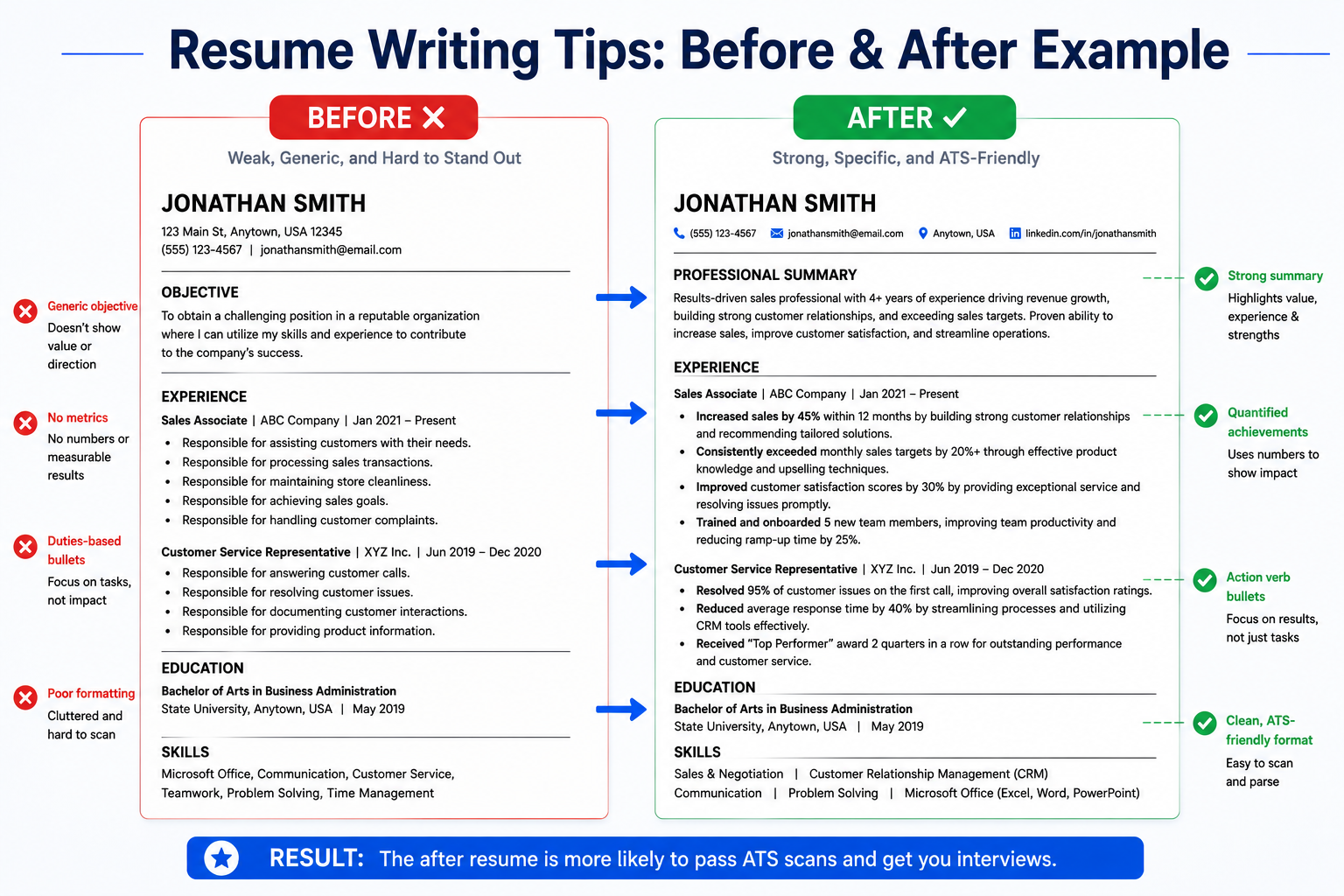
Why it works: Your job description is already in the job title. Recruiters want to know what you accomplished, not what you were supposed to do.
| Responsibility-Focused ❌ | Result-Focused ✅ |
|---|---|
| Responsible for managing email marketing campaigns | Increased email open rates from 18% to 31% by A/B testing subject lines and optimizing send times |
| Handled customer service inquiries | Resolved 95% of customer inquiries on first contact, reducing escalations by 40% |
| Assisted with data analysis projects | Built automated reporting dashboard in Python, saving analysts 12 hours per week |
| Managed vendor relationships | Renegotiated contracts with 6 key vendors, reducing annual costs by $180K (22% savings) |
7. Include Keywords from the Job Description (But Use Them Naturally)
Why it works: ATS software scores resumes based on keyword match. If the job description mentions "Google Analytics" 4 times and you wrote "web analytics," you get zero points for that keyword even though it's the same skill.
How to avoid keyword stuffing:
- Use exact phrases from the job description in your Work Experience bullets
- Add a Skills section with both the exact JD keywords and related terms
- Don't repeat the same keyword 10 times — ATS algorithms penalize obvious stuffing
- Write for humans first, then add keywords naturally during editing
Example: If the JD says "project management," "stakeholder communication," and "Agile methodology," your resume should use those exact terms instead of synonyms like "program management," "client relations," or "Scrum process."
8. Remove "Responsible For" from Every Bullet
Why it works: "Responsible for" is filler. It adds no information and makes your bullets sound like a job description instead of an achievement record.
Find-and-replace: Search your resume for "responsible for" or "duties included" and delete those phrases. Start directly with the action verb.
Before: Responsible for creating weekly reports on sales performance.
After: Created automated weekly sales dashboard, reducing reporting time from 4 hours to 15 minutes.
9. Write a Professional Summary (Not an Objective)
Why it works: A Professional Summary tells the recruiter who you are and what value you bring in the first 3 seconds. An Objective tells them what you want — which they don't care about until they know what you offer.
Weak (Objective): Seeking a challenging role in data analysis where I can grow my skills.
Strong (Summary): Data Analyst with 4 years of experience in Python, SQL, and Tableau. Increased revenue forecasting accuracy by 28% at a Series B SaaS company. Expertise in building dashboards that drive executive decision-making.
Summary formula: [Job Title] with [X years] experience in [top 3 skills]. [Biggest quantified achievement]. [Core expertise or specialization].
10. Put Your Most Impressive Achievement First
Why it works: Recruiters read top to bottom. If your most impressive achievement is buried as the 4th bullet in your second job, they'll never see it. Lead with your strongest evidence.
How to prioritize bullets:
- Biggest revenue impact or cost savings ($ amounts)
- Largest % improvement or growth number
- Most relevant to the target role's top requirement
- Leadership scope (team size, budget size)
- Awards, recognition, or competitive wins
Resume Writing Tips: Formatting
11. Use a Standard One-Column Layout
Why it works: ATS systems parse one-column layouts reliably. Two-column layouts often get scrambled — the ATS reads left column top to bottom, then right column, mixing your Skills section into your Work Experience bullets and destroying your match score.
ATS-friendly: Single column, sections stacked vertically (Summary → Experience → Skills → Education).
ATS-risky: Two columns (contact info + summary on left, experience on right), text boxes, tables.
12. Stick to Standard Fonts
Why it works: Decorative fonts confuse OCR (optical character recognition) that ATS uses to read your resume. If the system can't read "Marketing Manager," it can't score you for that keyword.
Safe fonts: Arial, Calibri, Garamond, Georgia, Helvetica, Times New Roman, Trebuchet MS
Avoid: Comic Sans, Papyrus, script fonts, handwriting fonts, ultra-thin fonts
Size: 10-12pt for body text, 14-16pt for your name, 11-13pt for section headers
13. Use Standard Section Headers
Why it works: ATS software looks for specific section headers to categorize your information. Creative headers confuse the parser, and your experience ends up in the wrong category or not scored at all.
Use these exact headers:
- Professional Summary (or just Summary)
- Work Experience (or Professional Experience)
- Skills (or Technical Skills, Core Competencies)
- Education
- Certifications (if applicable)
Avoid: "My Journey," "Where I've Worked," "What I'm Good At," "Credentials" — ATS doesn't recognize these as section headers.
14. Save as PDF (Unless the Job Posting Says Otherwise)
Why it works: PDF preserves your formatting across all devices and operating systems. A DOCX file might look perfect on your Mac but show up with broken formatting on a recruiter's Windows PC.
Exception: If the job posting explicitly says "submit resume as DOCX" or "no PDFs," follow that instruction. Some older ATS systems parse DOCX better than PDF.
File name: FirstNameLastName_Resume.pdf (not "Resume_Final_v3.pdf" or "John_Resume.pdf")
15. Remove Photos, Graphics, and Logos
Why it works: ATS can't read images. A photo, logo, or graphic chart takes up space and adds zero keyword value. In the US, photos also introduce bias liability, so many companies auto-reject resumes with photos.
Remove: Headshot photo, company logos, skill bar charts, infographic elements, decorative icons
Keep (as text only): Bullet points (use simple round bullets), section divider lines (single horizontal line in standard format)
Regional note: Photos are expected on resumes in some European and Asian countries. If you're applying in Germany, France, or parts of Asia and the job posting shows example resumes with photos, include one. For US/Canada/UK roles, never include a photo.
16. Use Consistent Formatting
Why it works: Inconsistent formatting looks sloppy and makes recruiters question your attention to detail — a critical skill in any role.
Check for consistency:
- Dates: All dates in same format (Jan 2022 – Mar 2024 OR 01/2022 – 03/2024, not mixed)
- Bullet points: All the same style (all round bullets, not mixed with dashes or squares)
- Bold/italic: All job titles bold, all company names italic (or vice versa, but pick one system)
- Spacing: Same spacing between all job entries
- Tense: Past tense for old jobs, present tense only for current role
17. Keep Margins at 0.5-1 Inch
Why it works: Margins smaller than 0.5 inch make your resume look cramped and hard to scan. Margins larger than 1 inch waste space you need for content.
Standard: 0.75 inch on all sides (top, bottom, left, right)
If you're tight on space: Reduce to 0.5 inch, but go no smaller
Resume Writing Tips: Skills & Keywords

18. Create a Skills Section with Hard Skills
Why it works: A dedicated Skills section gives ATS an easy place to scan for keyword matches. It also lets recruiters see your technical qualifications at a glance without reading every bullet.
What to include:
- Technical tools (Excel, Salesforce, Tableau, Python, AWS)
- Certifications (PMP, CPA, Google Analytics Certified)
- Languages (Spanish - fluent, Mandarin - conversational)
- Hard skills specific to your field (SEO, data modeling, financial forecasting)
What to skip: Soft skills like "communication," "teamwork," "problem-solving" — these go in your bullets with evidence, not in a skills list.
Format: List format with commas, or grouped by category:
Technical Skills: Python, SQL, Tableau, Power BI, Google Analytics, AWS
Certifications: PMP (Project Management Professional), Certified ScrumMaster (CSM)
Languages: English (native), Spanish (fluent), French (intermediate)
19. Spell Out Acronyms the First Time
Why it works: ATS might search for the full term or the acronym. If you only write "SEO," you won't match a search for "Search Engine Optimization." If you only write the full term, you won't match "SEO."
Format: Search Engine Optimization (SEO), Project Management Professional (PMP), Customer Relationship Management (CRM)
Where to do this: First mention in your Summary or first mention in each job entry. After that, you can use just the acronym.
20. Match Industry-Specific Tool Names Exactly
Why it works: ATS searches for exact matches. "Microsoft Excel" ≠ "Excel" ≠ "MS Excel" in some systems. If the job description says "Salesforce CRM," use "Salesforce CRM," not just "Salesforce."
Common exact-match tools:
- Correct: JavaScript (not Javascript or Java Script)
- Correct: Microsoft Excel (or just Excel, but be consistent)
- Correct: Google Analytics (not GA)
- Correct: AWS (Amazon Web Services) — include both
Cross-reference the job description and use their exact spelling and capitalization.
Resume Writing Tips: Common Mistakes
21. Don't List "References Available Upon Request"
Why it's outdated: Recruiters assume you have references. This phrase wastes a line of valuable space and makes your resume look like it was written in 2005.
Remove it. Save references for when you're asked (usually after the first or second interview).
22. Avoid Personal Pronouns (I, Me, My)
Why it works: Resumes use implied first-person. "Led a team of 5 engineers" is cleaner and more professional than "I led a team of 5 engineers."
Weak: I was responsible for managing the social media accounts and I increased our follower count.
Strong: Managed social media accounts across Instagram, LinkedIn, and Twitter, growing combined followers from 12K to 34K in 8 months.
23. Remove Hobbies (Unless Directly Relevant)
Why it works: Hobbies take up space that could showcase relevant skills or achievements. "Interests: hiking, photography, reading" tells a recruiter nothing about your qualifications.
Exception: Include hobbies only if they're directly relevant to the role (e.g., "Marathon runner" for a job at a fitness company, "Open-source contributor" for a developer role, "Volunteer tax preparer" for an accounting job).
24. Don't Lie or Exaggerate
Why it backfires: Background checks catch degree fraud, employment date mismatches, and inflated job titles. Even small lies (claiming "fluent" in a language you barely speak) get exposed in interviews.
What's OK: Rounding dates to months (March 2022 instead of March 15, 2022), simplifying a convoluted job title to something standard (your title was "Customer Success Enablement Specialist" but you write "Customer Success Manager"), using "led" for projects where you were the de facto leader even if not the formal manager.
What's not OK: Claiming degrees you don't have, listing companies you never worked for, inventing results (saying 50% growth when it was 12%), fabricating job titles.
25. Proofread (Then Proofread Again)
Why it matters: A single typo can cost you the interview. Recruiters see typos as evidence of carelessness — if you can't proofread a one-page document about yourself, how will you handle client deliverables?
How to catch errors:
- Read your resume out loud (you'll catch awkward phrasing and missing words)
- Print it and review on paper (errors are easier to spot in physical format)
- Use Grammarly or spell-check, but don't rely on it exclusively
- Ask someone else to review it (fresh eyes catch what you've read 10 times and missed)
- Check dates for accuracy (start/end dates, graduation years)
- Verify all company names are spelled correctly
Resume Writing Tips by Experience Level
| Entry Level (0-2 years) | Mid Level (3-7 years) | Senior / Lead (8+ years) |
|---|---|---|
| Lead with Education section (move above Experience if recent graduate) | Lead with Professional Summary emphasizing years of experience and specialization | Lead with quantified leadership impact and scope (budget size, team size, strategic initiatives) |
| Include internships, volunteer work, relevant coursework, and class projects | Remove internships unless highly relevant; focus on full-time roles | Compress or remove roles older than 10-12 years; focus on recent leadership positions |
| 3-4 bullets per role (even if only 6-month internship) | 4-5 bullets for current role, 3-4 for previous roles | 5-6 bullets for most recent role, 2-3 bullets for older roles, 1 line for roles 12+ years ago |
| Emphasize academic achievements (GPA if 3.5+, honors, scholarships, relevant coursework) | Remove GPA unless applying to competitive grad programs; keep major awards only | Education section becomes 1-2 lines (degree, school, year) unless you have advanced degrees relevant to role |
| Quantify wherever possible, even in academic/volunteer contexts ("Managed budget of $5K for student org") | Every bullet must be quantified — no exceptions for mid-level candidates | Focus on strategic impact, not task execution; show business outcomes, not activity |
| 1 page maximum — no exceptions for entry-level | 1 page strongly preferred, 2 pages acceptable if 7+ years experience in same field | 2 pages standard; compress to fit if possible but don't sacrifice key achievements |
How to Check If Your Resume Follows These Tips
The fastest way to see which tips you're already following and which ones need work: paste your resume into the ResumeBold free ATS Resume Checker.
It scans your resume and shows you:
- Keyword match score: Are you using job description keywords? (Tip #3, #7)
- Formatting issues: Does your layout confuse ATS? (Tip #11, #12, #13)
- Section detection: Can ATS find your Experience, Skills, and Education? (Tip #13)
- Contact info parsing: Is your name, email, and phone number readable? (Tip #14, #15)
- Specific fixes: Exactly what to add, remove, or change to improve your score
Upload your resume, paste the job description, and get your results in under two minutes. You'll see your ATS match score (0-100) and a detailed breakdown showing which tips you're missing.
Resume Writing Tips FAQ
What are the most important resume writing tips?
The three most important resume writing tips: (1) Quantify every achievement with numbers to prove impact, (2) Tailor your resume to match each job description's keywords for better ATS scoring, and (3) Use strong action verbs at the start of every bullet point. These three changes alone can increase your interview rate by 40-60% because they directly address what recruiters and ATS systems look for.
How do I write a resume with no experience?
Focus on transferable skills from academic projects, volunteer work, internships, part-time jobs, or extracurricular leadership. Use the same PAR formula (Problem-Action-Result) to show impact even in non-professional contexts. For example: "Organized campus fundraiser (Problem: needed $10K for student org), recruited 15 volunteers and secured 8 local sponsors (Action), raising $12,400 and exceeding goal by 24% (Result)." Lead with your Education section and include relevant coursework, academic honors, and technical skills gained through classes or self-study.
Should I use a resume template?
Yes, but only use ATS-friendly templates with simple one-column layouts, standard fonts, and clear section headers. Avoid templates with graphics, text boxes, tables, or two-column designs — these fail ATS parsing and your resume gets rejected before anyone reads it. The ResumeBold Resume Builder includes pre-tested ATS templates that pass all major applicant tracking systems while still looking professional and modern.
How long should my resume be?
One page for 0-7 years of experience, two pages for 8+ years or senior/executive roles. Never exceed two pages unless you're in academia (where a CV is appropriate instead of a resume). If you're struggling to fit everything on one page, you're including too much irrelevant detail — cut jobs older than 10 years, remove soft skill fluff, and focus only on achievements relevant to your target role.
What's the best resume format for 2026?
Reverse chronological format (most recent job first) with a one-column layout, standard fonts (Arial, Calibri, or Garamond), and clear section headers (Professional Summary, Work Experience, Skills, Education). This format works for 90% of job seekers and passes ATS reliably. Functional or skills-based formats raise red flags because they're often used to hide employment gaps or lack of relevant experience — recruiters and ATS systems penalize them.
How often should I update my resume?
Update your master resume every 3-6 months with new achievements, skills, or responsibilities. When actively job searching, customize your resume for every single application by adjusting keywords, reordering bullets to prioritize relevant experience, and tailoring your Professional Summary to match the specific role. A generic resume sent to 50 jobs will underperform a tailored resume sent to 10 jobs every time.
What should I put in my resume summary?
Your resume summary should answer three questions in 2-3 lines: (1) Who are you? (job title + years of experience), (2) What's your biggest quantified achievement? (revenue impact, efficiency gain, or scope), and (3) What's your core expertise? (specialization or unique skill combination). Example: "Marketing Manager with 6 years driving growth for B2B SaaS companies. Increased MQL-to-SQL conversion by 43% and reduced CAC by $280 per customer. Expert in demand generation, marketing automation (HubSpot, Marketo), and revenue attribution modeling."
How can I check if my resume is ATS-friendly?
Use the ResumeBold ATS Resume Checker to scan your resume and see exactly what an ATS reads. Upload your resume and paste the job description — you'll get an ATS match score (0-100), see which keywords are missing, identify formatting issues that block parsing, and get specific recommendations to improve your score. Most ATS-friendly resumes score 75+ and use simple formatting, standard section headers, no graphics, and job description keywords naturally integrated throughout.
Final Takeaway: Resume Writing Tips That Work
You now have 25 specific, actionable resume writing tips that directly address what recruiters and ATS systems evaluate. These aren't theory — they're tactical changes you can make today that will improve your interview rate.
Start with the highest-impact tips first: quantify your achievements (#2), tailor to the job description (#3), and use strong action verbs (#1). Then run your resume through the ResumeBold free ATS Resume Checker to see which other tips you're missing and get personalized recommendations.
If you're building a resume from scratch or want to ensure you're following all 25 tips automatically, use the ResumeBold Resume Builder — it includes ATS-optimized templates, pre-written bullet examples for your industry, and real-time formatting checks so you never miss a critical tip.
Related: Resume vs CV: What's the Actual Difference? | How to Write a Resume: Complete Guide | Software Engineer Resume Examples
Ready to optimize your resume?
Check My ATS Score Free