Employment Gap on Resume: What ATS Sees (How to Fix)
Employment gaps make most job seekers panic. They assume the ATS will flag them, the recruiter will reject them, and the gap will follow them from application to application until they give up or lie about the dates.
Here's the truth: 91% of hiring managers say they accept candidates with employment gaps[1]. ATS systems do not automatically reject resumes because of them[2]. And in 2026, career breaks are so common — layoffs, caregiving, health, further education, career pivots — that most recruiters have stopped treating gaps as red flags at all.
The real problem isn't the gap. It's how most people handle it on their resume — either trying to hide it in ways that confuse ATS parsing, or leaving it completely unexplained in ways that make recruiters nervous. This guide fixes both.
What ATS Systems Actually See When You Have a Gap
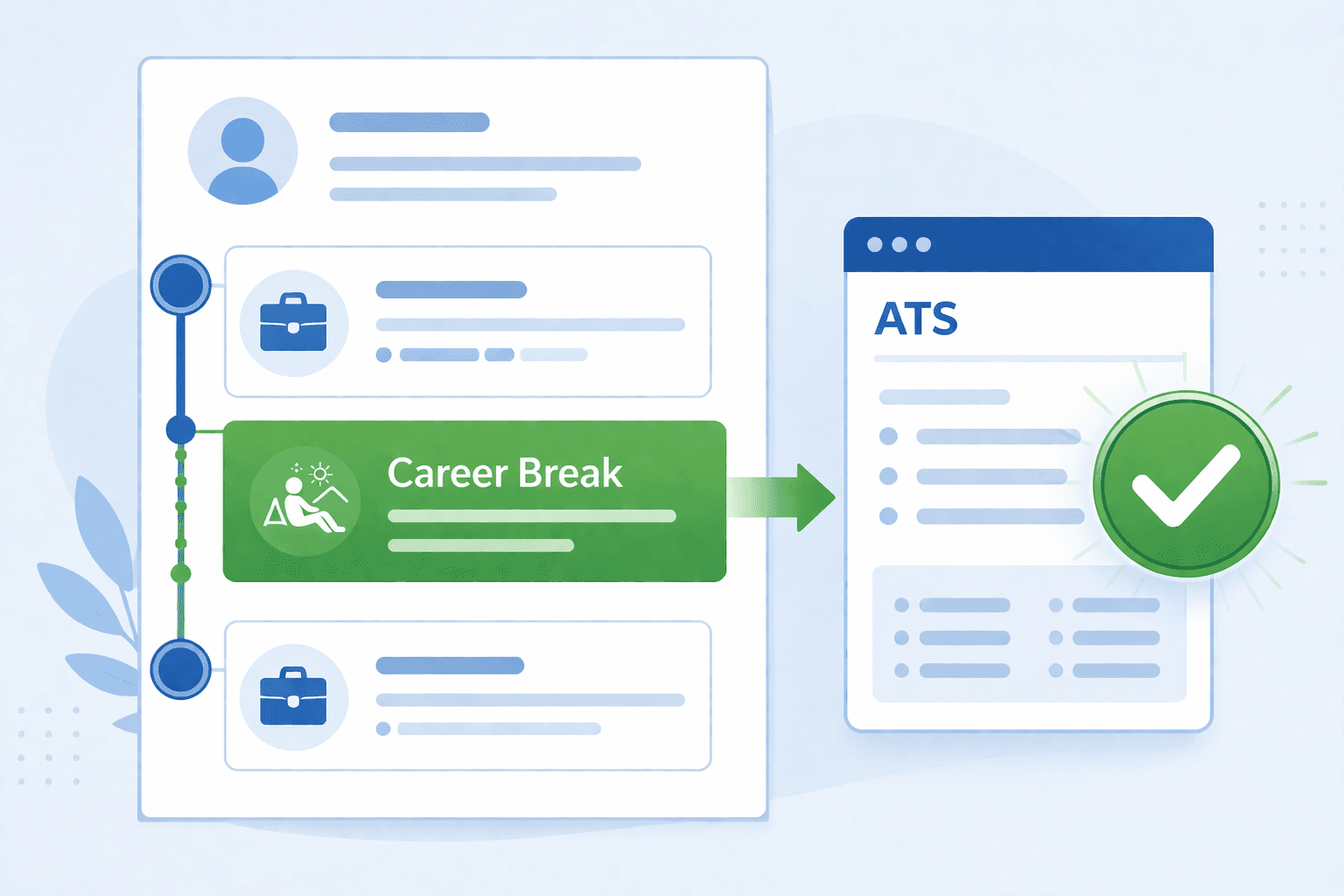
ATS (Applicant Tracking Systems) parse your resume to extract dates, job titles, and companies. When there's a gap between employment dates, the system doesn't automatically reject you. It simply records the chronology and flags the gap as a data point for the recruiter to review.
Here's what happens technically when an ATS processes your resume:
- Date parsing: The system extracts start and end dates from each position (e.g., "Jan 2020 - Mar 2022")
- Timeline construction: It builds a chronological employment history
- Gap identification: Any period longer than 2-3 months between jobs gets flagged
- Keyword matching continues: The system still matches your skills and experience against job requirements regardless of gaps
The ATS doesn't "penalize" gaps with a lower score. It just presents them to the human recruiter. What matters is how that person interprets the gap — and that's where your formatting and explanation strategy comes in.
The 3 Resume Formats for Employment Gaps
Your format choice depends on your gap length, how recent it is, and your overall career trajectory.
1. Reverse-Chronological Format (Best for Short or Old Gaps)
Use this standard format if your gap is less than 6 months or occurred more than 2 years ago. List all positions in reverse order with clear month/year dates.
When to use: Gap under 6 months, or gap happened years ago and you have steady work since then.
Example:
Senior Marketing Manager | TechCorp Inc.
June 2023 - Present
• Led digital marketing strategy reaching 2M+ monthly users
• Managed $500K annual advertising budget with 32% ROI improvement
• Built and mentored team of 5 marketing specialists

Career Development Break
March 2022 - May 2023
• Completed Google Analytics 4 and Google Ads certifications
• Freelance marketing consulting for 3 local businesses
• Volunteer social media management for nonprofit (grew followers 200%)

Marketing Manager | StartupXYZ
January 2019 - February 2022
• Grew email subscriber list from 5,000 to 50,000
• Launched 12 product campaigns with average 18% conversion rate
Notice the gap is explicitly listed with a professional label and brief context. This prevents ATS confusion and gives recruiters clear information rather than making them guess.
2. Functional/Skills-Based Format (Best for Multiple or Long Gaps)
This format organizes your resume by skills and achievements rather than strict chronology. It's less common in 2026 but useful for significant gaps.
When to use: Multiple gaps throughout your career, returning to work after 3+ years, or career change after extended break.
Structure:
- Professional Summary (3-4 lines about your value)
- Core Competencies (skills grouped by category)
- Key Achievements (results, not tied to specific jobs)
- Employment History (dates listed but de-emphasized at bottom)
- Education & Certifications
Important note: Many recruiters prefer chronological, so only use functional format when gaps are your biggest challenge. Otherwise, stick with hybrid.
3. Hybrid/Combination Format (Best for Recent 1-2 Year Gaps)
This combines a skills-first approach with chronological work history. It's the most versatile for handling significant but explainable gaps.
Example structure:
PROFESSIONAL SUMMARY
Results-driven Project Manager with 8+ years leading cross-functional teams and delivering
$10M+ projects on time and under budget. PMP certified with expertise in Agile methodologies.

CORE COMPETENCIES
• Project Management: Agile, Scrum, Waterfall, JIRA, MS Project
• Team Leadership: Led teams of 5-15 across engineering, design, marketing
• Budget Management: $2M+ P&L responsibility, vendor negotiations
• Stakeholder Communication: C-suite presentations, client relationship management

PROFESSIONAL EXPERIENCE

Senior Project Manager | ABC Technology Solutions
March 2020 - November 2023
• Delivered 8 enterprise software implementations averaging $1.5M project value
• Reduced project delays by 40% through improved risk management processes
• Managed remote team of 12 across 3 time zones during COVID transition

Career Transition & Professional Development
December 2023 - October 2024
• Completed PMP certification (passed first attempt, 90th percentile)
• Led volunteer project management for community center renovation ($200K project)
• Freelance PM consulting for 2 startups (both secured Series A funding)
• Stayed current with industry trends through PMI webinars and networking events

Project Manager | XYZ Corporation
June 2015 - February 2020
• Managed portfolio of 12 concurrent projects with combined budget of $5M
• Improved team productivity 25% by implementing Agile practices
• Mentored 3 junior PMs who were promoted within 18 months
How to Explain Different Types of Employment Gaps
The specific language you use matters. Here's exactly what to write for each type of gap situation:
Layoff or Company Closure
This is the easiest gap to explain because it's beyond your control and extremely common (especially 2020-2024).
What to write on resume:
- "Career transition following company restructure"
- "Position eliminated due to organizational changes"
- "Company closure" (if applicable)
- "Affected by reduction in force"
Full example:
Career Transition Following Layoff
March 2024 - November 2024
Following company-wide restructuring, focused on professional development:
• Completed AWS Solutions Architect Professional certification
• Contributed to 3 open-source projects on GitHub (Python, React)
• Contract cloud architecture consulting for 2 clients
• Active member of Cloud Architecture meetup group
Don't say: "Unemployed," "Looking for work," "Between jobs," "Fired." Even if you were laid off, avoid negative framing.
Health or Medical Leave
You don't need to disclose specifics about your health condition. The goal is simply to show the gap was necessary and you're now ready to work.
What to write:
- "Medical leave" or "Medical sabbatical"
- "Family medical leave"
- "Health-related leave (fully recovered)"
- "Personal medical leave"
Example:
Medical Leave
June 2023 - March 2024
• Addressed health matter and completed full recovery
• Maintained industry knowledge through online courses (Coursera, LinkedIn Learning)
• Continued professional network engagement through virtual industry events
• Now cleared for full-time work commitment
What NOT to disclose: Specific diagnosis, disability details, ongoing treatment, or anything suggesting you might need future leave. Keep it brief and professional.
Legal note: In the US, you're not required to disclose medical information during hiring. Only mention health gaps if they're significant (6+ months) and need explanation.
Caregiving Responsibilities (Children, Elderly Parents, Family Members)
Caregiving gaps are increasingly common and well-understood by recruiters. Frame it professionally and show you stayed engaged with your field.
What to write:
- "Full-time parent" or "Primary caregiver"
- "Family care responsibilities"
- "Caregiving leave"
- "Stay-at-home parent"
Example for parental leave:
Full-Time Parent
April 2020 - August 2024
• Managed household operations, budgeting, and family logistics
• Served as PTA Treasurer managing $50,000 annual budget
• Completed online professional development: Data Analysis with Python (Coursera), Advanced Excel (LinkedIn Learning)
• Maintained industry connections through professional association membership
• Volunteer project manager for school fundraising campaign ($75K raised)
Example for elder care:
Family Caregiving Responsibilities
January 2022 - December 2023
• Full-time care for elderly parent recovering from surgery
• Coordinated medical appointments, insurance, and in-home nursing care
• Maintained technical skills through online coursework and personal projects
• Part-time freelance work (10-15 hours/week) to stay connected to industry
The key is showing you didn't just disappear — you managed responsibilities, stayed current in your field, and are ready to return.
Education or Career Change
Education gaps are the easiest to explain and often viewed positively because they show proactive career investment.
What to write:
- "Master of Science in [Field]"
- "Full-time graduate student"
- "Professional training and certification"
- "Career development - [Specific program]"
Example for degree:
Master of Science in Computer Science
Georgia Institute of Technology
August 2022 - May 2024 | GPA: 3.8/4.0
• Specialization: Machine Learning and Artificial Intelligence
• Teaching Assistant for CS 2110: Data Structures and Algorithms (2 semesters)
• Capstone project: Built NLP sentiment analysis model with 94% accuracy using Python and TensorFlow
• Relevant coursework: Deep Learning, Natural Language Processing, Computer Vision
Example for certification/bootcamp:
Professional Development & Career Transition
June 2023 - December 2023
• Completed Full-Stack Web Development Bootcamp (General Assembly, 500 hours)
• Built 5 portfolio projects: e-commerce site, task management app, weather API integration
• Freelance web development for 2 small businesses
• Contributed to open-source projects on GitHub (JavaScript, React, Node.js)
When education is the gap reason, put details in the education section and a brief note in work history timeline.
Travel, Sabbatical, or Personal Development
Personal sabbaticals are increasingly accepted, especially if you can show professional growth or skill development during that time.
What to write (if career-relevant):
- "Professional development sabbatical"
- "Career break for personal growth"
- "International work experience"
- "Sabbatical leave"
Example with professional angle:
Professional Sabbatical
January 2023 - December 2023
• Taught English and business skills in Southeast Asia (developed training & presentation abilities)
• Managed personal consulting business remotely (4 ongoing clients, project management, invoicing)
• Completed online courses: Digital Marketing Certification (Google), Business Analytics (Wharton)
• Returned with strengthened cross-cultural communication skills and global perspective
When to minimize explanation: If the gap is under 3 months or personal time isn't professionally relevant, you can simply use month/year dates without detailed explanation:
Product Manager | Google
January 2023 - Present

Product Manager | Amazon
June 2019 - October 2022
The 2-month gap between October 2022 and January 2023 doesn't need explanation. Most recruiters assume standard job transition time.
Common Mistakes That Make Gaps Worse
❌ Mistake #1: Stretching Employment Dates to Hide Gaps
Don't do this:
Marketing Manager | TechCorp
2019 - 2022

Sales Associate | RetailCo
2017 - 2019
Using only years when you actually worked January 2019 - March 2022 and June 2017 - December 2018 is dishonest and will be caught during background checks.
What happens: You get the job offer, HR runs background check, dates don't match, offer is rescinded. This happened to candidates at Google, Amazon, and major consulting firms in 2024.
Do this instead: Use accurate month/year dates and explain gaps professionally.
❌ Mistake #2: Using "Present" for Past Jobs
Never write "2021 - Present" for a job that ended. This is easily verified and immediate grounds for disqualification.
ATS systems flag ongoing employment, and recruiters will ask about your "current" role. When you admit it ended months ago, you've destroyed trust.
❌ Mistake #3: Leaving Large Gaps Completely Unexplained
If you have a 2+ year gap with no explanation, recruiters will assume the worst: termination for cause, incarceration, or complete career disengagement.
Bad example:
Software Engineer | Google
2019 - 2021

Junior Developer | Startup
2016 - 2018
This 1-year gap (2018-2019) plus 2+ year gap (2021-2023) with zero explanation raises red flags.
Better example:
Software Engineer | Google
March 2019 - November 2021

Career Development
December 2021 - October 2023
Master's in Computer Science (Stanford) | Freelance consulting

Junior Developer | Startup
June 2016 - January 2018

Education & Skill Building
February 2018 - February 2019
Coding bootcamp completion | Portfolio project development
❌ Mistake #4: Over-Explaining or Apologizing
Don't do this:
Unfortunately had to take time off work in 2022 due to unexpected personal circumstances
that were completely beyond my control. I understand this gap may raise concerns, but I want
to assure you that I'm now fully ready and committed to returning to work and will not...
Do this:
Family Care Leave | 2022 - 2023
Caregiving responsibilities | Completed industry certifications during this period
Be factual, brief, and confident. Never apologize for necessary life circumstances.
❌ Mistake #5: Inconsistent Dates Across Resume and LinkedIn
Your resume says "2019-2021" but LinkedIn shows "2019-2022." Which is correct?
Recruiters check LinkedIn before calling you. Date discrepancies suggest carelessness or dishonesty. Make sure every date matches exactly across all platforms.
Cover Letter Strategy for Employment Gaps
Your cover letter is where you can provide more context about resume gaps — but only if the gap is significant (12+ months) or unusual for your industry.
The Cover Letter Gap Explanation Formula
- State it upfront (paragraph 2): Don't make recruiters wonder. Address it briefly.
- Explain the reason factually: No drama, no over-sharing. One sentence.
- Show what you did during the gap: Learning, staying current, relevant activities.
- Pivot to value and readiness: Connect gap experience to the role you're applying for.
Example paragraph:
You'll notice a gap in my employment from March 2022 to January 2024. During this period, I completed my MBA while working part-time as a strategy consultant for three early-stage startups. This experience gave me hands-on exposure to scaling operations, financial modeling, and resource allocation under constraints — directly relevant to the Operations Manager role at your company. I'm now ready to bring these skills to a full-time position where I can drive measurable operational improvements.
Another example (caregiving):
Between June 2021 and September 2023, I took a career break to care for my elderly parent recovering from a serious illness. During that time, I maintained my technical skills through online coursework (completed AWS Solutions Architect and Kubernetes certifications) and took on occasional freelance projects. My parent has since recovered, and I'm excited to return to full-time work. The experience strengthened my time management, crisis response, and stakeholder communication skills — all valuable for the DevOps Engineer position at your organization.
When NOT to Mention the Gap in Cover Letter
Skip gap explanation in your cover letter if:
- The gap is less than 6 months (normal job transition time)
- The gap happened more than 5 years ago and you have steady work since
- You already explained it clearly on your resume with dates and context
Focus your cover letter on why you're the best candidate, not on explaining your career history.
Answering the Gap Question in Interviews
If you get to the interview stage, they may still ask about your employment gap. Prepare a confident 30-45 second answer.
The Interview Answer Formula
- Acknowledge it directly (5 seconds): "I took time off in 2022 to..."
- Explain the reason without drama (10 seconds): State facts, not feelings
- Show what you did to stay engaged (15 seconds): Learning, projects, volunteering
- Pivot to why you're ready now and excited about this role (15 seconds): Forward-looking
Example answer for caregiving gap:
"I took a 16-month career break starting in January 2023 to care for my elderly parent who was recovering from major surgery. During that time, I managed all medical appointments, insurance coordination, and home nursing — which actually strengthened my project management and organizational skills. I also maintained my professional development by completing my PMP certification online and volunteering to manage a nonprofit fundraising campaign that raised $80,000. My parent has since fully recovered, and I'm now ready to return to work full-time. I'm particularly excited about this role because it combines my project management experience with the healthcare industry knowledge I gained during that period."
Example answer for layoff gap:
"I was part of a company-wide layoff in March 2024 when our startup ran out of runway — about 70% of the company was let go. I spent the next 8 months focused on expanding my technical skills. I completed three AWS certifications, built and launched two side projects that now have active users, and did contract work for a couple of early-stage companies. That time actually allowed me to explore areas of cloud architecture I hadn't touched in my previous role, which is why I'm so interested in this position — it's exactly the type of work I discovered I love during that transition period."
Practice Your Answer
Write out your gap explanation answer and practice it out loud until it:
- Sounds natural, not rehearsed
- Takes 30-45 seconds (not 2 minutes)
- Ends on a forward-looking, positive note
- Includes specific examples (certifications, projects, metrics)
Practice with a friend or record yourself. The first time you say it should NOT be in the actual interview.
Real Resume Examples: Before and After
Example 1: Two-Year Parenting Break
❌ Before (Confusing, Unexplained):
Senior Accountant | ABC Corporation
2018 - 2020

Accountant | XYZ Financial Services
2015 - 2017
Problems: The 2020-2024 gap is completely unexplained. The 2017-2018 gap also has no context. Recruiter doesn't know if you were unemployed, working elsewhere, or what happened.
✅ After (Clear, Professional):
Senior Accountant | ABC Corporation
March 2018 - December 2020
• Managed monthly close process for $50M revenue division
• Reduced financial reporting errors by 31% through process automation
• Supervised team of 3 staff accountants

Full-Time Parent
January 2021 - August 2024
• Primary caregiver for two children
• Maintained CPA license through 40 hours annual continuing education
• Volunteer Treasurer for local nonprofit ($120K annual budget)
• Completed online courses: Advanced Excel Financial Modeling, Power BI for Accountants

Accountant | XYZ Financial Services
June 2015 - February 2018
• Prepared quarterly financial statements for 15 corporate clients
• Assisted with annual audits (zero findings for 3 consecutive years)
• Implemented new accounts payable system reducing processing time 25%

Education & Early Career Development
March 2018 - February 2018
Completed CPA exam (passed all 4 sections first attempt) | Professional preparation
Example 2: Layoff and 9-Month Job Search
❌ Before (Trying to Hide):
Software Engineer | TechStartup Inc.
2019 - 2022

Junior Software Developer | BigTech Corp
2017 - 2019
Problems: Using only years hides that they actually worked until March 2022 and started new job in January 2023. The 10-month gap isn't explained.
✅ After (Honest, Adds Value):
Software Engineer | TechStartup Inc.
February 2019 - March 2022
• Built microservices architecture handling 1.2M+ API requests daily
• Led migration from monolith to containerized deployment (Docker, Kubernetes)
• Reduced system latency 40% through database query optimization

Professional Development Following Company Closure
April 2022 - December 2022
Company shut down operations due to funding challenges
• Completed AWS Solutions Architect Professional certification
• Built 3 open-source projects (combined 2.8K GitHub stars): ML model deployment tool, React component library, Python API framework
• Contract engineering work for 2 startups (authentication systems, API optimization)
• Active contributor to local developer meetup organizing committee

Junior Software Developer | BigTech Corp
June 2017 - January 2019
• Developed RESTful APIs for internal tools used by 500+ employees
• Reduced page load times 40% through React performance optimization
• Collaborated with UX team to redesign user dashboard (20% increase in engagement)
LinkedIn Profile: Make Your Dates Match
Whatever dates you put on your resume MUST match LinkedIn exactly. Recruiters check LinkedIn before interviews.
How to Handle Gaps on LinkedIn
Option 1: Create a position entry for the gap
- Position title: "Professional Development" or "Career Break"
- Company: Leave blank or write "Independent"
- Dates: Match your resume exactly
- Description: Brief explanation (2-3 bullets like your resume)
Option 2: Add to headline/summary if gap is recent
Example headline: "Software Engineer | Recently completed AWS certification | Seeking backend role"
Example summary intro: "After taking a year off to care for family, I'm excited to return to full-stack development with fresh AWS and React skills..."
Option 3: Let the gap exist if it's short (under 4 months)
Small gaps don't need explanation on LinkedIn. Save the detail for your resume.
ATS-Friendly Formatting Checklist
After you've added gap explanations, make sure your resume format doesn't confuse ATS:
- ✅ Use standard section headers: "Professional Experience," "Work History," "Employment"
- ✅ Include month and year for all dates (not just year)
- ✅ Use consistent date format throughout: "January 2020" or "Jan 2020" or "01/2020"
- ✅ List positions in reverse chronological order (most recent first)
- ✅ Use standard job titles, not cutesy internal titles ("Marketing Manager" not "Marketing Ninja")
- ✅ Save as PDF or Word (not Pages, not image files)
- ✅ Use simple fonts (Arial, Calibri, Georgia) not decorative fonts
- ✅ Avoid tables, text boxes, headers/footers for main content
Final Pre-Submission Checklist
Before you hit submit on any job application, verify these 8 things:
- ✅ All employment dates use consistent month/year format
- ✅ Every gap longer than 3 months has a brief explanation
- ✅ Gap explanations are professional (not apologetic or overly personal)
- ✅ You show value-added activities during gaps (courses, volunteering, freelance, etc.)
- ✅ Most recent experience is listed first
- ✅ No dates are stretched, fudged, or misrepresented
- ✅ LinkedIn dates match resume dates exactly (check every position)
- ✅ You've practiced your 30-second interview answer about the gap
Test Your Resume Score
After updating your resume with gap explanations, test it against real job descriptions:
- Go to ResumeBold's ATS Resume Checker
- Paste your resume and a job description you're targeting
- See your ATS match score and keyword analysis
- Check if dates are parsing correctly
- Identify missing keywords to add
The tool shows you exactly how ATS systems are reading your resume, including how they parse your employment timeline and gaps.
The Bottom Line: Gaps Don't Disqualify You
Employment gaps are normal. What disqualifies candidates is poor handling of gaps — either lying about dates (caught in background checks) or leaving gaps unexplained (recruiters assume the worst).
ATS systems parse dates and identify gaps, but they don't automatically reject candidates. Recruiters understand that linear careers are increasingly rare. What they want to see is:
- Honesty: Dates that match reality and background checks
- Context: Brief explanation of what happened during the gap
- Growth: Evidence you stayed engaged with your field or developed new skills
- Readiness: Clear signal that you're committed to working now
Follow the strategies in this guide — choose the right format, explain gaps professionally, prepare your interview answer, and make sure your dates are consistent — and your gap becomes just another line on your resume instead of a barrier to your next job.
Ready to build an ATS-optimized resume that handles gaps effectively? Use ResumeBold's resume builder with gap-friendly templates, or check your current resume with our free ATS checker to see exactly how recruiters will see your employment history.
References
- LinkedIn Talent Solutions. (2025). Hiring Manager Perspectives on Employment Gaps and Career Breaks. https://business.linkedin.com/talent-solutions
- Jobscan. (2025). How ATS Systems Handle Employment Gaps and Resume Date Parsing. https://www.jobscan.co/blog/ats-resume-statistics/
- SHRM. (2024). Employment Gaps and Hiring Decisions: Survey of 2,000 HR Professionals. https://www.shrm.org/topics-tools/news/talent-acquisition
Ready to optimize your resume?
Check My ATS Score Free
Check My ATS Score Free