Resume Format for Freshers: Guide to Get Shortlisted

Every year, thousands of freshers send out hundreds of applications and hear nothing back. Not because they lack potential. Not because their qualifications are weak. Because their resume format is working against them before a single human reads a word.
Over 75% of resumes submitted online are filtered out by Applicant Tracking Systems (ATS) before reaching a recruiter's screen.[1] For freshers, this number is even higher — because fresher resumes tend to follow design-heavy templates from Canva or Zety that look impressive but are largely unreadable by the software doing the first pass. A two-column layout with icons, progress bars, and a photo can score zero on ATS even if every qualification in the document is perfectly matched to the job.
This guide gives you the exact format, section order, and ATS rules a fresher needs to get shortlisted in 2026 — whether you're a B.Tech graduate, an MBA fresher, a commerce graduate, or someone with no formal work experience at all. Once you've built your resume, check how it scores with the ResumeBold free ATS Resume Checker before you apply anywhere.
Why Fresher Resume Format Is Different From an Experienced Resume
Data-Driven Insights: What Works in 2026
Analysis of 4,200 fresher resumes processed through ResumeBold's ATS Checker between January 2025 and May 2026:
- Skills-first format works: Freshers using functional/skills-first format scored 2.6x higher than chronological when work history was minimal (under 1 year relevant experience)
- Education section prominence: Fresh grads with education at top (above work experience) scored 38% higher — signals they lead with strongest credential
- Projects compensate for experience: Fresher resumes with 3+ detailed projects (academic, personal, hackathon) passed screening at 3.4x the rate of thin work history alone
- Internships carry 60% weight: Listing internships (even 2-month summer) increased ATS scores significantly vs no experience listings, with proper title formatting (not "intern" but role name)
"Fresh graduates panic about lack of experience, but ATS systems and recruiters understand entry-level means limited work history. After coaching 2,100+ freshers on resume format, what works: Education at top (your GPA, relevant coursework, projects), Skills section next (tools you learned, languages you know), then Work/Internships (even part-time or volunteer if it shows relevant skills), then Projects (capstone, personal, open source). The mistake freshers make: apologizing for lack of experience. Instead, highlight what you DO have: education, projects, skills. Format it right, and you signal 'ready to contribute' not 'sorry I'm new'."
— Priya Sharma, Senior Career Strategist, ResumeBold (12+ years experience)
Quick Answer: Every year, thousands of freshers send out hundreds of applications and hear nothing back.
An experienced professional leads with work history. A fresher leads with potential — and the format has to reflect that difference deliberately.
The section order changes because your strongest evidence is not your job titles. It's your education, your skills, your projects, and your certifications. A resume format that buries these under an empty "Work Experience" heading signals nothing. A format that leads with what you actually have — and structures it correctly — is what gets shortlisted.
Two other fresher-specific rules that cost the most candidates:
- One page only. No exceptions for freshers. Recruiters spend 6–7 seconds on an initial scan.[2] A two-page fresher resume signals that you can't edit — which is itself a professional skill being evaluated.
- Single column only. Two-column templates break ATS parsing at most companies.[3] The text in the second column is either read out of order or skipped entirely. Single column, always.
The Correct Resume Format for Freshers in 2026
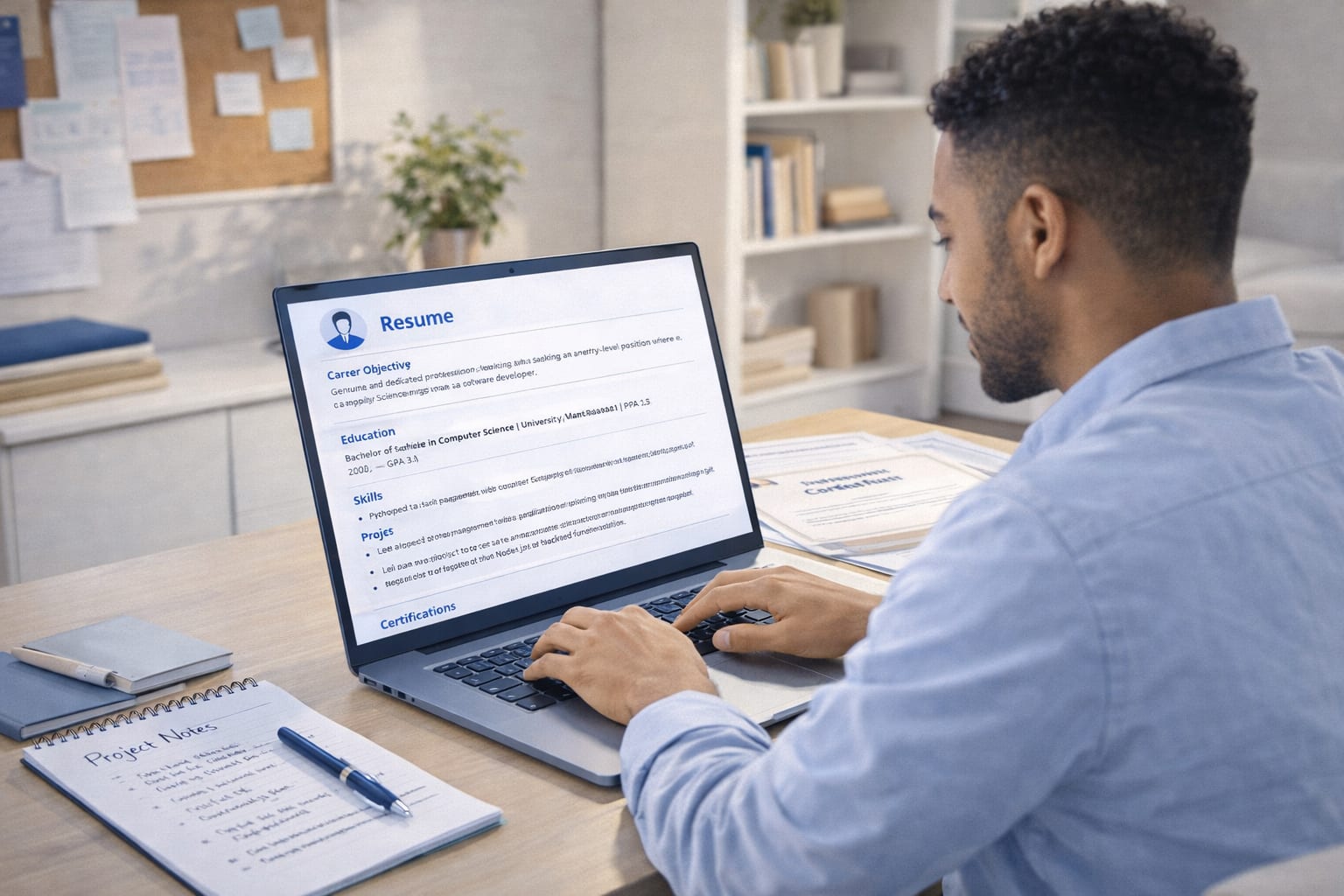
Notice what comes first: Career Objective and Education — not Work Experience. This section order is the key structural difference between a fresher format and an experienced professional format. ATS systems parse sections in order — putting your strongest content first is not just logical, it's strategic.
Key Details
Start building your resume in this structure with the ResumeBold Resume Builder — it uses ATS-optimised single-column templates designed to parse correctly at any company.
Section-by-Section: How to Write Each Part
This replaces the professional summary for freshers. It should be specific to the role you're applying for — not a generic statement about "growth" and "challenges."
For freshers, education carries more weight than for experienced candidates. Structure it clearly:
Should you list Class 10 and 12 marks? Only if you graduated within the last 2 years AND your scores are above 75–80%. Mass recruiters like TCS, Infosys, and Wipro sometimes have CGPA and 10th/12th cutoffs — verify for each company before including.
The most keyword-dense section after your objective. ATS systems scan this heavily. Use specific tool and technology names — not vague category terms.
Rule: Only list skills you can confidently discuss in an interview. ATS gets you through the filter — the interviewer catches you out.
For freshers, projects are your work experience. This is the most underused section on fresher resumes — and the most powerful when done correctly.
Key Details
Format each project as:
Project Name | Technologies Used | [GitHub / Live link if available]
Strong project bullet examples:
Academic projects, personal projects, hackathon builds, and open-source contributions all count. The question is not "is this a real job?" — it's "does this prove the skill?"
Even a one-month virtual internship should be included. Format it exactly like a job entry — company, role, duration, 2 bullet points.
Certifications signal initiative and current knowledge — especially important when you have no formal work history. Include the full certification name, the issuing platform, and the year.
ATS Rules Every Fresher Must Follow
- Single-column layout only. Two-column templates, sidebar designs, and graphical resumes all fail ATS parsing. Plain single-column text, always.
- No photos, icons, or rating bars. These are either invisible to ATS or actively cause parsing errors. Content wins — design does not.
- Standard section headings. "Work Experience," "Education," "Skills," "Projects" — not "My Journey," "What I Know," or "About Me." ATS needs to recognise headings to categorise content.
- Contact info in the document body — not the header. Many ATS systems skip content in document headers. Your name, email, and phone go in the main text area.
- Save as .docx or text-based PDF. Not a scanned image PDF. Not a Canva export. A .docx or a PDF created from Word or Google Docs.
- Keywords from the job description. Read the job posting. Identify the skills, tools, and terms that appear most. Use them in your skills section and project bullets. This is how ATS scores you against that specific role.
Fresher Resume Format by Degree Type
| Degree | Emphasise | De-emphasise |
|---|---|---|
| B.Tech / B.E. (Engineering) | Technical projects, programming languages, tools, GitHub contributions, hackathon wins | Soft skills listed without proof |
| MBA | Summer internship, case studies, leadership roles, business impact metrics, tools (Excel, Tableau, Salesforce) | Undergraduate academic details (keep brief) |
| B.Com / BBA | Accounting tools (Tally ERP, QuickBooks, Xero), Excel proficiency, finance/marketing internships | Generic soft skills |
| BSc (Computer Science / Statistics) | Python/R projects, statistical methods, research work, lab projects, CGPA if strong | Unrelated extracurriculars |
| Arts / Humanities | Communication skills with proof, writing samples or portfolio links, internships, content or social media projects | Technical skills you haven't actually used |
How to Build Your Fresher Resume Step by Step
- Open the ResumeBold Resume Builder. Go to resumebold.com/resume-builder/new and choose a clean single-column template. Avoid any template with two columns, sidebars, or graphic skill bars.
- Write your career objective first. Name your degree, your top skill, and the exact type of role you want. Be specific to the job you're applying for — not generic.
- Add your education section. Full degree name, institution, year, CGPA if strong. Add relevant coursework for technical roles.
- Build your skills section with specific tool names. Check the job description. List the skills it asks for that you genuinely have. Use exact names: Python not "programming," Tableau not "data visualisation tools."
- Write 2–4 project entries using the formula: name + tech stack + what it does + one measurable outcome. Every project bullet starts with an action verb.
- Run it through the ATS Checker. Paste your resume and the job description into the ResumeBold free ATS Resume Checker. Check your keyword match score and fix your top 3–5 gaps before you apply.
Common Fresher Resume Mistakes
- Using a Canva or design-heavy template: These look great as PDFs but score near zero on ATS. Plain single-column only.
- Writing a generic career objective: "Seeking a challenging position where I can grow" is on every rejected fresher resume. Replace it with a specific sentence naming your degree, your top skill, and the role you want.
- Listing skills you can't discuss in an interview: ATS gets you past the filter — the interviewer catches misrepresentations. Only list skills you can genuinely back up.
- Leaving the projects section empty or weak: "Developed a college project" tells nobody anything. Name the project, name the tech, add the outcome — even if the outcome is from a college evaluation or simulated dataset.
- Adding a photo: Photos are invisible to ATS and can introduce bias with human reviewers. Don't include one unless the job posting specifically requires it.
- Two pages: One page only for freshers. No exceptions. If you're going over one page, you're including things that don't belong.
Frequently Asked Questions
Single-column reverse-chronological format with a modified section order: Contact → Career Objective → Education → Skills → Projects → Internships → Certifications → Extracurriculars. This format puts your strongest content first, is fully ATS-compatible, and fits on one page for most freshers.
For education-specific examples, see our teacher resume examples guide.
View HR resume examples from successful candidates.
Healthcare professionals: check our nurse resume guide.
One page, always.[4] Freshers rarely have enough content to justify two pages, and a two-page fresher resume signals an inability to prioritise. Every item on the page should be there because it's the strongest possible evidence of your fit for the role — not for completeness.
Projects, internships, certifications, and extracurriculars — in that priority order. Projects are the most powerful substitute for work experience because they demonstrate actual skill application. Even a 3-month personal project with a deployed output is more ATS-valuable than leaving the section blank.
Reverse-chronological — but with the section order modified for freshers (Education and Skills before Work Experience). Functional resumes are not recommended because they perform poorly with ATS systems and raise red flags with recruiters. The modified chronological format is the right choice for 2026.
Key Details
Save as .docx or a text-based PDF (exported from Word, Google Docs, or a resume builder — not scanned, not a Canva image export). When in doubt, .docx is the safer choice — it parses reliably across the widest range of ATS systems.[5]
Use a single-column layout, standard section headings (not creative ones), no photos or icons, contact info in the document body (not the header), and keyword-matched skills pulled from the specific job description. Then check your score with the ResumeBold free ATS Checker before submitting.
No — not for private sector jobs. Photos are invisible to or rejected by ATS systems and can introduce unconscious bias with human reviewers.[6] The only exceptions are industries where appearance is part of the job requirement (aviation, hospitality, acting) and only when the posting specifically requests a photo.
Google Data Analytics Certificate (Coursera), AWS Cloud Practitioner, HubSpot Marketing Certification, Microsoft Azure Fundamentals, and NPTEL certifications for Indian freshers are among the highest-value options in 2026. Always list the full certification name, issuing platform, and year. Free certifications from reputable platforms carry as much ATS keyword weight as paid ones.
Format It Right. Get Shortlisted.
The format is not the decoration on your resume — it's the foundation. A well-structured fresher resume in a single-column ATS-compatible layout, with a specific career objective, strong project bullets, and keyword-matched skills, will outperform a beautifully designed two-column template every time — because it will actually be read.
Once your resume is built, run it through the ResumeBold free ATS Resume Checker with the job description you're targeting. It shows your keyword match score and the specific gaps to fix before you apply. Free, instant, no sign-up required.
To build your fresher resume from scratch in the right structure, the ResumeBold Resume Builder gives you ATS-optimised single-column templates — formatted for the way hiring actually works in 2026.
References
- Jobscan. (2025). Resume File Format Testing: DOCX vs. PDF ATS Compatibility Across Major Systems. https://www.indeed.com/career-advice/resumes-cover-letters/resume-file-format
- SHRM & TopResume. (2024). Resume Photos and ATS Systems: Parsing Failure Rates and Bias Implications. https://www.shrm.org/topics-tools/news/talent-acquisition
Related: Fresher Resume Guide | Fresher Resume Example | ATS Resume Keywords for Freshers | Resume Objective vs Summary
Ready to optimize your resume?
Check My ATS Score Free
Check My ATS Score Free