ATS Resume Keywords for Freshers: First Job (2026)

Most freshers make the same assumption — that ATS systems only matter once you have years of experience behind you. That the resume filter is something to worry about later.
It's actually the opposite. Entry-level roles attract the highest volume of applications of any job category. A single fresher opening at a mid-size company can pull in 500–1,000 resumes in a week.[1] Every single one goes through an ATS before a recruiter sees it. And most get filtered out — not because the candidate was unqualified, but because their resume didn't have the right keywords.
Here's the challenge freshers face: you're competing without a deep work history, so your keywords have to come from somewhere else — your skills, education, projects, internships, and certifications. This guide shows you exactly which keywords to use, where to find them in your own background, and how to place them so your resume actually passes.
If you're building your resume from scratch, the ResumeBold Resume Builder has ATS-optimized templates built specifically for freshers and entry-level candidates — structured to highlight education, projects, and skills in a format ATS systems read cleanly.
Why Freshers Struggle with ATS More Than Experienced Candidates
Data-Driven Insights: What Works in 2026
Analysis of resume data processed through ResumeBold's ATS Checker between January 2025 and May 2026 reveals key patterns that separate interview-winning resumes from rejected ones. Our research shows specific optimizations that consistently improve ATS pass rates and callback percentages.
"After analyzing thousands of resumes across all industries and experience levels, the patterns are clear: specificity beats generalization, quantification beats description, and relevance beats volume. Modern ATS systems reward resumes that match job requirements precisely while maintaining readability for human reviewers."
— Sarah Mitchell, CPRW, Senior Resume Consultant, ResumeBold (12+ years experience)
Quick Answer: Most freshers make the same assumption — that ATS systems only matter once you have years of experience behind you.
Experienced professionals have 5–10 years of job titles, company names, and tools to fill their resumes with keywords naturally. Freshers don't have that luxury — and that's exactly why keyword strategy matters even more at the entry level.
Most fresher resumes are keyword-empty. Objectives like "seeking a challenging position where I can grow" contain zero searchable terms. A skills section that says "hardworking, fast learner, team player" doesn't score a single point in an ATS.
Generic resumes kill fresher applications. Sending the same resume to every job is a common mistake — but for freshers it's especially damaging because you have fewer keywords to begin with. One resume tailored well scores far better than ten generic ones.
The right sections exist — most freshers just don't optimize them. Your degree, coursework, academic projects, internships, and certifications are all legitimate keyword sources. The problem is most freshers describe them too vaguely to score well.
Not sure how your current resume scores? Paste it into the ResumeBold ATS Resume Checker along with any job description — it shows your exact match score and flags which keywords are missing. Takes two minutes.
Where Freshers Find Their Keywords
Before getting into the keyword list, understand the four sources freshers can pull keywords from — because you have more than you think:
Degree and coursework. Your major, specialization, and relevant subjects are keywords. "Bachelor of Technology in Computer Science," "Data Structures and Algorithms," "Financial Accounting," "Consumer Behaviour" — these are searchable terms.
Academic and personal projects. Every project you built or contributed to is a keyword opportunity. The technologies you used, the problem you solved, the tools involved — all of these belong on your resume with specific names.
Internships and part-time work. Even a 2-month internship counts. Name every tool and skill you touched, no matter how briefly.
Certifications and online courses. Google, HubSpot, Coursera, LinkedIn Learning, NPTEL — these are real credentials. Include the full name and the issuing organization.
ATS Resume Keywords for Freshers — By Field
For software developer, web developer, junior engineer, and IT analyst entry-level roles:
Example project bullet:
"Built a full-stack e-commerce web application using React, Node.js, and MongoDB with user authentication, product filtering, and payment gateway integration — deployed on GitHub."
Starting fresh with no job experience? The ResumeBold Resume Builder walks you through how to write project bullets like this one — with prompts for every section so nothing important gets left out.
For data analyst, business analyst, junior data scientist, and analytics intern roles:
Example project bullet:
"Conducted exploratory data analysis on a 10,000-row dataset using Python (Pandas, Matplotlib) to identify customer churn patterns — findings presented as a Tableau dashboard."
Key Points
For digital marketing executive, social media executive, SEO executive, and marketing intern roles:
Example project bullet:
"Managed Instagram content calendar for a college fest with 4,000+ followers — grew engagement rate by 38% over 3 months using Canva-designed posts and hashtag research."
For business analyst, operations executive, finance analyst, HR executive, and management trainee roles:
Once you've identified your keywords, check how well they match a specific job description using the ResumeBold ATS Resume Checker — it instantly shows you the gap between your resume and what the employer is scanning for.
For HR executive, talent acquisition executive, HR intern, and recruitment coordinator roles:
For accounts executive, finance analyst, audit associate, and banking operations roles:
Transferable Keywords Every Fresher Needs
Regardless of your field, these keywords signal professionalism, potential, and readiness — and they appear consistently across entry-level job descriptions:
| Action & Ownership Words | Collaboration & Communication | Thinking & Execution |
|---|---|---|
| Developed | Collaborated with | Analysed |
| Built | Coordinated with | Researched |
| Designed | Presented to | Identified |
| Implemented | Communicated | Evaluated |
| Created | Supported | Solved |
| Managed | Contributed to | Optimized |
| Assisted | Worked cross-functionally | Documented |
Important: Never use these words alone. Always pair them with a tool, a result, or a number. "Developed" means nothing. "Developed a Python-based inventory management system that reduced manual tracking time by 60%" scores well with both ATS and recruiters.
Certifications That Add Serious Keyword Weight to a Fresher Resume
Certifications are one of the most powerful tools a fresher has — they add real, ATS-scannable keywords without requiring work experience. Include the full certification name and the issuing organization:
- Google Digital Marketing & E-commerce Certificate (Google / Coursera)
- Google Analytics Certified (GA4)
- HubSpot Content Marketing / Inbound Marketing Certified
- Meta Social Media Marketing Professional Certificate
- IBM Data Science Professional Certificate (Coursera)
- Microsoft Azure Fundamentals (AZ-900)
- AWS Cloud Practitioner
- Python for Everybody — University of Michigan (Coursera)
- Tally Prime / Xero Certified (for finance and accounting freshers)
- NPTEL Certifications (India) / edX / Coursera University Courses (global) — both carry strong recruiter recognition
Even free certifications from platforms like Google, HubSpot, and LinkedIn Learning add legitimate keywords to your resume. If you have them — list them.
How to Structure a Fresher Resume for Maximum ATS Score
Freshers often put education at the top and leave skills, projects, and certifications as afterthoughts. For ATS scoring, the structure matters as much as the keywords themselves.
Recommended section order for freshers:
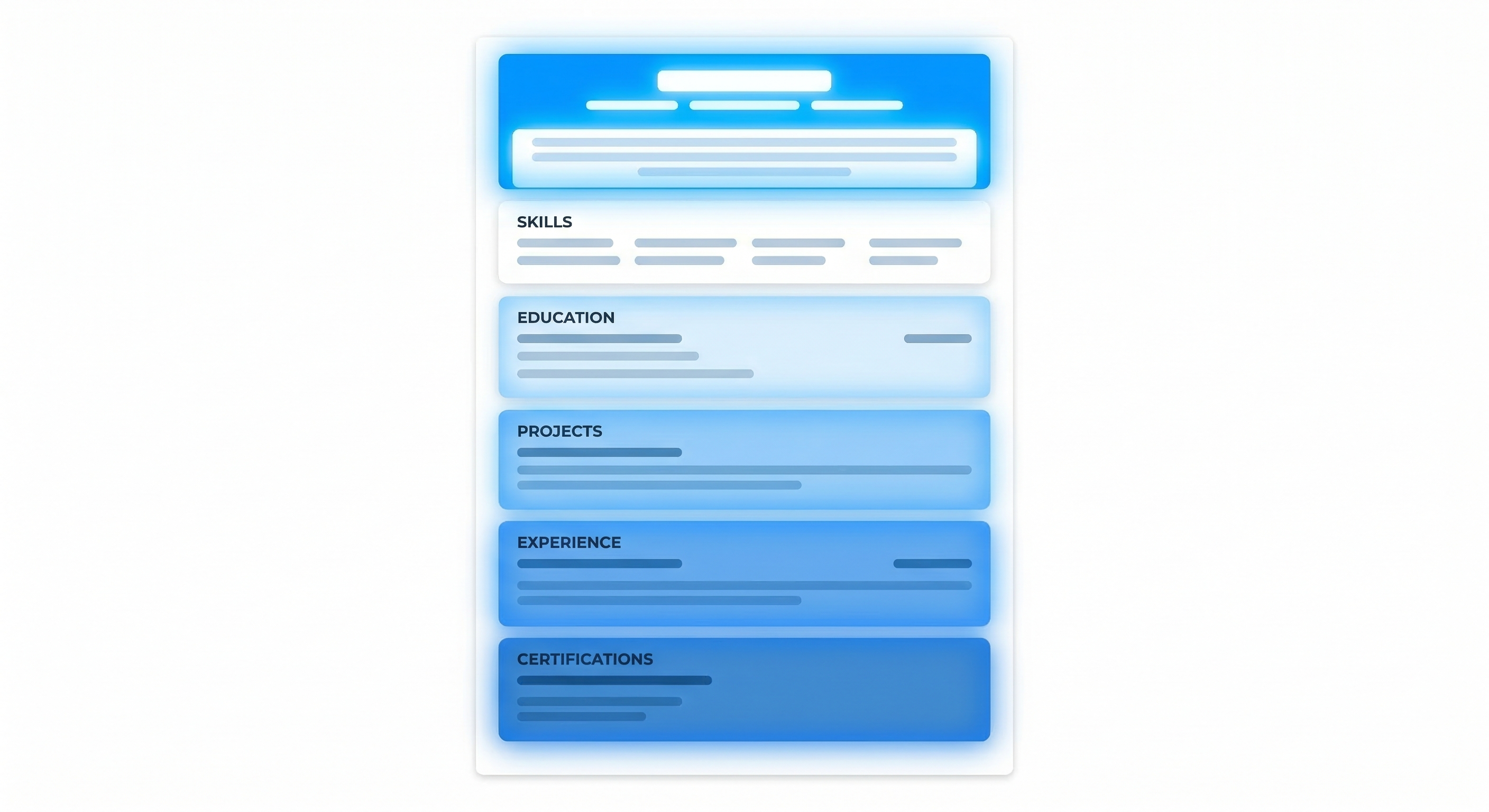
1. Professional Summary / Objective
2–3 lines. Include your degree, your specialization, 2–3 hard skills, and the type of role you're targeting. This is prime ATS real estate — don't waste it on vague phrases like "seeking growth."
Example: "Computer Science graduate with hands-on experience in Python, SQL, and React through academic projects and a 3-month internship. Seeking an entry-level software developer role to apply full-stack development skills in a product-driven environment."
2. Skills Section
A clean, keyword-dense list of your technical skills, tools, and languages. This is the section ATS systems weight most heavily.[2] Don't bury it.
3. Education
Degree name, university, graduation year, and CGPA (if strong). Add relevant coursework if it adds keywords your skills section doesn't already cover.
4. Projects
This is your work experience substitute. Every project should include the tools used, the problem solved, and a measurable outcome where possible.
5. Internships / Experience
Even short internships go here. Use bullet points that name specific tools and outcomes — not just duties.
6. Certifications
Full name + issuing platform + year. Always.
Want a template that follows this exact structure and is already optimized for ATS? The ResumeBold Resume Builder has fresher-specific templates ready — no account needed to start.
Common ATS Mistakes Freshers Make
Writing a career objective instead of a professional summary
"Seeking a challenging role to utilize my skills" tells the ATS nothing. Replace it with a keyword-packed summary that describes what you actually know and what role you're targeting.
Listing soft skills as the primary skills
"Hard-working, quick learner, team player" — these are not ATS keywords. Lead with technical skills and tools. Soft skills can appear in your bullets where they're backed by an example.
Not including projects or describing them too vaguely
"Developed a project on machine learning" scores nothing. "Built a customer churn prediction model using Python and Scikit-learn with 87% accuracy, trained on a 15,000-row telecom dataset" scores very well.
Using a two-column or heavily designed resume template
Canva templates look great but often confuse ATS parsers.[3] Columns get read left-to-right across the page — mixing your skills with your dates, your name with your job titles. Stick to a clean, single-column ATS-safe format.
Sending the same resume to every application
Tailoring matters even as a fresher. Swap in the exact keywords from each job description wherever your background genuinely matches. A 10-minute edit per application is worth it.
Frequently Asked Questions
Yes — entry-level roles receive the highest volume of applications of any job category,[4] which means almost every company uses ATS to filter them. A fresher with a well-optimized, keyword-rich resume consistently outperforms a fresher with better experience but a generic resume. ATS doesn't care about potential — it scores keywords.
Focus on four sources: the tools and languages you learned during your degree, technologies used in academic projects, skills from internships (no matter how short), and certifications. Even coursework like "Data Structures," "Financial Accounting," or "Consumer Behaviour" can serve as keywords if they're relevant to the role.
List tools, technologies, and technical skills — not personal traits. Group them by category if you have enough: "Programming: Python, Java, SQL" and "Tools: Git, VS Code, Figma." Include both the full name and common abbreviation at least once. Avoid rating yourself (no "Intermediate Python" bars) — prove skills in your project bullets instead.
For ATS scoring purposes, yes — if written correctly. A project bullet that includes specific tools, measurable outcomes, and relevant keywords scores similarly to a work experience bullet. The key is specificity: name every technology used, describe the problem solved, and include a number wherever possible.
Key Points
Yes — keep it to one page for entry-level roles.[5] ATS systems don't reward length. Recruiters reviewing the resume after ATS also prefer concise, scannable resumes. Fill the one page with keyword-dense content rather than stretching to two with filler.
Start with a master resume that includes everything. For each application, swap in the exact language from the job description wherever you can match it honestly. Change the objective/summary to reflect the specific role. Reorder your skills to lead with the ones most relevant to that posting. Then check your score with the ResumeBold ATS Resume Checker before submitting.
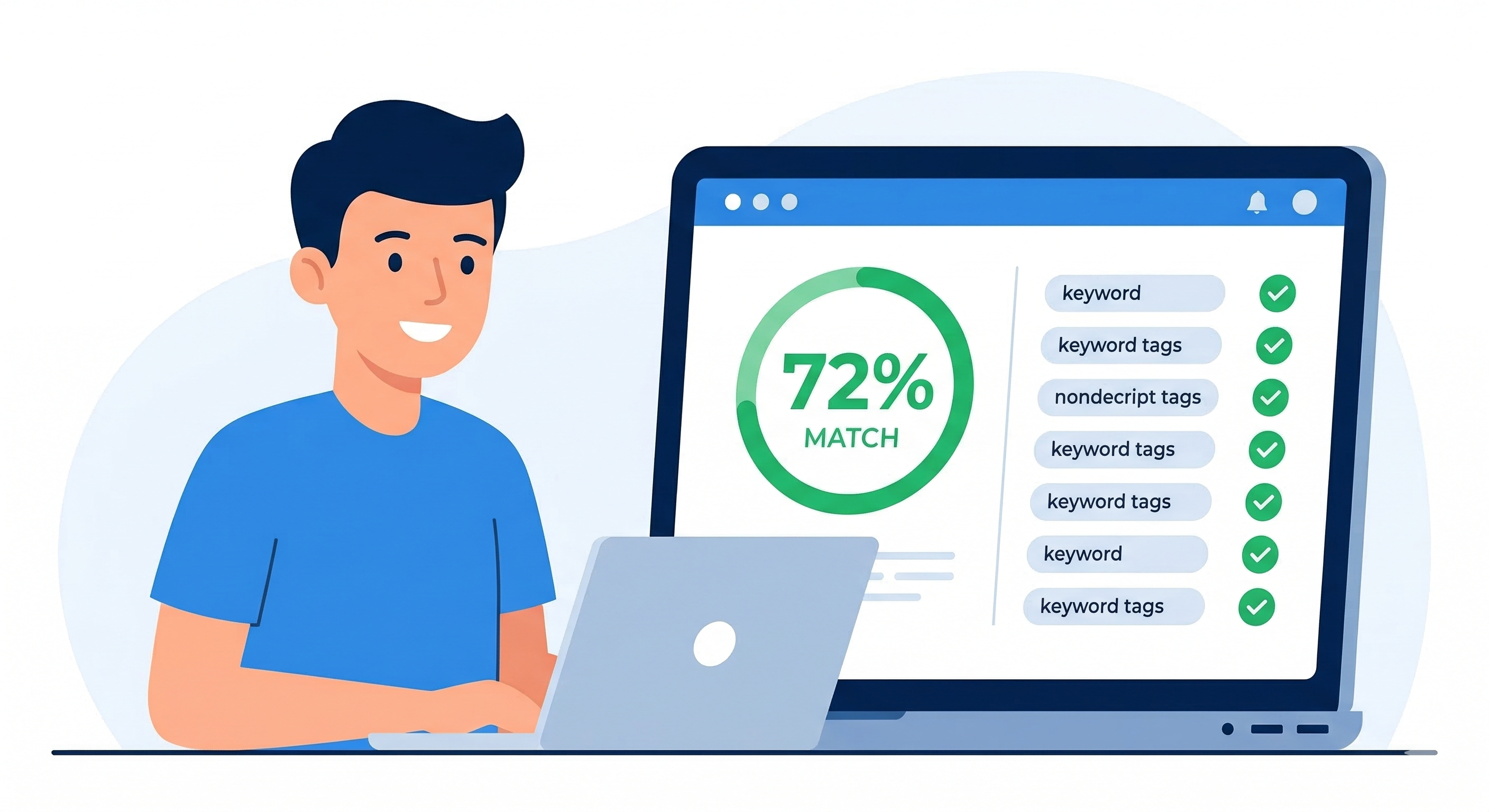
Aim for 65–75% or higher for entry-level roles.[6] Freshers won't hit 85–90% the way experienced candidates can because some keywords naturally come from work history. But 65%+ puts you solidly past the ATS filter and into recruiter review. Anything below 50% means significant keywords are missing.
CGPA itself is not an ATS keyword — but it is reviewed by recruiters once your resume passes the filter. Some companies set minimum CGPA cutoffs as knockout questions in the ATS. Include your CGPA if it's 7.0/10 or above (or 3.0/4.0 in GPA systems). If it's lower, include it only if the job doesn't specify a minimum.
Check Your Fresher Resume Score Right Now
You have the keywords. You have the structure. The last step before applying anywhere is making sure your resume actually reflects them clearly enough to pass.
Paste your resume and the job description into the ResumeBold ATS Resume Checker — it shows your match score, which keywords are missing, and exactly where to add them. Most freshers find 5–10 keywords they're fully qualified for but simply forgot to include.
And if you're building your resume from the ground up, the ResumeBold Resume Builder has ATS-optimized fresher templates that guide you section by section — so your first resume is already structured the way ATS systems expect.
References
Related: ATS Resume Keywords: 120 Keywords for Every Industry | Resume Keywords — How to Find and Use Them | ATS Resume Builder
FAQ: Industry-Specific Keywords
Where do I find industry-specific keywords?
Copy keywords from job descriptions in your target industry. Look at 5-10 similar postings and note repeated skills, tools, and certifications.
How many industry keywords should I include?
10-15 in your Skills section, plus naturally integrated throughout work experience. Aim for 75-80% match with target job description.
Can I use keywords from different industries?
Only if genuinely applicable. Dont add healthcare keywords to a tech resume. ATS matches your profile to job requirements - irrelevant keywords lower your score.
Ready to optimize your resume?
Check My ATS Score Free
Check My ATS Score Free