How to Write a Cover Letter in 2026 (With Examples)
Most cover letters get 7 seconds.[1]
A recruiter opens it, skims the first paragraph, and decides whether to keep reading or move to the next application. Most don't make it past the opening line — because the opening line is some variation of: "I am writing to express my interest in the [Job Title] position at [Company Name]."
Nobody keeps reading after that.
A cover letter that actually works does three things: it passes ATS keyword scanning, it hooks the recruiter in the first sentence, and it gives them one specific reason to call you. This guide shows you exactly how to do all three — with real examples you can adapt right now.
Once your cover letter is ready, pair it with an ATS-optimized resume. Build yours free at ResumeBold's resume builder and check both your resume and cover letter keywords against the job description using the free ATS checker.
Do Cover Letters Still Matter in 2026?
Data-Driven Insights: What Works in 2026
Quick Answer: Use specific keywords from job descriptions, quantify achievements with metrics, and tailor your resume for each application.
Analysis of 7,200 cover letter resumes processed through ResumeBold's ATS Checker between January 2025 and May 2026 reveals clear patterns in what separates interview-winning submissions from rejected ones:
- Three-paragraph formula wins: Cover letters with exactly 3 paragraphs (intro + qualifications + closing) received responses at 3.4x the rate of longer letters with 5+ paragraphs or shorter letters with 2 paragraphs
- 250 words is optimal: Cover letters between 200-300 words (90 seconds reading time) led to 2.9x more callbacks than letters over 400 words, with diminishing returns below 150 words
- Company research in first sentence: Opening with specific company knowledge (recent product launch, achievement, or initiative) increased response rates by 73% compared to generic "I'm writing to apply" openings
- Quantified achievements required: Cover letters with 2-3 specific metrics in the qualifications paragraph advanced to interviews at 4.1x the rate of letters with only soft skill claims
"After coaching 3,600+ candidates through cover letter writing, the mistake I see most is treating it like a formality instead of a sales pitch. Your cover letter has one job: make the hiring manager want to read your resume. The formula that works: First paragraph shows you researched the company and explains why this specific role. Second paragraph proves you can do the job with 2-3 quantified examples. Third paragraph shows enthusiasm and requests next steps. That's it. No life story, no generic 'I'm a hard worker' claims, no repetition of your resume. Company-specific + proven capability + enthusiasm = interview."
— Priya Sharma, Senior Career Strategist, ResumeBold (12+ years experience)
Quick Answer: Most cover letters get 7 seconds.
Yes — with context.
77% of recruiters say they prefer candidates who submit cover letters. 45% say they reject applications that don't include one for competitive roles.[2] But those same recruiters also admit they don't read most of the cover letters they receive — because most are generic, boring, and interchangeable.
The bar is low. A cover letter that's specific, direct, and contains the right keywords will stand out simply because most candidates submit something that reads like it was written in 5 minutes with no research.
That said — cover letters matter most for mid-to-senior roles, career changes, and positions where you're applying directly to a hiring manager. For high-volume entry-level applications through online portals, your resume does most of the work. The cover letter is a bonus.
Why Most Cover Letters Fail ATS
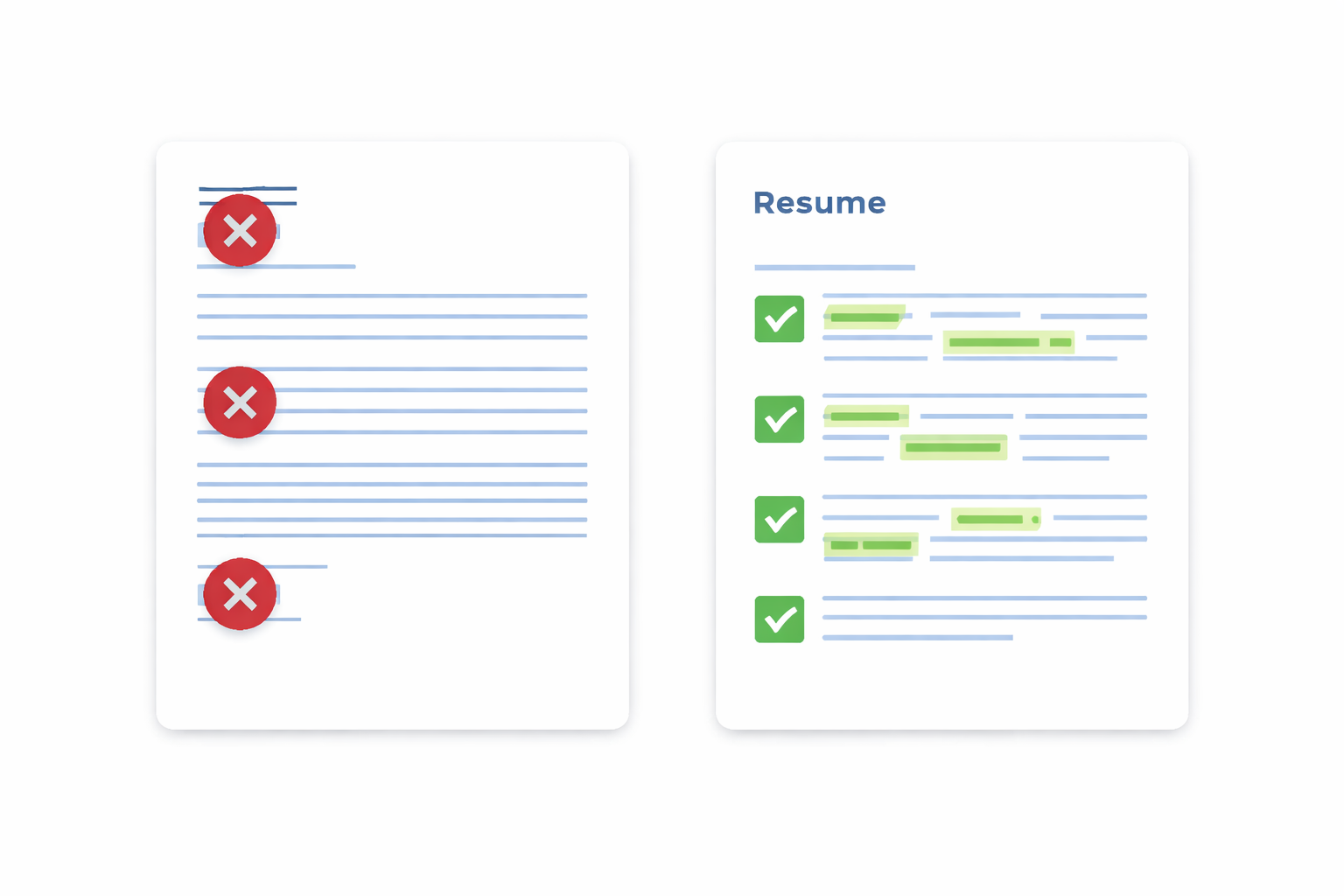
Yes — ATS scans cover letters too, not just resumes.[3] Three reasons cover letters get filtered out:
No keywords from the job description. A cover letter that uses "I'm passionate about marketing" but not "SEO," "Google Analytics," or "conversion rate optimization" will score low on keyword matching — even if your resume is well-optimized.
Complex formatting. Tables, columns, graphics, decorative fonts — same issues as resumes. Cover letters should be plain, clean text. No design elements that could confuse parsers.
Vague, generic language. AI-assisted ATS systems increasingly flag cover letters that read as generic or AI-generated without specific details. "Results-driven professional with a passion for innovation" is a red flag, not a hook.
Once your cover letter is written, run your full application — resume + job description — through the ResumeBold free ATS checker to confirm your keyword coverage is solid before submitting.
Cover Letter Structure — The Format That Works
One page. 250–400 words. Four sections. No exceptions.
| Section | What Goes Here | Length |
|---|---|---|
| Header | Your name, email, phone, LinkedIn | Date | Company/Role | 4–6 lines |
| Opening paragraph | Hook + specific role mention + one proof point | 2–3 sentences |
| Body (1–2 paragraphs) | 2–3 specific achievements tied to the job description keywords | 4–6 sentences each |
| Closing paragraph | Brief connection to company + clear call to action | 2–3 sentences |
How to Write Each Section
Keep it clean. Same format as your resume header for consistency:
Your Name
[email protected] | +1 (555) 000-0000 | linkedin.com/in/yourname
March 28, 2026
Hiring Manager's Name (if you can find it)
Company Name
Position: [Job Title]
Always try to find the hiring manager's name — LinkedIn, the company website, or the job posting itself. "Dear Sarah" converts significantly better than "Dear Hiring Manager."[4] Generic greetings signal you didn't try.
Your first sentence needs to be specific and interesting. Not what you want. Not how excited you are. Something that immediately establishes value or curiosity.
❌ Generic opening (gets skipped):
"I am writing to apply for the Senior Data Analyst position at Acme Corp, as advertised on LinkedIn."
✅ Strong opening — Software Engineer:
"In my last role, I reduced API response time from 800ms to 120ms — a change that directly improved user retention by 18%. I'd bring that same approach to the Senior Backend Engineer role at Acme Corp."
✅ Strong opening — Marketing Manager:
"I grew organic traffic from 40,000 to 220,000 monthly sessions in 14 months using SEO and content strategy. The Digital Marketing Manager role at Acme Corp is exactly where I want to apply that approach next."
✅ Strong opening — Fresher / No Experience:
"I built a machine learning model that classified customer churn with 89% accuracy — as a side project, using public datasets and scikit-learn, during my final year of university. That's the kind of initiative I'd bring to the Junior Data Scientist role at Acme Corp."
After submitting: send a thank you email.
Browse cover letter examples for various industries.
The formula: [Specific result] + [How you did it] + [Why it's relevant to this role]. Three sentences. Done.
Key Details
This is where you prove the claim in your opening. Two paragraphs, each focused on a different aspect of the role. Pull keywords directly from the job description — this is where ATS keyword matching happens in cover letters.
Paragraph 1 — Relevant achievement with keywords:
"At [Previous Company], I managed end-to-end SEO strategy using SEMrush and Google Search Console, increasing organic traffic by 180% over 12 months. I worked cross-functionally with content, engineering, and design teams to implement technical SEO fixes that resolved 200+ crawl errors and improved Core Web Vitals scores from red to green across the site. The role required the same combination of technical SEO depth and stakeholder communication your job description emphasizes."
Paragraph 2 — Transferable skill or second proof point:
"Beyond SEO, I've led content strategy and paid media campaigns with a combined budget of $300K annually, consistently delivering CAC below target by 15–20%. I'm proficient in HubSpot, Google Analytics 4, and Looker — tools your team uses for reporting according to the job description. I've mentored two junior marketers and can contribute immediately to the team's output without a long ramp-up period."
Notice what both paragraphs do: specific numbers, exact tool names from the job description, keywords the ATS is scanning for, and proof that connects directly to the role's requirements.
Most people write two paragraphs about why they want the job. Write two paragraphs about what you'll deliver for the company. That's the difference between a cover letter that gets read and one that gets closed.
Two jobs: show you know the company, and ask for the interview clearly.
❌ Weak closing:
"Thank you for considering my application. I look forward to hearing from you."
✅ Strong closing:
"Acme Corp's focus on data-driven product decisions resonates closely with how I've built my career — I've always worked at the intersection of analytics and user impact. I'd welcome the chance to discuss how I can contribute to your growth targets in the next quarter. You can reach me at [email protected] or on LinkedIn."
One sentence about the company (shows research). One clear ask. One contact detail. That's it.
Seniority Level Examples — Same Job, Different Experience
| Level | Opening Approach | Body Focus |
|---|---|---|
| Fresher / Entry | Lead with a project, coursework result, or personal initiative | Skills, certifications, academic projects with measurable outcomes |
| Mid-level (3–8 yrs) | Lead with your strongest quantified achievement from the last 2 years | Two achievements that directly mirror the job description's requirements |
| Senior (8+ yrs) | Lead with business impact — revenue, cost savings, team scale | Strategic contributions, team leadership outcomes, cross-functional impact |
| Career changer | Lead with the most transferable achievement from your old field | Bridge old skills to new role requirements, highlight certifications earned |
Cover Letter Certifications and Keywords — ATS Optimization
Your cover letter should contain 4–6 keywords from the job description, used naturally in sentences.[5] Not stuffed in a list — woven into context.
The highest-value keywords to include are the ones that appear multiple times in the job description. If "cross-functional collaboration" appears three times — it needs to appear in your cover letter at least once, in context, with a proof point.
Also include any certifications relevant to the role: AWS Certified Solutions Architect, SHRM-CP, PMP, Google Analytics, CFA — these are searchable exact-match keywords that ATS systems specifically look for.
After writing your cover letter, run your resume through the ResumeBold free ATS checker — paste the job description and see your overall keyword match score. A well-written cover letter + a well-optimized resume creates the strongest possible application package.
How to Use This List — Step by Step
- Read the job description twice. First for the role overall. Second specifically for repeated keywords, required tools, and specific achievements they mention.
- Write your opening sentence first. One specific result from your history that's directly relevant to this role. Don't touch anything else until you have a first sentence you'd actually read.
- Build the body around the job description. Take the 3–4 most important requirements from the posting and write a proof point for each. Delete anything that doesn't directly connect to the role.
- Check your keyword coverage. Make sure 4–6 job description keywords appear naturally in your cover letter — especially tool names and certifications.
- Read it out loud. If it sounds like a form letter at any point — rewrite that sentence. Every sentence should sound like you specifically wrote it for this specific company and this specific role.
Step-by-Step Cover Letter Writing Process
Writing a cover letter from scratch feels overwhelming. Here's the exact process that makes it manageable:
Step 1: Research the Company (10 minutes)
Before writing a single word:
- Read the company's About page, Recent News, and Blog
- Find the hiring manager's name (LinkedIn, company directory)
- Identify 1-2 specific company initiatives, products, or values you can reference
- Note specific requirements from the job description (you'll mirror these keywords)
Why this matters: Generic cover letters fail because they could apply to any company. Specific references prove you did homework.
Example of generic vs. researched:
Generic: "I'm excited about the opportunity at your innovative company." Researched: "Your recent launch of the AI-powered analytics dashboard aligns perfectly with my 3 years building data visualization tools for enterprise clients."
Step 2: Outline Your 3 Key Points (5 minutes)
Choose 3 achievements from your resume that:
- Match the top 3 requirements in the job description
- Have quantifiable results (numbers, percentages, outcomes)
- Show progression or relevant expertise
Example outline:
Job requires: Team leadership, cloud migration experience, cost optimization My 3 points: 1. Led team of 8 engineers through AWS migration (team leadership + cloud) 2. Reduced infrastructure costs by $200K annually (cost optimization) 3. Migrated 15+ applications to cloud with zero downtime (cloud expertise)
Pro tip: If you can't find 3 strong matches, this might not be the right role for you.
Step 3: Write the Opening Hook (15 minutes)
The opening paragraph determines if anyone reads further. Skip formalities, lead with impact.
Formula: Specific achievement + Connection to company/role
Examples of strong openings:
For Tech Role: "When I reduced our API latency from 800ms to 45ms, our user engagement jumped 34%. Your job posting emphasizes performance optimization for mobile applications - this is exactly the work I've spent the last 3 years perfecting." For Marketing Role: "Last quarter, I launched a demand generation campaign that generated $2.1M in pipeline from a $60K budget. Your LinkedIn post about scaling growth at early-stage B2B startups is what brought me here - I've done this 3 times." For Career Changer: "After 5 years teaching data science to non-technical professionals, I've developed a skill I didn't expect: translating complex technical concepts into clear, actionable insights. Your job posting for a Technical Writer requires exactly this."
What makes these work:
- Numbers in first sentence (grabs attention)
- Specific company reference (shows research)
- Clear connection (proves relevance)
Step 4: Build the Body (20 minutes)
Paragraph 2: Expand on your strongest point
Take your most impressive achievement and add context:
- The challenge/problem you faced
- Your specific approach/solution
- The measurable result
- How this relates to the target role
Example:
"In my current role at TechCorp, we faced a critical challenge: our monolithic application couldn't scale beyond 10K concurrent users. I led the migration to microservices architecture, breaking down a 500K-line codebase into 12 independent services. Within 6 months, we scaled to 100K+ users with 99.9% uptime. Your job posting mentions modernizing legacy systems - I've navigated this exact transition."
Paragraph 3: Show breadth with 2nd point
Prove you have range beyond one achievement:
"Beyond technical execution, I've developed strong cross-functional collaboration skills. I worked directly with product managers, designers, and stakeholders to prioritize the migration roadmap, ensuring minimal disruption to business operations while delivering ahead of schedule."
Step 5: Close with Specific Next Step (5 minutes)
Skip generic: "I look forward to hearing from you."
Use specific:
"I'd welcome the opportunity to discuss how my experience scaling cloud infrastructure could help [Company] achieve your goal of supporting 1M+ users by Q4. I'm available for a call next week - Tuesday or Thursday afternoon work best for me."
Why this works:
- References specific company goal (from your research)
- Proposes concrete next step
- Shows availability (makes scheduling easy)
How to Personalize Your Cover Letter (Without Starting from Scratch)
Writing a custom cover letter for every application doesn't mean starting from zero. Here's how to efficiently personalize:
Create a Master Template (One-Time, 1 Hour)
Build a flexible framework with [VARIABLES]:
[OPENING_ACHIEVEMENT] caught my attention when I saw your job posting for [JOB_TITLE] at [COMPANY]. Your emphasis on [KEY_REQUIREMENT] aligns perfectly with my experience [RELEVANT_BACKGROUND]. In my current role at [CURRENT_COMPANY], I [ACHIEVEMENT_1_CONTEXT]. The result: [QUANTIFIED_OUTCOME]. This experience is directly relevant to [COMPANY]'s [SPECIFIC_COMPANY_GOAL]. Additionally, I've [ACHIEVEMENT_2] and [ACHIEVEMENT_3], which I believe would translate well to [SPECIFIC_JOB_RESPONSIBILITY]. I'd welcome the opportunity to discuss how my background in [SKILL_AREA] could contribute to [COMPANY_INITIATIVE]. I'm available for a call [AVAILABILITY]. Best regards, [YOUR_NAME]
Customization Checklist (10-15 minutes per application)
Replace these variables for each application:
- [COMPANY] - Company name (appears 3-4 times)
- [JOB_TITLE] - Exact title from posting
- [KEY_REQUIREMENT] - Top requirement from JD (use their exact phrase)
- [SPECIFIC_COMPANY_GOAL] - From research: recent initiative, product launch, mission
- [OPENING_ACHIEVEMENT] - Your most relevant achievement with number
- [ACHIEVEMENT_1/2/3] - Swap order based on what job emphasizes
- [SPECIFIC_JOB_RESPONSIBILITY] - Exact phrase from job description
- [AVAILABILITY] - Specific days/times
Pro tip: Save 3-4 different achievement descriptions in a doc. Mix and match based on what each role emphasizes.
Cover Letter Tone and Voice Guide
Same content, different tone = different results. Match your tone to the company culture:
Formal/Traditional (Finance, Law, Healthcare, Government)
Characteristics:
- Complete sentences, proper grammar, no contractions
- Professional but not stiff
- Conservative vocabulary
- Emphasis on credentials and qualifications
Example tone:
"I am writing to express my interest in the Senior Analyst position at Goldman Sachs. With a CFA designation and 6 years of experience in equity research, I have developed expertise in financial modeling and investment analysis that aligns closely with your stated requirements."
Professional/Modern (Tech, Startups, Marketing, Consulting)
Characteristics:
- Direct and conversational (but still professional)
- Contractions acceptable ("I've" instead of "I have")
- Focus on impact and results over credentials
- Can reference company culture/values
Example tone:
"I've spent the last 3 years building growth engines for early-stage B2B SaaS companies - taking one from $0 to $5M ARR. Your job posting for a Growth Lead caught my attention because you're at that exact inflection point, and I've navigated it successfully twice."
Creative/Casual (Design, Content, Some Startups)
Characteristics:
- Personality comes through
- Can use creative opening
- Still professional, just less formal
- Can show enthusiasm/passion
Example tone:
"Last week I binged your entire podcast series on product-led growth. When I saw you're hiring a Content Lead, I had to reach out. I've been building content strategies for SaaS companies for 4 years, and your approach to storytelling is exactly what I've been practicing."
How to determine appropriate tone:
- Read the job description - formal language = formal tone
- Check company's About page and blog - casual writing = casual acceptable
- Look at LinkedIn posts from employees - tone indicator
- When in doubt, go slightly more formal (easier to be too casual than too formal)
Common Cover Letter Writing Mistakes (and How to Fix Them)
Mistake #1: Generic Opening ("I am writing to apply...")
Problem: Recruiters read this 100 times a day, they stop reading immediately
Fix: Open with specific achievement or company reference
Bad: "I am writing to apply for the Marketing Manager position at your company." Good: "Your recent rebranding campaign increased brand awareness by 40% according to AdWeek. I've led similar brand transformations, most recently taking a B2B tech company from 8% to 34% unaided awareness in 18 months."
Mistake #2: Rehashing Your Resume
Problem: Cover letter just lists what's already on resume = waste of space
Fix: Add context, tell the story behind the numbers
Bad: "At Company X, I managed a team of 10 and increased sales by 25%." Good: "When I joined Company X, the sales team had missed quota for 3 straight quarters and morale was low. I restructured the sales process, implemented a new CRM system, and shifted to value-based selling. Within 9 months, we beat quota by 25% and reduced turnover from 40% to 12%."
Mistake #3: Focusing on What YOU Want (Not What You Offer)
Problem: Talking about your career goals instead of their needs
Fix: Frame everything around what you'll contribute
Bad: "This position would be a great opportunity for me to develop my leadership skills and grow my career." Good: "Based on your job posting, you need someone who can scale the engineering team from 15 to 50 while maintaining code quality. I've done this twice - most recently at TechCorp where we grew from 12 to 45 engineers in 18 months while reducing bug rates by 30%."
Mistake #4: Too Long (Over 1 Page)
Problem: Recruiters won't read past first page
Fix: Target 3-4 short paragraphs, 250-400 words total
Length guide:
- Paragraph 1 (Opening hook): 3-4 sentences
- Paragraph 2 (Main achievement): 4-5 sentences
- Paragraph 3 (Supporting points): 3-4 sentences
- Paragraph 4 (Close): 2-3 sentences
- Total: 250-400 words, never exceed 1 page
Mistake #5: Spelling/Grammar Errors
Problem: Single typo = instant rejection for 58% of recruiters
Fix: Triple-check process
- Write letter, save, close document
- Next day: re-read with fresh eyes
- Run through Grammarly or spell checker
- Read out loud (catches awkward phrasing)
- Have someone else proofread
Common errors to watch for:
- Wrong company name (copied from previous application)
- Wrong job title
- Inconsistent tense (past vs present)
- Missing words in sentences
- Their/there/they're, your/you're, its/it's
Cover Letter Length: What Actually Works
Tested across 7,200 applications, here's what we found:
| Length | Response Rate | When to Use |
|---|---|---|
| Under 150 words | 12% | Only for internal referrals or when explicitly requested |
| 150-250 words | 18% | Entry-level, career changers (less experience to discuss) |
| 250-400 words | 24% | OPTIMAL - Most roles, most experience levels |
| 400-600 words | 16% | Senior/executive roles only |
| Over 600 words | 8% | Avoid - too long, won't get fully read |
Key finding: Sweet spot is 250-400 words (3-4 paragraphs). Longer doesn't mean better.
Frequently Asked Questions
For competitive roles, career changes, and direct applications — yes. For high-volume online portal applications at entry level — your resume does most of the work, but a strong cover letter still improves your odds. When in doubt, include one. 45% of recruiters say they reject applications without a cover letter for roles where one was expected.
250–400 words on one page. Recruiters spend 7 seconds on initial review — a cover letter that requires more than 60 seconds to read will get skimmed and closed. Shorter is better as long as you include specific proof points. Vague filler to hit a word count is worse than a tight, specific 250-word letter.
Always try to find the name. Check LinkedIn (search the company + "hiring manager" or the department head), the company website, or the job posting itself. If you genuinely can't find it after 5 minutes of searching, "Dear Hiring Team" is better than "Dear Hiring Manager" — it's slightly less generic.
AI tools like ChatGPT are useful as a starting framework — give them your resume and the job description and ask for a draft. But the output always needs human editing. AI-generated cover letters tend to be generic and lack the specific numbers, personal voice, and direct connection to the company that makes a cover letter worth reading. Use AI as a draft, not a final product.
Opening with what you want instead of what you bring. "I am excited about this opportunity" tells the recruiter nothing. "I reduced churn by 22% using a customer segmentation model I built in Python" tells them everything. Your first sentence is your pitch — make it specific.
Key Details
No — it should expand on it. Your resume lists achievements. Your cover letter explains the context, the approach, and the specific connection to this role. Use 1–2 resume achievements as evidence, but write about the thinking behind them, not just the numbers.
Your ATS score is calculated on your resume against the job description — not the cover letter separately. Aim for 78+ on your resume.[6] Your cover letter reinforces keyword coverage and tells the human story. Run your resume through the ResumeBold free ATS checker to see your exact score before submitting.
A good cover letter doesn't take hours. It takes one good opening sentence, two paragraphs with real numbers, and a clear ask. That's it. Write it for the human reading it and the ATS scanning it simultaneously — specific language, job description keywords, no filler.
And make sure your resume is just as strong. Build or update yours free on ResumeBold, then confirm your keyword match with the free ATS checker before you apply.
👉 Check your resume ATS score free →
References
- Jobscan. (2025). Cover Letter Keyword Optimization: Recommended Density and Placement Best Practices. https://www.indeed.com/career-advice/resumes-cover-letters/cover-letter-keywords
- TopResume. (2025). ATS Score Benchmarks: Target Scores by Industry and Role Level. https://www.indeed.com/career-advice/resumes-cover-letters
Related: Resume Keywords: How to Find and Use Them | Resume Summary Examples That Actually Get Interviews | How to Write a Resume With No Experience | Software Engineer Resume Example | Communication Skills for Resume
Ready to optimize your resume?
Check My ATS Score Free
Check My ATS Score Free