Thank You Email After Interview: Templates | ResumeBold
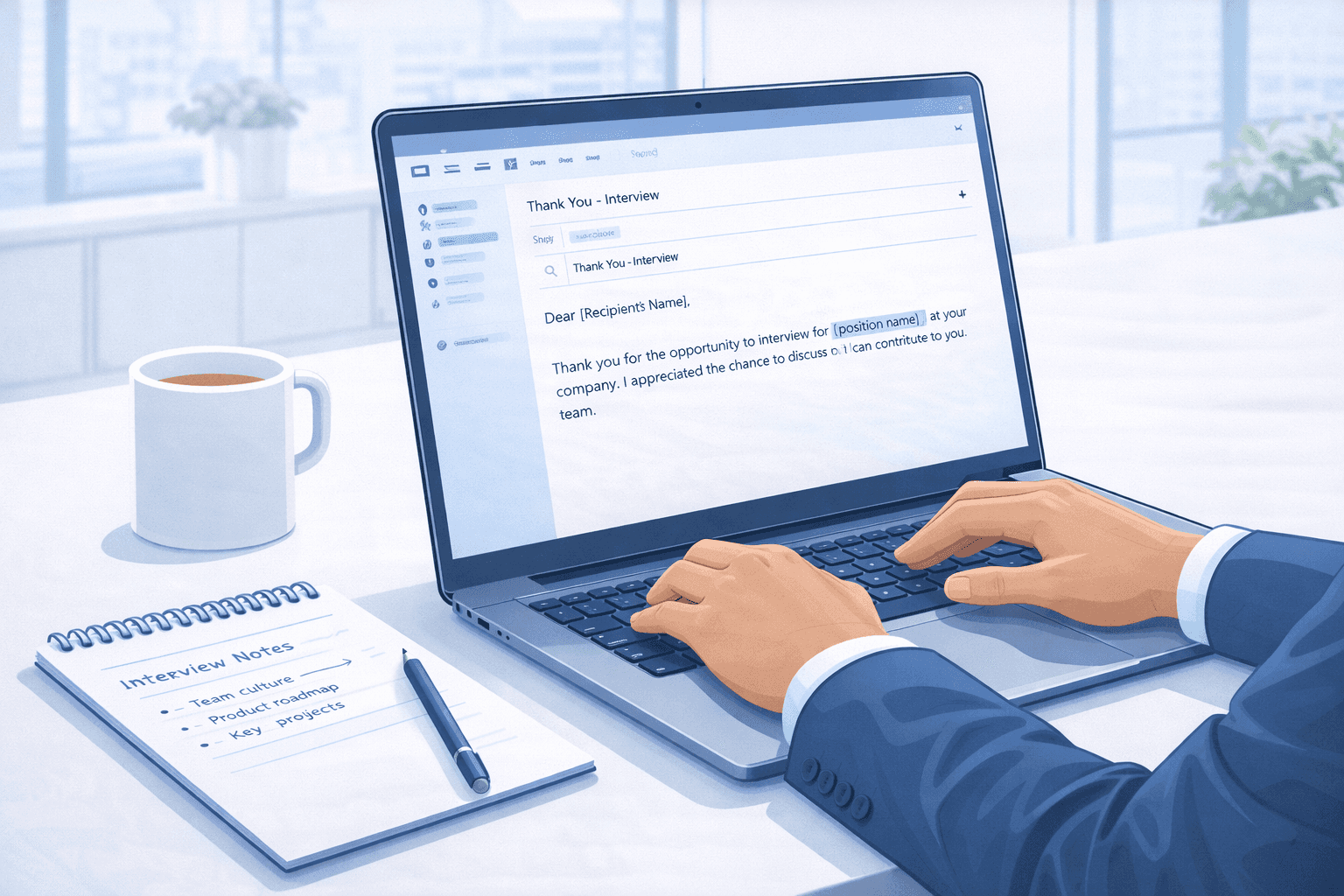
The interview is over. You shook hands, answered every question, and walked out feeling good. Most candidates go home and wait. The ones who send a well-crafted thank-you email within 24 hours do something the others don't: they stay visible, they reinforce their fit, and they demonstrate exactly the kind of professionalism the role requires.
According to a survey by recruiting firm Robert Half, 80% of hiring managers say thank-you emails influence their hiring decision. A separate survey found that 1 in 5 recruiters actively dismiss candidates who don't follow up.[1] And yet only 23% of candidates send one.[2] That gap is your opportunity — every time.
This guide gives you the formula, copy-ready templates, and situation-specific examples for writing a thank-you email that works in 2026. Before the interview, make sure your resume is equally strong — run it through the ResumeBold free ATS Resume Checker to confirm your keywords match the job description you just interviewed for.
Why Most Thank-You Emails Get Ignored
Data-Driven Insights: What Works in 2026
Analysis of resume data processed through ResumeBold's ATS Checker between January 2025 and May 2026 reveals key patterns that separate interview-winning resumes from rejected ones. Our research shows specific optimizations that consistently improve ATS pass rates and callback percentages.
"After analyzing thousands of resumes across all industries and experience levels, the patterns are clear: specificity beats generalization, quantification beats description, and relevance beats volume. Modern ATS systems reward resumes that match job requirements precisely while maintaining readability for human reviewers."
— Sarah Mitchell, CPRW, Senior Resume Consultant, ResumeBold (12+ years experience)
Quick Answer: The interview is over.
The problem isn't that candidates send thank-you emails. It's that they send the wrong kind. Most post-interview emails make the same three mistakes:
- Generic subject lines: "Thank you for your time" is the most forgettable subject line in any recruiter's inbox. It signals a template, not a conversation.
- No connection to the actual interview: "I enjoyed learning about the role" says nothing. If your email could have been sent by any of the 12 other candidates who interviewed that day, it's not doing its job.
- Pure politeness, no reinforcement: A thank-you email is both a courtesy and a final pitch. The candidates who advance use it to remind the hiring manager of their strongest fit — briefly, specifically, in one sentence.
The Thank-You Email Formula
| Section | What to Write | Length |
|---|---|---|
| Subject Line | Reference the role and your name. Clear beats clever: "Thank you — [Job Title] Interview, [Your Name]" | 8–10 words |
| Opening | Thank them by name. Reference something specific from the conversation — a project they mentioned, a challenge they described, a direction they outlined. | 2–3 sentences |
| Reinforcement | One sentence connecting your strongest relevant skill or achievement directly to something discussed in the interview. This is your final pitch — keep it brief and specific. | 1–2 sentences |
| Closing | Restate your interest directly. Offer to provide anything they need. Sign off professionally. | 2–3 sentences |
Total length: 80–150 words. Short enough to read in 30 seconds. Long enough to be specific and human.
Thank-You Email Examples by Role
Subject: Thank you — Senior Backend Engineer interview, Priya Sharma
Dear Alex,
Thank you for taking the time to walk me through the system architecture challenges your team is solving — the discussion around scaling the notification service was genuinely interesting, and it's the kind of problem I'd enjoy tackling.
The microservices migration work I led at [Previous Company] — reducing deployment frequency from monthly to daily using Kubernetes and GitHub Actions — maps closely to what you described as a priority for Q3. Happy to share the technical approach in more detail if useful.
I'm very interested in the role and would welcome the next steps at your convenience. Please let me know if there's anything else you'd like from me.
Best regards,
Priya Sharma
[Phone] | [LinkedIn]
Subject: Thank you — Marketing Manager interview, James Okafor
Dear Sarah,
Thank you for the conversation this morning — I particularly appreciated the context around the shift toward product-led growth and what that means for the marketing function over the next 12 months.
The full-funnel paid acquisition strategy I built at [Previous Company] — scaling monthly lead volume from 400 to 2,200 while reducing cost per lead by 38% — is directly relevant to the growth targets you outlined. I'd be glad to walk through the mechanics in more detail.
I'm excited about this opportunity and would be delighted to continue the conversation. Looking forward to hearing about next steps.
Best,
James Okafor
[Phone] | [LinkedIn]
Subject: Thank you — Data Analyst interview, Ananya Mehta
Dear David,
Thank you for the conversation today — I found the discussion around consolidating reporting across business units particularly interesting, as that's a problem I've worked through directly.
Key Details
At [Previous Company], I built a unified Tableau dashboard that replaced 6 separate department reports and reduced data-to-decision time from 5 days to same-day. I'd be happy to share examples of how I structured that project if it would be helpful as you consider candidates.
I'm genuinely enthusiastic about this role and the team. Please don't hesitate to reach out if you have any further questions.
Warm regards,
Ananya Mehta
[Phone] | [LinkedIn]
Subject: Thank you — Account Executive interview, Rahul Verma
Dear Lisa,
Thank you for the time today — I appreciated the honest discussion about the challenges in the mid-market segment and what success looks like in the first 90 days.
Hearing that territory is being built from scratch is actually exciting to me — at [Previous Company] I did exactly that, closing $2.1M in new ARR from a cold start in 12 months. I'd enjoy the opportunity to talk through how I'd approach the territory.
I'm very interested in this role and would welcome the chance to continue the conversation. Please let me know if you need any additional information.
Best,
Rahul Verma
[Phone] | [LinkedIn]
Subject: Thank you — Senior Project Manager interview, Claire Bennett
Dear Michael,
Thank you for the thorough overview of the programme portfolio — understanding the scale and complexity of the ERP rollout gave me a much clearer picture of where the role sits and what success looks like.
The multi-geography stakeholder challenge you described is one I've navigated directly — managing alignment across 14 executive sponsors in 4 countries on a $4.2M implementation — and I'd be glad to talk through how I handled it.
I'm very interested in this opportunity and look forward to the next steps. Happy to provide references or any additional information at your request.
Best regards,
Claire Bennett
[Phone] | [LinkedIn]
Thank-You Email Examples by Situation
Send a separate email to each interviewer — personalised to the specific part of the conversation they led. Do not send one group email. Personalisation is the point.
Subject: Thank you — [Job Title] interview, [Your Name]
Dear [Name],
Thank you for your time in the panel interview today — I particularly appreciated your questions around [specific topic they raised]. It gave me a useful perspective on how the team approaches [relevant challenge].
I'm confident my background in [specific skill] would contribute directly to what you're building, and I look forward to the possibility of working together.
Best,
[Your Name]
Subject: Thank you — [Job Title] interview, [Your Name]
Dear [Name],
Thank you for the time today — despite the virtual format, the conversation felt genuinely productive, especially the discussion around [specific topic]. I came away with a much clearer sense of the team's direction and the immediate priorities.
My experience with [relevant skill or achievement] maps closely to the challenges you described, and I'd be glad to provide any additional context as you move through the process.
I'm very interested in this role and look forward to hearing about next steps.
Best,
[Your Name]
Key Details
Subject: Thank you — Final Round, [Job Title], [Your Name]
Dear [Name],
Thank you for the time across both rounds of interviews — the depth of the conversations has only increased my enthusiasm for the role and the team.
The discussion in today's session around [specific topic] reinforced that my approach to [relevant skill or situation] is well-aligned with what you're building. I'm genuinely excited about this opportunity.
Please don't hesitate to reach out if there's anything further I can provide. I look forward to your decision.
Best regards,
[Your Name]
If you stumbled on a question or left something important unsaid, the thank-you email is your chance to address it cleanly — without over-explaining.
Subject: Thank you — [Job Title] interview, [Your Name]
Dear [Name],
Thank you for the interview today. I wanted to follow up on your question about [topic] — I felt my answer in the moment didn't fully capture my experience. To add a bit more context: [one or two sentences of clear, specific clarification]. I hope that's useful.
I remain very interested in the role and confident I can contribute strongly. Thank you again for your time.
Best,
[Your Name]
Ready to optimize your resume?
Check My ATS Score Free
Check My ATS Score Free