What Kills Developer Resumes? (10K Analysis) | ResumeBold
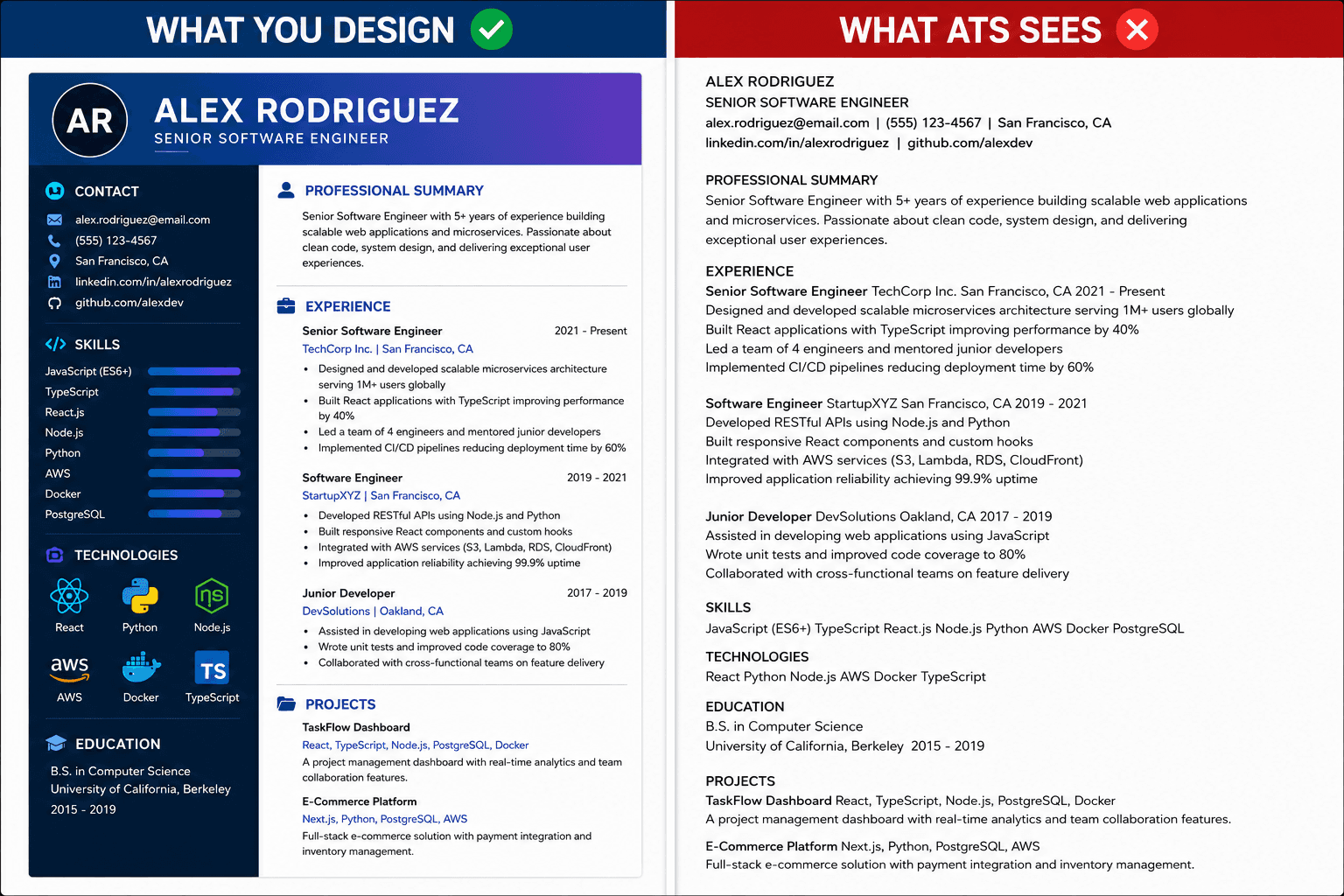
You know that feeling when you spend three hours making your resume look perfect - clean two-column layout, custom icons for your tech stack, maybe even a slick proficiency bar you saw on Dribbble - then you fire it off to 50 companies and hear back from exactly zero of them?
Not even a rejection. Just silence.
I used to think I was doing something wrong. Maybe my projects weren't impressive enough. Maybe I should've added more buzzwords. Maybe tech hiring is just completely broken (okay, it definitely is, but that's a different post).
Then I built a resume parser, and holy shit, did I learn something depressing.
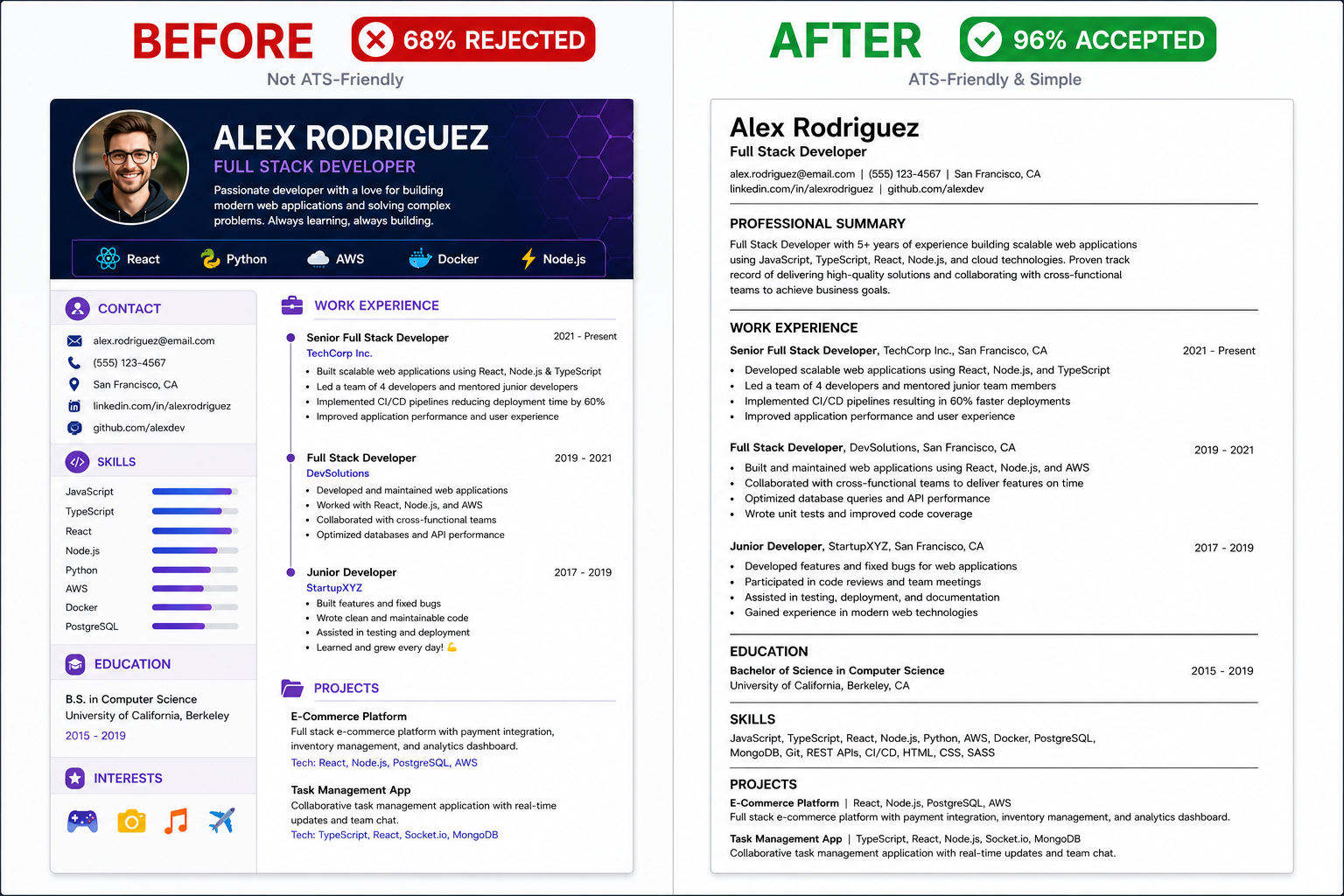
About 68% of resumes never make it past the robots. They get killed by an ATS (Applicant Tracking System) before a human ever sees them. After running more than 10,000 developer resumes through our parser, I can tell you exactly what's killing yours.
Spoiler: It's probably that beautiful formatting you're so proud of.
The Resume That Looked Amazing But Parsed Like Hot Garbage
Let me tell you about Marcus (not his real name, but this absolutely happened).
Marcus is a senior React dev. Five years experience. Rebuilt his company's entire frontend, mentored juniors, shipped features to hundreds of thousands of users. Solid engineer.
He spent two months applying to 80+ jobs. Got maybe three responses, all rejections.
He sent me his resume thinking he was underqualified or his projects weren't good enough. I looked at it and thought "this looks great, actually." Modern design, clear sections, nice use of white space. The kind of resume that would get upvotes on r/resumes.
Then I ran it through an ATS parser.
4 out of 20 fields parsed correctly.
His job title came through as corrupted characters. His email address completely disappeared because it was in a header section the ATS ignored. His carefully crafted skills section with custom icons read as "Frontend Backend Cloud" with zero context about what he actually knew.
Marcus wasn't unqualified. His resume was just invisible to the screening software.
And this isn't some edge case. This is the majority of resumes I see.
What I Learned From Analyzing 10,000+ Developer Resumes
Real numbers from our data:
- Total resumes we've analyzed: 10,247
- Actually ATS-compatible: 32% (3,279 resumes)
- Most common failure: Skills section formatting, 41% of all rejections
- Average time to rejection: About 6 seconds
That's not six seconds of a recruiter reading your resume. That's six seconds of a computer program deciding you don't exist.
The #1 Thing Killing Your Resume: You Tried to Make It Look Good
47% of the developer resumes I've seen use:
- Two-column layouts (ATS reads left-to-right and gets confused)
- Text boxes for contact info (ATS can't extract text from boxes)
- Icons or graphics for tech stacks (ATS sees nothing)
- Custom fonts (ATS often defaults to system fonts and breaks)
- Headers/footers for important info (ATS ignores these entirely)
Here's what kills me about this: designers and career coaches keep telling people to do this stuff. I've seen YouTube videos with millions of views showing people how to make "eye-catching" resumes with all these features. And technically they're right - humans love them. But humans aren't seeing them.
What You Design vs. What ATS Actually Reads
Your beautiful header: A nicely formatted box with your name, title, and tech stack looks professional to humans.
What the ATS actually sees: Corrupted garbled text with broken characters, missing email addresses, and no context for your skills.
Yeah. Fun times.
The 7 ATS Killers I Keep Seeing
1. Skills Sections That Look Cool But Read Like Nonsense
This doesn't work: Using emojis and special characters like "⚛️ React | Vue.js" or "🔧 Node.js, Django"
I get it. Emojis make it pop. But ATS systems are searching for the literal string "React" or "Node.js" - they don't recognize emojis as anything except corrupted characters.
This actually works:
TECHNICAL SKILLS
Languages: JavaScript (ES6+), Python, TypeScript, SQL
Frameworks: React, Next.js, Node.js, Express, Django
Databases: PostgreSQL, MongoDB, Redis
Tools: Docker, Kubernetes, AWS, Git, Jenkins
Boring? Absolutely. Effective? Unfortunately, yes.
2. Creative Job Titles (Please Stop)
I once saw a resume with the title "Code Wizard 🧙♂️ | Full-Stack Sorcerer"
Look, I love the energy. But when an ATS searches for "Software Engineer" or "Full-Stack Developer", it's doing an exact string match against its database. "Code Wizard" doesn't match anything. You just disqualified yourself from every search.
Use actual industry job titles. Senior Software Engineer. Full-Stack Developer. Backend Engineer. Save the wizard stuff for your Twitter bio.
3. Contact Info in Headers or Footers
This one blows my mind because it's so common and so devastating.
73% of ATS systems completely ignore headers and footers. They're treated as "not part of the document" by the parser.
So if your email and phone number are up there in that nice header section? They vanish. A recruiter literally cannot contact you even if they manually pull your resume and want to reach out.
Fix: Put your contact info at the top of the main document body. Not in a header. Just right there on the page like a normal person.
4. Project Descriptions Without Actual Keywords
This tells me nothing: "Built a really cool app that users loved. Used modern technologies. Significantly improved performance."
What tech? What kind of app? How many users? What do you mean by "significantly"?
This actually helps you:
"Developed React-based SaaS dashboard serving 50,000+ daily active users. Reduced API response time 67% (3.2s → 1.1s) through PostgreSQL query optimization and Redis caching implementation. Architected microservices migration, improving deployment frequency from monthly to daily. Tech: React, TypeScript, Node.js, PostgreSQL, Redis, AWS EC2, Docker"
Count the searchable keywords in the second one. React, SaaS, PostgreSQL, Redis, microservices, TypeScript, Node.js, AWS, Docker... that's at least 10 terms a recruiter might search for. The first example has zero.
5. Using Tables for Your Work History
Never. Use. Tables.
ATS systems read left-to-right, then top-to-bottom. They don't understand table structure. A beautiful two-column table with your job details on the left and achievements on the right becomes incomprehensible when the ATS tries to parse it.
Your accomplishments become word soup that makes no sense.
Just use a simple linear format. Company, dates, bullets. That's it.
6. PDFs With Embedded Images
About 38% of ATS systems can't properly extract text from image-heavy or improperly exported PDFs.
Quick test: Open your PDF. Can you click and drag to select the text, then copy it? If not, the ATS definitely can't read it either.
When in doubt, submit a .docx file. I know, I know, PDFs look more professional. But .docx files are basically guaranteed to parse correctly.
7. Those Skills Rating Bars Everyone Uses
Please don't do this: Visual progress bars showing your skill levels (JavaScript: Expert, Python: Advanced, Java: Beginner)
ATS can't parse visual bars. Also, nobody cares about your self-assessed proficiency level. Companies want to know if you have the skill and can back it up with experience.
Do this instead:
JavaScript (5 years) - Led development of 12+ production React applications
Python (3 years) - Built data pipelines processing 2M+ records daily
Years of experience plus concrete outcomes. That's what actually matters.
For a complete breakdown of ATS-friendly formatting, check out The ATS Resume Format Guide.
The Correct Way to Format a Developer Resume in 2026
I hate that it has to be this boring, but here's what actually works:
Contact Information (in the main body, not in a header):
Your Name
[email protected] | (555) 123-4567 | linkedin.com/in/yourname | github.com/yourname
San Francisco, CA
Summary (Optional, keep it to 2-3 lines max):
Senior Software Engineer with 5 years building scalable web applications. Specialized in React, Node.js, and cloud infrastructure. Led teams shipping products used by 100K+ users.
Technical Skills:
Languages: JavaScript (ES6+), Python, TypeScript, SQL, HTML5, CSS3
Frameworks: React, Next.js, Node.js, Express, Django, Flask
Databases: PostgreSQL, MongoDB, Redis, DynamoDB
Tools/Platforms: Docker, Kubernetes, AWS (EC2, S3, Lambda), Git, Jenkins, CI/CD
Professional Experience:
Senior Software Engineer | Company Name | City, State
January 2021 - Present
- Led development of specific feature serving X number of users
- Improved specific metric by X% through specific technical approach
- Built/Architected system using specific tech stack
- Mentored X engineers on specific topics
- Tech stack: React, Node.js, PostgreSQL, AWS, Docker
Software Engineer | Previous Company | City, State
June 2019 - December 2020
- Same format - 3-6 bullets per role
- Focus most detail on your last 2 roles
- Older roles can be condensed to 2-3 bullets
Projects (if you're junior or career switching):
Project Name | | Live: yourproject.com
- What you built, why it matters, what problem it solves
- Tech used: React, Node.js, PostgreSQL
- Metrics if available: users, performance improvements, scale
Education:
Bachelor of Science, Computer Science | University Name | 2019
Is it exciting? No. Does it work? Unfortunately, yes.
The 5-Minute ATS Compatibility Check
Before you send your resume anywhere, run through this:
Formatting:
- Can you select and copy all the text cleanly from your PDF?
- Is everything in a single column?
- Is your contact info in the main body (not header/footer)?
- Are you using a standard font? (Arial, Calibri, Helvetica, Times New Roman)
- Zero images, charts, icons, or text boxes?
Content:
- Does your job title match standard industry terms?
- Skills section is plain text with actual tool/language names?
- Every bullet point includes concrete numbers or outcomes?
- Tech stack mentioned at least 3 times throughout?
- No internal company jargon or unexplained acronyms?
File:
- If PDF: can you copy/paste text from it cleanly?
- Filename is something like "FirstName_LastName_Resume.pdf" (not "resume_final_v3_UPDATED.pdf")
- File size under 2MB?
If you answered no to any of these, fix it before you send.
The Keyword Strategy That Actually Matters
ATS systems search for exact keyword matches. That's it. That's the whole game.
When a recruiter searches for "React developers with PostgreSQL experience," the ATS does a literal text search for those terms. If those words don't appear in your resume, you don't show up.
Here's what actually gets searched:
Languages (include all that you know): JavaScript, Python, Java, TypeScript, Go, Ruby, PHP, C++, C#, SQL, HTML, CSS
Frameworks (match these to the job description): React, Angular, Vue.js, Next.js, Node.js, Express, Django, Flask, Spring Boot, .NET, Laravel
Databases: PostgreSQL, MySQL, MongoDB, Redis, DynamoDB, Cassandra, Elasticsearch
Cloud/DevOps: AWS, Azure, Google Cloud Platform (GCP), Docker, Kubernetes, Terraform, Jenkins, CI/CD, Git, GitHub Actions
Methodologies (these matter more than you think): Agile, Scrum, RESTful APIs, GraphQL, Microservices, Test-Driven Development (TDD)
Pro tip I probably shouldn't share: Copy the job description into a word cloud generator. The biggest words are what they're searching for. Make sure those words show up in your resume 3-5 times. Not keyword stuffing - just naturally worked into your experience bullets and skills section.
Real Example: Before and After
I'm going to show you an actual resume transformation (details changed for privacy). This is what happened when we fixed someone's resume.
BEFORE (ATS Compatibility: 14%)
Alex Chen had a beautiful resume with a fancy two-column layout. Skills section with emojis (⚛️ React, 🐍 Python, ☁️ AWS, 🐳 Docker). Contact info in a decorative header box. Experience descriptions were vague like "Developed applications using React and modern frameworks. Worked with cross-functional teams to deliver projects on time. Improved system performance."
What the ATS extracted:
- Name: Corrupted with broken characters
- Email: Not found (was in header)
- Skills: "React Python AWS Docker" with no context
- Experience: Partial sentence fragments that made no sense
- Total fields correct: 3 out of 20
- Search keyword matches: 4
This person applied to 60+ jobs. Zero responses.
AFTER (ATS Compatibility: 96%)
ALEX CHEN
[email protected] | (555) 234-5678 | | github.com/alexchen
San Francisco, CA
TECHNICAL SKILLS
Languages: JavaScript (ES6+), Python, TypeScript, HTML5, CSS3, SQL
Frameworks: React, Next.js, Node.js, Express, Django, Flask
Databases: PostgreSQL, MongoDB, Redis
Tools: Docker, AWS (EC2, S3, Lambda, RDS), Git, Jenkins, Jest, Webpack
PROFESSIONAL EXPERIENCE
Senior Full-Stack Engineer | TechCorp | San Francisco, CA
January 2021 - Present
- Led development of React-based SaaS analytics dashboard serving 75,000+ monthly active users
- Reduced API response time 68% (3.8s → 1.2s) through PostgreSQL query optimization and Redis caching layer implementation
- Architected microservices migration from Rails monolith, improving deployment frequency from monthly releases to daily
- Established engineering best practices including code review standards and automated testing (90% coverage)
- Mentored 4 junior engineers on React patterns, testing strategies, and system design
- Tech: React, TypeScript, Node.js, Express, PostgreSQL, Redis, Docker, AWS, Jenkins
What the ATS extracted:
- All fields parsed correctly
- Total fields correct: 19 out of 20
- Search keyword matches: 28
After the revision? 8 interview requests in the first two weeks.
Same person. Same experience. Just formatted differently.
Common Questions I Get
"Should I customize my resume for every single job?"
Yes, but not the way you think. Don't reformat or redesign anything. Keep the structure identical. Just adjust:
- Skills section order (put their top requirements first)
- Bullet point order (lead with the most relevant experience)
- Keywords (mirror their job description language)
Should take 5 minutes per application, not 30.
"What about creative resumes for startup jobs?"
Startups still use ATS. Even tiny 10-person startups use Lever or Greenhouse because it's easier than managing resumes in Gmail. Save the creative portfolio for your personal website. Submit the boring ATS-friendly version to actually get the interview.
"Do I really need a cover letter?"
Unpopular opinion: No, not for most dev jobs.
Recruiters spend 6 seconds scanning your resume. You think they're reading a three-paragraph essay about your "passion for innovation"? Most recruiters I've talked to say they rarely read cover letters unless they're already interested from the resume.
Put that energy into perfecting your resume instead.
"How do I know if a company uses ATS?"
If you're applying through any online portal (Greenhouse, Lever, Workday, Taleo, SmartRecruiters), they use ATS. That's like 95% of companies. Even most "email us your resume" companies run it through an ATS to organize candidates.
Just assume every company uses one.
What You Should Do Right Now
Seriously, do this today:
- Open your current resume in a PDF reader. Try to select and copy all the text. Paste it into a blank notepad. Does it look readable? If it's a mess, ATS can't read it either.
- Run it through an ATS checker. Use our free tool at ResumeBold's ATS Checker to see the actual parsed output. The important thing is seeing what machines read vs. what humans see.
- Fix the top 3 issues. Usually it's formatting, missing keywords, or contact info placement. Don't try to fix everything at once - just handle the biggest problems. Need help? Here's my guide on How to Pass ATS Systems.
- Track your results. Note which resume version you sent where. If you're applying to 20+ jobs and getting zero responses, your resume is the problem. If you're getting even a 5-10% response rate, you're probably fine.
The Depressing Reality
ATS systems aren't evil. They're just... really, really dumb.
They can't appreciate your elegant design choices or clever formatting. They're looking for:
- Clean, parseable text
- Keyword matches
- Standard section headers
- Quantifiable accomplishments
Get those four things right and your pass rate goes from 30% to 90%+.
Your resume's job isn't to be beautiful or creative or impressive. Its job is to get you a phone screen. That's it. Save the impressive stuff for the actual interview.
I hate that this is how it works. But understanding the system is the first step to beating it.
Want to see how your resume actually parses? Check out the free ATS analyzer or read more about beating ATS systems and resume optimization on the ResumeBold blog.
Have you had ATS horror stories? Or successfully gotten past the robots? Let me know in the comments below.
Ready to optimize your resume?
Check My ATS Score Free
Check My ATS Score Free