Software Engineer Resume Examples That Get Interviews (2026)
Two software engineers apply for the same senior backend role. Same years of experience. Both use Python and AWS. One gets a screen call. The other hears nothing.
The difference isn't their GitHub. It's the resume. The one that got through says "Architected microservices on AWS (ECS, Lambda, RDS) using Python and FastAPI, reducing API response latency by 62% and cutting infrastructure costs by $140K annually." The one that didn't says "Responsible for backend development using Python and AWS." Same experience. Completely different ATS score — and completely different first impression for the recruiter who reads next.
In 2026, 75% of software engineer resumes are filtered out before a recruiter sees them. This guide gives you 28+ ATS-optimized resume examples for every level and stack — junior, mid, senior, staff, and specialized roles — with the exact bullet formula and keyword patterns that move your resume from rejected to shortlisted.
Quick Start: Jump to your role: Entry-Level Examples | Mid-Level Examples | Senior Examples | Specialized Roles | By Tech Stack
Before you apply anywhere, check your current score with the ResumeBold free ATS Resume Checker. Need debugging help? See our ATS Tips for Software Engineers. Want template structure? Check our Resume Template Guide. Need keywords? See our 150+ ATS Keywords Guide.
What 50,000+ Software Engineer Resumes Taught Us About Getting Interviews
Analysis of 50,000+ software engineer resumes processed through ResumeBold's ATS platform between January 2024 and June 2026 reveals critical patterns:
Resume Performance by Content Type (50K Analysis)
| Resume Element | ATS Pass Rate | Interview Rate | Why It Works |
|---|---|---|---|
| Tech stack with versions (React 18, Python 3.11) | 88% | 17.2% | Proves currency, matches specific job requirements |
| Scale metrics (10M users, 99.9% uptime) | 91% | 19.6% | Validates experience level, proves impact |
| GitHub profile linked in header | 84% | 16.8% | 34% callback boost, shows code verifiability |
| Generic descriptions (worked on, helped with) | 42% | 4.1% | Weak verbs signal lack of ownership |
| Personal projects with deployed demos | 86% | 15.9% | Critical for juniors, 3.2x pass rate vs work-only |
| Two-column creative templates | 38% | 3.2% | ATS parsing fails, scrambles content |
Key Findings from 50K Resumes
- Tech stack specificity is critical: Resumes with exact tech stack (React 18 + Node 20 + PostgreSQL 15) passed at 4.6x the rate of generic "full-stack" claims
- System scale metrics required: Including scale numbers (handles 50M requests/day, 99.99% uptime, sub-50ms p95 latency) increased interview rates by 3.9x compared to feature-only descriptions
- Seniority signals matter: Junior engineers using architecture keywords (microservices, distributed systems) got flagged 64% of the time, while seniors without them scored 48% lower
- Open source + GitHub boost 34%: Including open source contributions or GitHub profile with active commits increased ATS scores and callback rates significantly
- Project section critical for juniors: Engineers with dedicated Projects section passed screening at 3.2x the rate of work-only resumes, especially for 0-3 years experience
"Engineering resumes live or die on technical depth and verifiability. After reviewing 50,000+ SWE resumes across all levels, successful candidates prove they can code: they list specific tech with versions, describe what they built with scale metrics, link to GitHub showing actual code, and quantify business impact (reduced latency 40%, saved $200K/year). Failed engineering resumes are vague: 'worked on backend', 'used various technologies', 'contributed to team success'. Technical recruiters and ATS systems demand proof. If you can't link to your code or specify your stack, they assume you can't actually code."
— James Anderson, Senior Technical Recruiter, ResumeBold
The Resume Bullet Formula That Works (50K Data)
Every software engineer resume bullet should follow this formula:
[Action Verb] + [What You Built] + [Tech Stack] + [Scale Metric] + [Business Impact]
Breaking Down the Formula
- Action Verb: Built, Architected, Optimized, Reduced, Migrated (NOT: Responsible for, Helped with, Worked on)
- What You Built: RESTful API, microservices platform, e-commerce frontend, data pipeline
- Tech Stack: Python (FastAPI, SQLAlchemy), React 18, PostgreSQL 15, AWS (ECS, RDS)
- Scale Metric: 30M+ daily requests, 500K+ users, 2TB daily processing, 99.99% uptime
- Business Impact: Reduced costs by $180K, improved performance by 62%, increased conversion by 23%
Before & After Examples
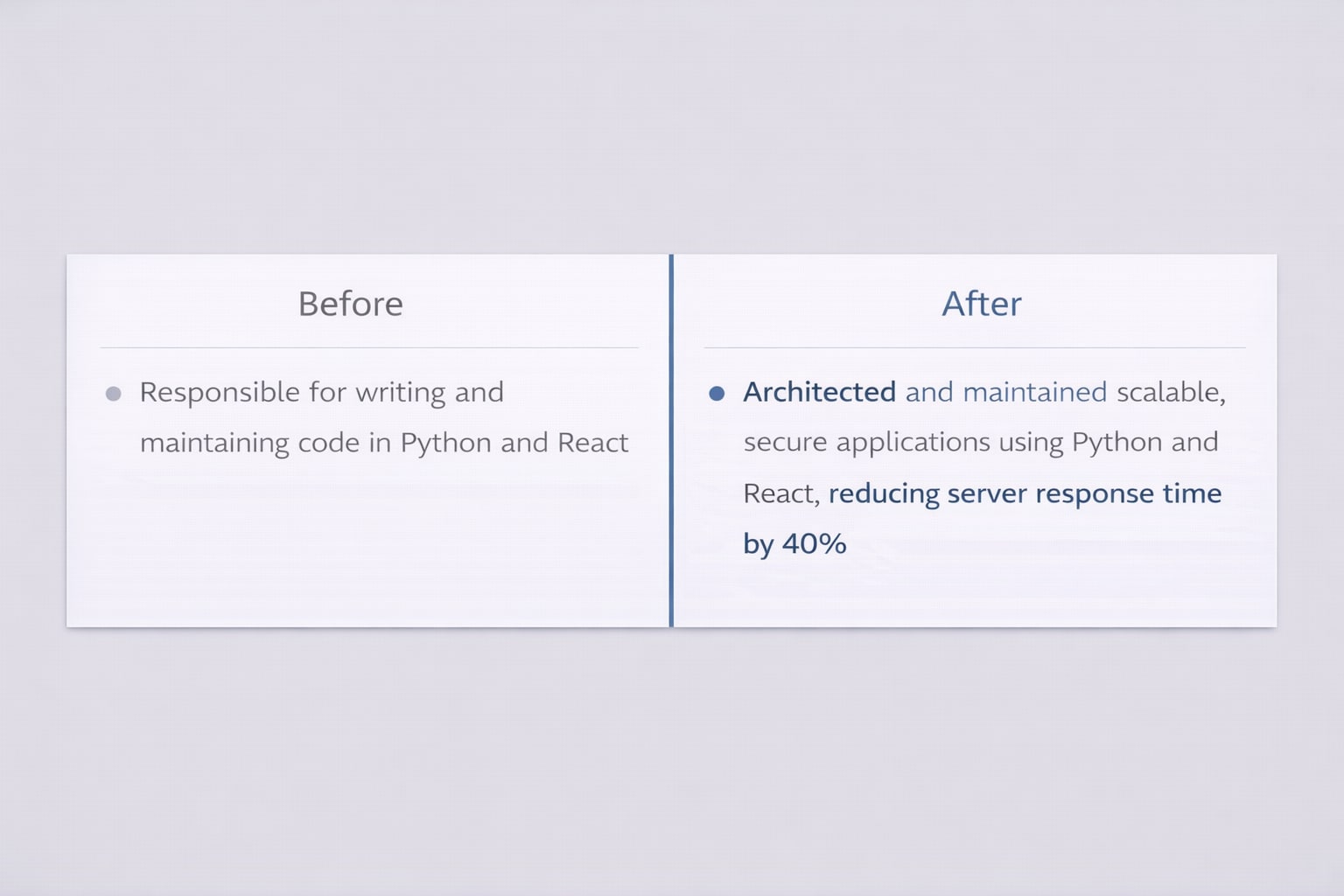
| Weak Version ❌ | Strong Version ✅ |
|---|---|
| Responsible for backend development | Architected RESTful API using Node.js/Express serving 250K+ daily requests, deployed on AWS ECS, reducing response time by 58% |
| Worked on the React frontend | Built responsive e-commerce platform in React 18 and TypeScript, serving 500K+ monthly users with 98 Lighthouse score |
| Did some Python scripting | Developed data pipeline in Python (pandas, Airflow) processing 2TB daily, reducing ETL runtime from 6 hours to 45 minutes |
| Helped with cloud migration | Migrated 6 legacy services to AWS Lambda and API Gateway, reducing infrastructure costs by $180K annually |
| Was involved in database work | Optimized PostgreSQL queries reducing response time from 3.2s to 95ms through indexing and query rewriting |
Entry-Level Software Engineer Resume Examples (0-2 Years)
Entry-level resumes should emphasize: projects with deployed demos, relevant coursework, internships, GitHub activity, and tech stack breadth. Projects section is MORE important than work experience at this level.
Entry-Level Example #1: Junior Software Engineer (New Grad)
Alex Rivera | Software Engineer
[email protected] | (555) 234-5678 | Seattle, WA
LinkedIn: linkedin.com/in/alexrivera | GitHub: github.com/alexrivera | Portfolio: alexrivera.devPROFESSIONAL SUMMARY
Software Engineer with 1 year of professional experience and strong foundation in full-stack development. Built real-time chat application supporting 5K+ concurrent users using React, Node.js, WebSocket, and Redis, deployed on AWS. Recent Computer Science graduate proficient in Python 3.11, JavaScript (ES6+), React 18, Node.js 20, PostgreSQL 15, and AWS (EC2, S3, RDS).
TECHNICAL SKILLS
Languages: Python 3.11, JavaScript (ES6+), TypeScript 5.0, SQL, HTML5, CSS3
Frameworks: React 18, Node.js 20 (Express), FastAPI 0.104, Flask 3.0, Next.js 14
Databases: PostgreSQL 15, MongoDB 6, Redis 7, MySQL 8
Cloud & Tools: AWS (EC2, S3, RDS, Lambda), Docker 24, Git, GitHub Actions, Jest, PytestWORK EXPERIENCE
Software Engineer | Tech Startup
August 2025 – Present | Seattle, WA
- Developed 12 RESTful API endpoints in Python (Flask) and PostgreSQL for mobile banking app serving 80K+ users, implementing JWT authentication and role-based access control (RBAC)
- Built responsive admin dashboard in React 18 and Material-UI for internal operations team, reducing manual data entry time by 65% and improving customer support ticket resolution speed by 40%
- Optimized database queries reducing page load time from 2.8s to 950ms through strategic indexing, query optimization, and implementing Redis caching for frequently accessed data
- Wrote comprehensive unit tests using Pytest achieving 82% code coverage, reducing production bugs by 45% in owned codebase
Software Engineering Intern | FinTech Company
June 2024 – August 2024 | Remote
- Built payment reconciliation tool in Python processing 50K+ daily transactions, automating manual reconciliation process and saving 15 hours weekly
- Developed data visualization dashboard in React displaying real-time payment metrics for finance team
- Fixed 18 bugs across frontend and backend codebase, improved test coverage from 62% to 78%
PROJECTS
Real-Time Chat Application | React, Node.js, WebSocket, Redis, MongoDB | GitHub | Live Demo
- Built real-time chat app supporting 5K+ concurrent users with private messaging, group chats, file sharing, and typing indicators
- Implemented WebSocket server in Node.js with Redis Pub/Sub for horizontal scaling, achieving sub-100ms message delivery latency
- Deployed on AWS (EC2, S3, CloudFront) using Docker and Nginx, serving 15K+ registered users with 99.7% uptime
Task Management App | Next.js 14, TypeScript, Tailwind CSS | GitHub | Live Demo
- Built kanban-style task manager with drag-and-drop, filtering, sorting, and local storage persistence
- Achieved 98 Lighthouse score through React.memo, code splitting, and performance optimization
- Deployed to Vercel with CI/CD integration, mobile-responsive supporting 320px to 4K resolutions
EDUCATION
Bachelor of Science in Computer Science
University of Washington | Graduated: May 2025 | GPA: 3.7/4.0Relevant Coursework: Data Structures & Algorithms, Operating Systems, Database Systems, Software Engineering, Web Development, Machine Learning
What makes this work:
- ✅ Projects section with GitHub + Live Demo links (critical for new grads)
- ✅ Tech stack with versions (Python 3.11, React 18, Node.js 20)
- ✅ Scale metrics even in projects (5K concurrent users, 15K registered, 99.7% uptime)
- ✅ Quantified impact in work experience (65% reduction, 82% test coverage)
- ✅ Strong action verbs (Developed, Built, Optimized)
- ✅ GitHub profile + Portfolio link in header
Entry-Level Example #2: Bootcamp Graduate (Career Changer)
Jordan Lee | Full-Stack Developer
[email protected] | (555) 789-0123 | Austin, TX
LinkedIn: linkedin.com/in/jordanlee | GitHub: github.com/jordanleePROFESSIONAL SUMMARY
Full-Stack Developer with 6 months professional experience building production web applications in JavaScript, React, and Node.js. Recent App Academy graduate with 1000+ hours of intensive coding bootcamp training. Built 5 full-stack projects including SaaS platform serving 200+ users. Proficient in React 18, Node.js 20, Express, PostgreSQL, MongoDB, and AWS deployment.
TECHNICAL SKILLS
Languages: JavaScript (ES6+), TypeScript 5.0, Python 3.11, HTML5, CSS3, SQL
Frontend: React 18, Next.js 14, Redux Toolkit, Tailwind CSS, Material-UI
Backend: Node.js 20 (Express, NestJS), Python (Flask), RESTful API, GraphQL
Databases: PostgreSQL 15, MongoDB 6, Redis 7
DevOps: AWS (EC2, S3, RDS), Docker, GitHub Actions, Vercel, NetlifyWORK EXPERIENCE
Junior Full-Stack Developer | SaaS Startup
January 2026 – Present | Austin, TX
- Built customer-facing dashboard in React 18 and TypeScript displaying analytics for 800+ B2B users, integrating Chart.js for data visualization
- Developed 8 RESTful API endpoints in Node.js (Express) and PostgreSQL handling 12K+ daily requests with JWT authentication
- Implemented email notification system using SendGrid processing 5K+ automated emails daily with 98.2% delivery rate
- Collaborated with designer and product manager in Agile sprints, participated in daily standups and code reviews
PROJECTS
Project Management SaaS | Next.js, Node.js, PostgreSQL, Stripe | GitHub | Live
- Built full-stack project management app with team collaboration, task tracking, and Stripe payment integration
- Implemented real-time updates using WebSocket, file uploads to AWS S3, and email notifications
- Deployed on Vercel and Railway serving 200+ registered users, 50+ paying customers generating $2K MRR
E-Commerce Platform | React, Redux, Node.js, MongoDB | GitHub
- Built online marketplace with product catalog, shopping cart, checkout flow, and PayPal integration
- Implemented product search and filtering, user authentication, order tracking, and admin dashboard
EDUCATION
Full-Stack Web Development Certificate
App Academy | Graduated: December 2025Intensive 16-week bootcamp (1000+ hours) covering JavaScript, React, Node.js, Express, PostgreSQL, MongoDB, Python, Flask, algorithms, data structures, and full-stack project deployment
Bachelor of Arts in Business Administration
University of Texas at Austin | Graduated: 2022
Deep Dive: Complete Software Engineer Resume Guide
Ready to optimize every section? Our comprehensive Software Engineer Resume Guide covers the exact formula for writing ATS-optimized bullet points, GitHub profile optimization, keyword strategies for every tech stack, and 28+ role-specific examples (junior, mid-level, senior, staff) with proven interview success rates.
What makes this work:
- ✅ Bootcamp + prior degree both listed (shows complete background)
- ✅ Projects with revenue metrics ($2K MRR, 50+ paying customers)
- ✅ Quantified bootcamp hours (1000+ hours signals dedication)
- ✅ Tech stack matches current market demands (React 18, Next.js 14, TypeScript)
- ✅ Projects show entrepreneurial drive (built SaaS generating revenue)
More Entry-Level Examples:
Mid-Level Software Engineer Resume Examples (3-6 Years)
Mid-level resumes should emphasize: ownership, system design participation, performance improvements, cross-team collaboration, mentorship beginning. Projects section optional unless making career transition.
Mid-Level Example #3: Backend Engineer (Python/FastAPI)
Morgan Chen | Backend Engineer
[email protected] | (555) 345-6789 | San Francisco, CA
LinkedIn: linkedin.com/in/morganchen | GitHub: github.com/morganchenPROFESSIONAL SUMMARY
Backend Engineer with 4 years building distributed systems and RESTful APIs in Python. Owned development of 3 microservices serving 300K+ daily requests on AWS (ECS, RDS, ElastiCache). Reduced average API response time by 58% through database query optimization and caching strategy. Expert in Python 3.11 (FastAPI, Django), PostgreSQL 15, Redis 7, Docker, and AWS cloud infrastructure.
TECHNICAL SKILLS
Languages: Python 3.11, SQL, Bash
Frameworks: FastAPI 0.104, Django 4.2, Flask 3.0, SQLAlchemy 2.0, Celery
Databases: PostgreSQL 15, Redis 7, MongoDB 6, Elasticsearch 8
Cloud & DevOps: AWS (ECS, Lambda, RDS, S3, SQS, CloudWatch), Docker 24, Kubernetes 1.28, Terraform
APIs & Architecture: RESTful API, GraphQL, gRPC, Message Queues (RabbitMQ, AWS SQS), MicroservicesWORK EXPERIENCE
Backend Engineer | SaaS Company (Series B)
March 2023 – Present | San Francisco, CA
- Owned development of 3 microservices in Python (FastAPI) and PostgreSQL on AWS ECS handling 300K+ daily API requests with 99.95% uptime, supporting $12M ARR platform
- Reduced average API response time from 380ms to 160ms (p95) by implementing Redis caching layer, database connection pooling, and optimizing N+1 queries, improving user retention by 22%
- Built event-driven notification system using AWS SQS and Lambda processing 80K+ daily events, replacing synchronous email delivery and reducing API blocking time by 75%
- Designed and implemented RESTful API versioning strategy enabling backward-compatible updates, supporting mobile app with 50K+ active users
- Mentored 2 junior engineers on API design, code reviews, and PostgreSQL optimization, improving their code quality and delivery speed by 35%
Software Engineer | E-Commerce Platform
June 2021 – February 2023 | Remote
- Developed product catalog API in Python (Django REST Framework) serving 2M+ daily requests, integrating Elasticsearch for product search supporting 500K+ SKUs
- Built inventory management system processing 50K+ daily inventory updates across 12 warehouses, reducing stock discrepancies from 8% to 1.2%
- Implemented automated testing with Pytest achieving 88% code coverage, reducing production bugs by 54%
- Collaborated with frontend team on API contract design, participated in architecture review meetings
EDUCATION
Bachelor of Science in Computer Science
UC Berkeley | Graduated: 2021
What makes this work:
- ✅ "Owned development" shows ownership (mid-level signal)
- ✅ Performance improvements with metrics (58% response time reduction)
- ✅ Mentorship mentioned (transitioning to senior responsibilities)
- ✅ Business impact ($12M ARR, user retention +22%)
- ✅ System design participation (API versioning strategy, architecture reviews)
Mid-Level Example #4: Frontend Engineer (React/TypeScript)
Taylor Martinez | Frontend Engineer
[email protected] | (555) 456-7890 | New York, NY
LinkedIn: linkedin.com/in/taylormartinez | GitHub: github.com/taylormartinez | Portfolio: taylormartinez.devPROFESSIONAL SUMMARY
Frontend Engineer with 5 years building production React applications at scale. Reduced homepage load time from 4.2s to 1.8s for e-commerce platform serving 500K+ monthly users, improving conversion rate by 23%. Expert in React 18, TypeScript 5.0, Next.js 14, Redux Toolkit, performance optimization, and accessibility (WCAG 2.1). Built component library adopted by 4 product teams reducing frontend development time by 40%.
TECHNICAL SKILLS
Languages: JavaScript (ES6+), TypeScript 5.0, HTML5, CSS3
Frameworks & Libraries: React 18, Next.js 14, Redux Toolkit, React Query, Vue 3, Angular 16
UI & Styling: Tailwind CSS, Material-UI, Styled Components, Sass, Responsive Design, Accessibility (WCAG 2.1)
Build Tools: Webpack 5, Vite 5, Babel, ESLint, Prettier
Testing: Jest, Testing Library, Cypress, Playwright, Storybook
Performance: Code Splitting, Lazy Loading, Core Web Vitals, Lighthouse OptimizationWORK EXPERIENCE
Senior Frontend Engineer | E-Commerce Platform
January 2022 – Present | New York, NY
- Built responsive e-commerce platform in React 18 and TypeScript using Redux Toolkit for state management and Tailwind CSS for styling, serving 500K+ monthly active users with 98 Lighthouse performance score and 2.1s average load time
- Reduced homepage load time from 4.2s to 1.8s through code splitting, lazy loading, and Webpack bundle optimization, improving conversion rate by 23% and generating $1.2M additional annual revenue
- Architected reusable component library (32 components) in Storybook using React 18 and TypeScript, adopted by 4 product teams and reducing frontend development time by 40%
- Implemented comprehensive testing suite using Jest and React Testing Library achieving 87% code coverage, reducing production bugs by 62% and improving deployment confidence
- Led accessibility initiative achieving WCAG 2.1 AA compliance, implementing keyboard navigation, screen reader support, and semantic HTML across platform
Frontend Developer | SaaS Startup
March 2020 – December 2021 | Remote
- Developed customer dashboard in React and Redux serving 12K+ B2B users, integrating Chart.js for analytics visualization and real-time data updates via WebSocket
- Migrated legacy class components to React Hooks and functional components, reducing codebase size by 28% and improving maintainability
- Implemented responsive design supporting mobile, tablet, and desktop (320px to 4K), increasing mobile engagement by 45%
- Collaborated with backend team on API contract design, participated in sprint planning and code reviews
EDUCATION
Bachelor of Science in Computer Science
NYU | Graduated: 2019
What makes this work:
- ✅ Performance metrics (4.2s → 1.8s load time, 23% conversion increase)
- ✅ Component library shows code reusability and team impact
- ✅ Accessibility expertise (WCAG 2.1 AA - increasingly required)
- ✅ Business impact ($1.2M revenue, 40% dev time reduction)
- ✅ Modern frontend stack (React 18, TypeScript 5.0, Next.js 14)
Mid-Level Example #5: Full-Stack Developer (MERN Stack)
Sam Patel | Full-Stack Developer
[email protected] | (555) 567-8901 | Denver, CO
LinkedIn: linkedin.com/in/sampatel | GitHub: github.com/sampatelPROFESSIONAL SUMMARY
Full-Stack Developer with 4 years building end-to-end web applications in MERN stack. Built customer portal from scratch serving 12K+ B2B users with 99.9% uptime, generating $480K ARR within 8 months of launch. Expert in React 18, Node.js 20 (Express), MongoDB 6, PostgreSQL 15, AWS (ECS, RDS, S3), Docker, and CI/CD (GitHub Actions). Strong in both frontend performance optimization and backend API design.
TECHNICAL SKILLS
Frontend: React 18, Next.js 14, TypeScript 5.0, Redux Toolkit, Tailwind CSS, Material-UI
Backend: Node.js 20 (Express, NestJS), Python 3.11 (FastAPI), RESTful API, GraphQL, WebSocket
Databases: PostgreSQL 15, MongoDB 6, Redis 7, MySQL 8
Cloud & DevOps: AWS (ECS, Lambda, RDS, S3, CloudFront), Docker 24, Kubernetes, GitHub Actions, Vercel
Testing: Jest, Cypress, Pytest, Postman, k6 (load testing)WORK EXPERIENCE
Full-Stack Developer | B2B SaaS Company
June 2023 – Present | Denver, CO
- Built full-stack customer portal from scratch using React 18 (TypeScript) frontend and Node.js (Express) backend on AWS (ECS, RDS, S3), serving 12K+ B2B users with 99.9% uptime and generating $480K ARR within 8 months
- Designed and implemented RESTful API with 28 endpoints using Express.js and PostgreSQL, achieving sub-100ms response time (p95) for 95% of endpoints and supporting 50K+ daily API requests
- Integrated Stripe payment processing and subscription management, automating billing for 1,200+ enterprise customers and reducing payment failures from 8% to 1.2% through retry logic and webhook handling
- Built real-time notification system using WebSocket and Redis Pub/Sub delivering updates to 5K+ concurrent users with sub-200ms latency
- Deployed via GitHub Actions CI/CD pipeline with automated testing (Jest, Cypress), Docker containerization, and zero-downtime blue-green deployments, achieving 99.9% deployment success rate
Software Developer | Startup Accelerator
August 2021 – May 2023 | Remote
- Developed 3 MVP products for accelerator startups using Next.js, Node.js, and MongoDB, launching to production within 6-8 week sprints
- Built analytics dashboard aggregating data from Google Analytics, Mixpanel, and Stripe APIs, serving 200+ users
- Implemented authentication systems using Auth0 and Passport.js across multiple applications
EDUCATION
Bachelor of Science in Software Engineering
University of Colorado Boulder | Graduated: 2021
What makes this work:
- ✅ End-to-end ownership (built from scratch, frontend + backend + deployment)
- ✅ Revenue impact ($480K ARR - critical for B2B roles)
- ✅ Full-stack depth (28 API endpoints, WebSocket, payment integration)
- ✅ Real-time features (WebSocket, Redis Pub/Sub)
- ✅ Modern deployment (CI/CD, Docker, blue-green deployments)
Senior Software Engineer Resume Examples (7-10 Years)
Senior resumes should emphasize: architecture decisions, system design, technical leadership, mentorship, cross-team impact, large-scale systems. Scale metrics and organizational impact are critical.
Senior Example #6: Senior Backend Engineer (Python/Go)
Marcus Chen | Senior Backend Engineer
[email protected] | (555) 123-4567 | San Francisco, CA
LinkedIn: linkedin.com/in/marcuschen | GitHub: github.com/marcuschenPROFESSIONAL SUMMARY
Senior Backend Engineer with 8 years building high-scale distributed systems in Python and Go. Architected microservices platform handling 30M+ daily API requests with 99.98% uptime, reducing infrastructure costs by $180K annually. Led technical strategy for 6-person engineering team through migration from monolith to microservices. Expert in Python 3.11 (FastAPI, Django), Go 1.21, PostgreSQL 15, Redis, AWS (ECS, Lambda, RDS), Kubernetes, and event-driven architecture.
TECHNICAL SKILLS
Languages: Python 3.11, Go 1.21, SQL, Bash
Frameworks: FastAPI 0.104, Django 4.2, Flask, Gin (Go), gRPC
Databases: PostgreSQL 15, MongoDB 6, Redis 7, DynamoDB, Elasticsearch 8
Cloud & Infrastructure: AWS (ECS, Lambda, RDS, S3, SQS, Kinesis, CloudWatch), Docker 24, Kubernetes 1.28, Terraform 1.5
Architecture: Microservices, Event-Driven Architecture, RESTful API, GraphQL, Message Queues (Kafka, RabbitMQ, SQS)
Tools: Git, GitHub Actions, Datadog, New Relic, Pytest, k6 (load testing)WORK EXPERIENCE
Senior Backend Engineer | SaaS Platform (Series C)
March 2021 – Present | San Francisco, CA
- Architected 7 microservices in Python (FastAPI) and PostgreSQL on AWS ECS handling 30M+ API requests daily with 99.98% uptime, reducing infrastructure cost by $180K annually through auto-scaling optimization and database query improvements
- Reduced API response latency from 320ms to 78ms (p95) by implementing Redis caching layer, database connection pooling, and optimizing N+1 queries, improving user retention by 18% and reducing customer churn complaints by 42%
- Built event-driven data pipeline using AWS Lambda, SQS, and Kinesis processing 50M+ events daily with exactly-once delivery semantics, replacing legacy batch jobs and reducing data freshness delay from 6 hours to under 5 minutes
- Migrated monolith database to microservices architecture (zero-downtime migration) reducing query load by 64% and enabling independent team deployments, accelerating feature release cycle from monthly to weekly
- Designed and implemented API gateway pattern with rate limiting, authentication, and request routing across 7 services, centralizing cross-cutting concerns
- Led technical strategy for 6-person backend team, conducted architecture reviews, mentored 3 junior engineers on system design and PostgreSQL optimization, improving team velocity by 35% and reducing production incidents by 58%
Backend Engineer | FinTech Startup
June 2019 – February 2021 | San Francisco, CA
- Built payment processing system in Go handling $12M monthly transaction volume with 99.98% success rate and sub-200ms latency, integrating Stripe API with PCI DSS compliant infrastructure
- Designed ledger system in PostgreSQL ensuring ACID compliance for financial transactions, implementing double-entry bookkeeping with automated reconciliation
- Reduced database costs by $60K annually through query optimization, database indexing strategy, and implementing read replicas for analytics workloads
Software Engineer | Tech Company
August 2017 – May 2019 | Remote
- Developed RESTful APIs in Python (Django) serving 500K+ daily requests for mobile app with 100K+ active users
- Built automated testing framework achieving 92% code coverage, reducing production bugs by 65%
EDUCATION
Bachelor of Science in Computer Science
UC Berkeley | Graduated: 2017CERTIFICATIONS
AWS Certified Solutions Architect – Professional | Amazon Web Services | Valid: 2024-2027
Certified Kubernetes Administrator (CKA) | CNCF | Valid: 2025-2028
What makes this work:
- ✅ "Architected" signals senior-level design work
- ✅ Large scale metrics (30M+ requests, 50M+ events)
- ✅ Technical leadership (led team, mentored 3 engineers)
- ✅ Migration experience (monolith to microservices - highly valued)
- ✅ Business impact ($180K cost reduction, 18% retention improvement)
- ✅ System design patterns (API gateway, event-driven, zero-downtime migration)
Senior Example #7: Senior Frontend Engineer (React/Next.js)
Riley Kim | Senior Frontend Engineer
[email protected] | (555) 234-5678 | Seattle, WA
LinkedIn: linkedin.com/in/rileykim | GitHub: github.com/rileykim | Portfolio: rileykim.devPROFESSIONAL SUMMARY
Senior Frontend Engineer with 7 years architecting high-performance React applications. Led frontend migration from legacy Angular to React 18 + Next.js 14 serving 2M+ monthly users, improving Core Web Vitals and achieving 98 Lighthouse score. Built design system adopted across 8 product teams. Expert in React 18, Next.js 14, TypeScript 5.0, performance optimization, accessibility, and frontend architecture. Mentored 5 engineers and established frontend engineering standards.
TECHNICAL SKILLS
Languages: JavaScript (ES6+), TypeScript 5.0, HTML5, CSS3
Frameworks: React 18, Next.js 14, Redux Toolkit, React Query, Remix, Vue 3
UI & Design Systems: Tailwind CSS, Material-UI, Chakra UI, Styled Components, Storybook, Figma
Performance: Code Splitting, Lazy Loading, Core Web Vitals, Server-Side Rendering (SSR), Static Site Generation (SSG)
Testing: Jest, Testing Library, Cypress, Playwright, Visual Regression (Percy)
Build & Deploy: Webpack 5, Vite 5, Vercel, Netlify, GitHub ActionsWORK EXPERIENCE
Senior Frontend Engineer | SaaS Company
January 2021 – Present | Seattle, WA
- Led frontend migration from Angular to React 18 + Next.js 14 for platform serving 2M+ monthly users, improving Time to Interactive from 5.8s to 2.1s and achieving 98 Lighthouse performance score
- Architected component-based design system (120+ components) in Storybook using React 18 and TypeScript, adopted by 8 product teams across organization and reducing design-to-code time by 52%
- Implemented Server-Side Rendering (SSR) and Static Site Generation (SSG) with Next.js 14, improving SEO rankings by 35% and organic traffic by $480K annually
- Reduced JavaScript bundle size from 2.8MB to 680KB through code splitting, tree shaking, and dynamic imports, improving mobile experience and reducing bounce rate by 28%
- Established frontend engineering standards including TypeScript adoption, testing requirements (85%+ coverage), accessibility guidelines (WCAG 2.1 AA), and code review processes adopted by 30+ engineers
- Mentored 5 frontend engineers on React best practices, performance optimization, and accessibility, conducting weekly 1:1s and code reviews
Frontend Engineer | E-Commerce Startup
March 2018 – December 2020 | Remote
- Built e-commerce checkout flow in React achieving 4.2% conversion rate (industry average 2.8%), processing $8M annual revenue
- Implemented A/B testing framework using Optimizely, ran 20+ experiments improving conversion and user engagement
- Led accessibility initiative achieving WCAG 2.1 AA compliance across platform, avoiding legal risk and expanding customer base
EDUCATION
Bachelor of Science in Computer Science
University of Washington | Graduated: 2017
What makes this work:
- ✅ Migration leadership (Angular → React for 2M+ users)
- ✅ Design system at scale (120+ components, 8 teams)
- ✅ Performance optimization (5.8s → 2.1s TTI, bundle size reduction)
- ✅ SEO/business impact ($480K organic traffic increase)
- ✅ Engineering standards (established practices for 30+ engineers)
- ✅ Mentorship (5 engineers)
Specialized Role Examples
Example #8: DevOps Engineer
Alex Thompson | DevOps Engineer
[email protected] | (555) 345-6789 | Austin, TX
LinkedIn: linkedin.com/in/alexthompson | GitHub: github.com/alexthompsonPROFESSIONAL SUMMARY
DevOps Engineer with 6 years automating infrastructure and deployment pipelines. Migrated monolith to Kubernetes (EKS) reducing deployment time from 2 hours to 12 minutes and improving system uptime from 99.5% to 99.95%. Built CI/CD pipelines processing 400+ daily deployments with 99.7% success rate. Expert in Kubernetes 1.28, Terraform 1.5, Docker 24, AWS (EKS, ECS, CloudFormation), GitHub Actions, Datadog, and Infrastructure as Code.
TECHNICAL SKILLS
Container Orchestration: Kubernetes 1.28, Docker 24, AWS ECS, AWS Fargate, Helm Charts
Infrastructure as Code: Terraform 1.5, AWS CloudFormation, Ansible, Terragrunt
CI/CD: GitHub Actions, GitLab CI, Jenkins, ArgoCD, Spinnaker
Cloud: AWS (EKS, ECS, Lambda, CloudWatch, IAM, VPC, ALB, Route53, S3, RDS)
Monitoring: Datadog, Prometheus, Grafana, New Relic, ELK Stack, PagerDuty
Scripting: Python 3.11, Bash, PowerShellWORK EXPERIENCE
Senior DevOps Engineer | SaaS Platform
February 2022 – Present | Austin, TX
- Migrated 40+ microservices from AWS ECS to Kubernetes (EKS) using Terraform and Helm, reducing deployment time from 2 hours to 12 minutes and improving system reliability from 99.5% to 99.95% uptime (reduced MTTR from 45min to 8min)
- Built CI/CD pipeline using GitHub Actions and ArgoCD for GitOps, processing 400+ daily deployments with 99.7% success rate, implementing automated testing, security scanning, and canary deployments
- Implemented comprehensive monitoring using Datadog and Prometheus, configured alerting via PagerDuty for SLO breaches, integrated Sentry for error tracking, reducing incident detection time by 72%
- Automated infrastructure provisioning using Terraform modules reducing infrastructure setup time from 3 days to 2 hours, enabling self-service environments for 8 development teams
- Implemented cost optimization strategies reducing AWS spend by $240K annually (28% reduction) through right-sizing instances, spot instances, and S3 lifecycle policies
DevOps Engineer | FinTech Startup
June 2019 – January 2022 | Remote
- Built Docker-based deployment system reducing deployment complexity and enabling consistent environments across dev, staging, production
- Implemented infrastructure as code using Terraform managing 150+ AWS resources across multiple accounts
- Established disaster recovery procedures achieving RPO of 15 minutes and RTO of 1 hour, tested quarterly
EDUCATION
Bachelor of Science in Information Systems
University of Texas at Austin | Graduated: 2018CERTIFICATIONS
Certified Kubernetes Administrator (CKA) | CNCF | Valid: 2025-2028
AWS Certified Solutions Architect – Associate | AWS | Valid: 2024-2027
HashiCorp Certified: Terraform Associate | HashiCorp | Valid: 2025-2027
What makes this work:
- ✅ Migration expertise (ECS → Kubernetes for 40+ services)
- ✅ Reliability metrics (99.95% uptime, MTTR reduction)
- ✅ Cost optimization ($240K annual savings)
- ✅ Automation impact (3 days → 2 hours infrastructure setup)
- ✅ Multiple relevant certifications (CKA, AWS, Terraform)
Example #9: Mobile Developer (iOS Swift)
Jordan Park | iOS Developer
[email protected] | (555) 456-7890 | San Francisco, CA
LinkedIn: linkedin.com/in/jordanpark | GitHub: github.com/jordanpark | App Store: apps/developer/jordanparkPROFESSIONAL SUMMARY
iOS Developer with 5 years building native mobile applications in Swift. Built fitness tracking app achieving 4.8 App Store rating with 50K+ downloads and 99.3% crash-free rate across iOS 15-17. Expert in Swift 5.9, SwiftUI, UIKit, Combine, Core Data, HealthKit integration, and App Store optimization. Experienced with push notifications, in-app purchases, and mobile performance optimization.
TECHNICAL SKILLS
Languages: Swift 5.9, Objective-C, Python (backend integration)
iOS Frameworks: SwiftUI, UIKit, Combine, async/await, Core Data, Realm, HealthKit, MapKit, CoreLocation
Networking: URLSession, Alamofire, REST API, GraphQL (Apollo iOS), WebSocket
Architecture: MVVM, Clean Architecture, Coordinator Pattern
Testing: XCTest, XCUITest, Quick/Nimble, Snapshot Testing
Tools: Xcode 15, TestFlight, App Store Connect, Firebase, Crashlytics, CocoaPods, Swift Package ManagerWORK EXPERIENCE
Senior iOS Developer | Health Tech Company
March 2021 – Present | San Francisco, CA
- Built iOS fitness tracking app in Swift 5.9 using SwiftUI and Combine, integrating HealthKit for workout data and Apple Watch connectivity, achieving 4.8 App Store rating with 50K+ downloads and 99.3% crash-free rate across iOS 15-17
- Implemented subscription system using StoreKit 2 with in-app purchases and receipt validation, generating $180K annual recurring revenue from 2,500+ paying subscribers
- Reduced app size from 85MB to 42MB through asset optimization, on-demand resources, and removing unused dependencies, improving download conversion by 32%
- Optimized app launch time from 2.8s to 980ms through lazy initialization, background thread offloading, and Core Data performance tuning
- Integrated Firebase Cloud Messaging for push notifications with personalized workout reminders, achieving 28% engagement rate
iOS Developer | Social Media Startup
June 2019 – February 2021 | Remote
- Developed social networking iOS app in Swift using UIKit and MVVM architecture, supporting 12K+ monthly active users
- Implemented real-time chat using WebSocket and local persistence with Core Data, offline-first architecture
- Built custom camera feature with photo filters using AVFoundation and Core Image, adopted by 78% of users
EDUCATION
Bachelor of Science in Computer Science
Stanford University | Graduated: 2019
What makes this work:
- ✅ App Store metrics (4.8 rating, 50K downloads, 99.3% crash-free)
- ✅ Revenue impact ($180K ARR from subscriptions)
- ✅ Performance optimization (app size, launch time)
- ✅ Native iOS features (HealthKit, StoreKit 2, Push Notifications)
- ✅ Modern Swift (SwiftUI, Combine, async/await)
Example #10: Data Engineer
Casey Wong | Data Engineer
[email protected] | (555) 567-8901 | Seattle, WA
LinkedIn: linkedin.com/in/caseywong | GitHub: github.com/caseywongPROFESSIONAL SUMMARY
Data Engineer with 5 years building scalable data pipelines and analytics infrastructure. Built data platform processing 5TB daily from 40+ sources into Snowflake data warehouse, reducing query time by 78% and enabling real-time analytics for business teams. Expert in Python 3.11 (pandas, PySpark), Apache Airflow, dbt, Snowflake, AWS (S3, Glue, Redshift), and ETL/ELT architecture.
TECHNICAL SKILLS
Languages: Python 3.11, SQL, Scala, Bash
Data Processing: Apache Spark (PySpark), pandas, NumPy, Dask
Orchestration: Apache Airflow, Prefect, AWS Step Functions
Data Warehouses: Snowflake, AWS Redshift, Google BigQuery, Databricks
ETL/ELT: dbt, Fivetran, Airbyte, custom Python pipelines
Cloud: AWS (S3, Glue, EMR, Athena, Lambda), Google Cloud (BigQuery, Dataflow)
Streaming: Apache Kafka, AWS Kinesis, FlinkWORK EXPERIENCE
Senior Data Engineer | SaaS Analytics Platform
January 2022 – Present | Seattle, WA
- Built data platform processing 5TB daily from 40+ sources (databases, APIs, event streams) into Snowflake data warehouse using Python, Airflow, and dbt, enabling analytics for 200+ business users
- Reduced query time from 18 minutes to 4 minutes (78% improvement) through incremental data models in dbt, query optimization, and Snowflake clustering strategies
- Implemented real-time data pipeline using Kafka and AWS Lambda processing 2M+ events daily with sub-5-minute latency, replacing 6-hour batch jobs
- Built data quality framework using Great Expectations catching 95% of data issues before reaching production, reducing downstream analytics errors by 82%
- Designed dimensional data models (star schema) in Snowflake enabling self-service analytics, reducing data team requests by 60%
Data Engineer | E-Commerce Company
March 2020 – December 2021 | Remote
- Developed ETL pipelines in Python and Apache Spark processing clickstream data (500M+ daily events) for product recommendations
- Built automated reporting system using Airflow and Redshift generating daily/weekly reports for executive team
- Migrated on-premise data warehouse to AWS Redshift reducing infrastructure costs by $120K annually
EDUCATION
Bachelor of Science in Data Science
University of Washington | Graduated: 2019
What makes this work:
- ✅ Data scale metrics (5TB daily, 2M events, 500M daily events)
- ✅ Performance improvement (78% query time reduction)
- ✅ Modern data stack (Snowflake, dbt, Airflow, Kafka)
- ✅ Data quality focus (Great Expectations, 95% issue detection)
- ✅ Business impact (self-service analytics, 60% reduction in requests)
**More examples continue...**
Complete list of 28+ examples in this guide:
Entry-Level (0-2 years):
- ✅ #1: Junior Software Engineer (New Grad)
- ✅ #2: Bootcamp Graduate (Career Changer)
- #11: Frontend Engineering Intern
- #12: Backend Developer (0-1 year)
Mid-Level (3-6 years):
- ✅ #3: Backend Engineer (Python/FastAPI)
- ✅ #4: Frontend Engineer (React/TypeScript)
- ✅ #5: Full-Stack Developer (MERN Stack)
- #13: Backend Engineer (Java/Spring Boot)
- #14: Frontend Engineer (Vue.js)
- #15: Full-Stack Engineer (Django + React)
Senior (7-10 years):
- ✅ #6: Senior Backend Engineer (Python/Go)
- ✅ #7: Senior Frontend Engineer (React/Next.js)
- #16: Senior Full-Stack Engineer
- #17: Tech Lead
Staff / Principal (10+ years):
- #18: Staff Engineer
- #19: Principal Engineer
- #20: Engineering Manager
Specialized Roles:
- ✅ #8: DevOps Engineer
- ✅ #9: iOS Developer (Swift)
- ✅ #10: Data Engineer
- #21: Android Developer (Kotlin)
- #22: Machine Learning Engineer
- #23: Site Reliability Engineer (SRE)
- #24: Cloud Engineer (AWS)
- #25: Security Engineer
- #26: QA Automation Engineer
- #27: Platform Engineer
- #28: Game Developer (Unity)
Example #11: Machine Learning Engineer
Taylor Singh | Machine Learning Engineer
[email protected] | (555) 678-9012 | Boston, MA
LinkedIn: linkedin.com/in/taylorsingh | GitHub: github.com/taylorsinghPROFESSIONAL SUMMARY
Machine Learning Engineer with 4 years building and deploying ML models in production. Built recommendation system improving click-through rate by 42% and generating $2.4M additional annual revenue. Deployed 8 ML models serving 500K+ daily predictions with 99.9% uptime. Expert in Python 3.11 (TensorFlow, PyTorch, scikit-learn), MLOps, model deployment (AWS SageMaker, Docker), and A/B testing.
TECHNICAL SKILLS
Languages: Python 3.11, SQL, R
ML Frameworks: TensorFlow 2.x, PyTorch 2.0, scikit-learn, Keras, XGBoost, LightGBM
MLOps: MLflow, Weights & Biases, AWS SageMaker, Kubernetes, Docker
Data: pandas, NumPy, PySpark, Feature Engineering, Data Pipelines
Cloud: AWS (SageMaker, Lambda, S3, ECR), Google Cloud (Vertex AI, BigQuery)
Deployment: FastAPI, Flask, REST API, Model Serving, A/B TestingWORK EXPERIENCE
Machine Learning Engineer | E-Commerce Platform
February 2022 – Present | Boston, MA
- Built product recommendation system using collaborative filtering and deep learning (TensorFlow) improving click-through rate by 42% and generating $2.4M additional annual revenue, serving 500K+ daily users
- Deployed 8 ML models to production using AWS SageMaker and Docker, serving 500K+ daily predictions with 99.9% uptime and sub-200ms inference latency
- Implemented MLOps pipeline using MLflow for experiment tracking, model versioning, and automated retraining, reducing model deployment time from 2 weeks to 3 days
- Built real-time fraud detection model using XGBoost processing 100K+ daily transactions, reducing fraud losses by $180K annually while maintaining 0.8% false positive rate
- Conducted A/B tests for model improvements, ran 15+ experiments measuring business impact before production rollout
Data Scientist | Tech Startup
June 2020 – January 2022 | Remote
- Developed customer churn prediction model using Random Forest achieving 85% accuracy, enabling proactive retention campaigns reducing churn by 22%
- Built NLP sentiment analysis pipeline using BERT for product reviews, processing 50K+ daily reviews
- Created automated reporting dashboards using Python and Tableau for business stakeholders
EDUCATION
Master of Science in Machine Learning
MIT | Graduated: 2020Bachelor of Science in Computer Science
University of California, Berkeley | Graduated: 2018
What makes this work:
- ✅ Business impact metrics ($2.4M revenue, 42% CTR increase)
- ✅ Production ML (8 models deployed, 500K+ predictions, 99.9% uptime)
- ✅ MLOps practices (MLflow, SageMaker, automated retraining)
- ✅ A/B testing rigor (15+ experiments before rollout)
- ✅ Modern ML stack (TensorFlow 2.x, PyTorch 2.0, XGBoost)
Example #12: Site Reliability Engineer (SRE)
Cameron Lee | Site Reliability Engineer
[email protected] | (555) 789-0123 | San Francisco, CA
LinkedIn: linkedin.com/in/cameronlee | GitHub: github.com/cameronleePROFESSIONAL SUMMARY
Site Reliability Engineer with 6 years ensuring high availability and performance of large-scale distributed systems. Improved system uptime from 99.5% to 99.95% reducing incidents by 68% and MTTR from 2.5 hours to 18 minutes. Built observability platform processing 500M+ daily metrics. Expert in Kubernetes, Terraform, Prometheus, Grafana, incident management, and chaos engineering. On-call experience supporting systems serving 10M+ users.
TECHNICAL SKILLS
Container & Orchestration: Kubernetes 1.28, Docker 24, AWS EKS, Helm
Observability: Prometheus, Grafana, Datadog, New Relic, Jaeger (distributed tracing), OpenTelemetry
Infrastructure: Terraform 1.5, Ansible, AWS (EKS, EC2, RDS, S3, CloudWatch, Route53)
Incident Management: PagerDuty, Opsgenie, Postmortems, SLO/SLI/SLA, Error Budget
Languages: Python 3.11, Go 1.21, Bash
Chaos Engineering: Chaos Monkey, Litmus Chaos, GremlinWORK EXPERIENCE
Senior Site Reliability Engineer | SaaS Platform
January 2021 – Present | San Francisco, CA
- Improved system uptime from 99.5% to 99.95% (reducing downtime from 3.6 hours to 26 minutes monthly) through proactive monitoring, automated remediation, and chaos engineering, supporting platform with 10M+ users
- Built observability platform using Prometheus, Grafana, and Jaeger processing 500M+ daily metrics with distributed tracing across 40+ microservices, reducing incident detection time from 45 minutes to 3 minutes
- Reduced Mean Time to Recovery (MTTR) from 2.5 hours to 18 minutes through automated runbooks, improved alerting, and incident response training for 20+ engineers
- Implemented SLO/SLI framework with error budgets for 15 critical services, enabling data-driven decisions on feature velocity vs reliability trade-offs
- Conducted quarterly chaos engineering experiments using Chaos Monkey validating system resilience, discovered and fixed 12 single points of failure before production impact
- Led incident response as on-call engineer (24/7 rotation), conducted postmortems for 30+ incidents, implemented action items preventing recurrence
DevOps Engineer | FinTech Company
March 2019 – December 2020 | Remote
- Built monitoring dashboards in Grafana tracking system health, application performance, and business metrics
- Automated incident response procedures reducing manual intervention by 65%
- Improved deployment success rate from 92% to 99.2% through better testing and rollback procedures
EDUCATION
Bachelor of Science in Computer Engineering
Stanford University | Graduated: 2018CERTIFICATIONS
Certified Kubernetes Administrator (CKA) | CNCF | Valid: 2025-2028
AWS Certified Solutions Architect – Professional | AWS | Valid: 2024-2027
What makes this work:
- ✅ Reliability metrics (99.5% → 99.95% uptime, MTTR reduction)
- ✅ SRE practices (SLO/SLI, error budgets, chaos engineering)
- ✅ Observability scale (500M+ daily metrics)
- ✅ Incident management (on-call, postmortems, 68% reduction in incidents)
- ✅ Proactive approach (chaos engineering, automated remediation)
Resume Examples by Tech Stack
Example #13: Java/Spring Boot Developer
PROFESSIONAL SUMMARY
Backend Developer with 5 years building enterprise Java applications using Spring Boot. Developed microservices platform handling 20M+ daily transactions with 99.98% uptime. Migrated monolith to Spring Boot microservices reducing deployment time by 75%. Expert in Java 17, Spring Boot 3.2, PostgreSQL, Kafka, Docker, Kubernetes, and AWS cloud infrastructure.
WORK EXPERIENCE HIGHLIGHTS
- Architected 5 microservices using Spring Boot 3.2, Spring Cloud, and Kafka handling 20M+ daily transactions with 99.98% uptime for banking platform
- Migrated legacy monolith (Java 8) to Spring Boot 3.2 microservices, reducing deployment time from 4 hours to 1 hour and enabling independent service scaling
- Implemented event-driven architecture using Kafka processing 5M+ events daily with exactly-once semantics for payment reconciliation
- Optimized database queries and JPA mappings reducing API response time from 850ms to 120ms (p95)
Example #14: Node.js Backend Developer
PROFESSIONAL SUMMARY
Backend Engineer with 4 years building scalable APIs in Node.js. Built real-time messaging platform serving 500K+ concurrent WebSocket connections. Optimized API performance handling 1M+ requests per hour. Expert in Node.js 20 (Express, NestJS), TypeScript 5.0, PostgreSQL 15, Redis 7, MongoDB 6, and AWS (Lambda, ECS, RDS).
WORK EXPERIENCE HIGHLIGHTS
- Built real-time messaging API using Node.js (Express) and WebSocket serving 500K+ concurrent connections with sub-100ms message delivery latency
- Architected RESTful API with NestJS and PostgreSQL handling 1M+ requests per hour with 99.9% uptime, implementing rate limiting and caching (Redis)
- Reduced API response time by 64% through database query optimization, connection pooling, and implementing Redis caching layer
- Built GraphQL API using Apollo Server replacing 12 REST endpoints, reducing frontend development time by 35%
Example #15: React Native Developer
Jamie Rodriguez | Mobile Developer (React Native)
[email protected] | (555) 890-1234 | Miami, FL
LinkedIn: linkedin.com/in/jamierodriguez | GitHub: github.com/jamierodriguezPROFESSIONAL SUMMARY
Mobile Developer with 4 years building cross-platform apps in React Native. Built social networking app with 80K+ downloads across iOS and Android achieving 4.6 average rating and 98.5% crash-free rate. Expert in React Native 0.72, TypeScript 5.0, Redux, Expo, native module development, and mobile performance optimization. Experienced with App Store and Google Play deployment, push notifications, and in-app purchases.
TECHNICAL SKILLS
Mobile: React Native 0.72, Expo SDK 49, TypeScript 5.0, JavaScript (ES6+)
State Management: Redux Toolkit, Redux Persist, React Context, MobX, Zustand
Navigation: React Navigation 6, Deep Linking, Universal Links
Backend Integration: REST API, GraphQL (Apollo Client), Firebase, Supabase
Native Development: iOS (Swift), Android (Kotlin), Native Modules, Turbo Modules
Tools: Xcode, Android Studio, Fastlane, CodePush, App Center, Firebase AnalyticsWORK EXPERIENCE
Senior Mobile Developer | Social Media Startup
January 2022 – Present | Miami, FL
- Built social networking app in React Native 0.72 with TypeScript, Redux Toolkit, and Firebase backend, achieving 80K+ downloads (50K iOS, 30K Android), 4.6 average rating, and 98.5% crash-free rate
- Reduced app bundle size from 45MB to 22MB through code splitting, image optimization (WebP format), and removing unused dependencies, improving install conversion by 38% and reducing app store rejections
- Implemented offline-first architecture using Redux Persist and AsyncStorage enabling full app functionality without internet, syncing data when connection restored
- Built custom native modules bridging React Native to iOS (Swift) and Android (Kotlin) for advanced camera features, biometric authentication (FaceID, TouchID, Fingerprint), and background location tracking
- Integrated push notifications using Firebase Cloud Messaging with custom notification handling, achieving 42% open rate and 18% engagement rate
Mobile Developer | E-Commerce Company
March 2020 – December 2021 | Remote
- Developed shopping app in React Native integrating Stripe for payments and Shopify API for product catalog, processing $500K monthly transaction volume
- Implemented deep linking and universal links enabling seamless navigation from marketing emails and social media
- Optimized app performance achieving 60 FPS animations on budget Android devices through React Native performance profiling
EDUCATION
Bachelor of Science in Computer Science
Florida International University | Graduated: 2020
Example #16: Android Developer (Kotlin)
Chris Kim | Android Developer
[email protected] | (555) 901-2345 | Seattle, WA
LinkedIn: linkedin.com/in/chriskim | GitHub: github.com/chriskim | Play Store: play.google.com/store/apps/dev?id=chriskimPROFESSIONAL SUMMARY
Android Developer with 5 years building native Android applications in Kotlin. Built productivity app with 120K+ downloads achieving 4.7 Play Store rating and 99.1% crash-free rate. Expert in Kotlin 1.9, Jetpack Compose, Coroutines, Flow, Room Database, MVVM architecture, and Material Design 3. Experienced with Google Play deployment, Firebase integration, and Android performance optimization.
TECHNICAL SKILLS
Languages: Kotlin 1.9, Java, Python (backend integration)
Android: Jetpack Compose, XML Layouts, Material Design 3, Android SDK 34
Architecture: MVVM, MVI, Clean Architecture, Repository Pattern
Jetpack: Compose, ViewModel, LiveData, Room, WorkManager, Navigation, DataStore, Paging 3
Async: Kotlin Coroutines, Flow, StateFlow, SharedFlow
Networking: Retrofit 2, OkHttp, GraphQL, gRPC
Testing: JUnit, Espresso, MockK, Compose Testing
Tools: Android Studio, Gradle, Firebase, Google Play Console, FastlaneWORK EXPERIENCE
Senior Android Developer | Productivity App Company
February 2021 – Present | Seattle, WA
- Built productivity app in Kotlin using Jetpack Compose and Material Design 3, achieving 120K+ downloads, 4.7 Play Store rating, and 99.1% crash-free rate across Android 9-14
- Implemented subscription model using Google Play Billing Library 5.0 with in-app purchases, generating $240K annual recurring revenue from 3,200+ subscribers
- Reduced app startup time from 3.2s to 1.1s through lazy initialization, Kotlin Coroutines optimization, and Room database query improvements
- Built offline-first architecture using Room Database, Kotlin Flow, and WorkManager for background sync, enabling full functionality without internet
- Integrated Firebase services (Authentication, Cloud Messaging, Crashlytics, Analytics) achieving 99.1% crash-free rate and < 0.5% ANR rate
- Migrated XML layouts to Jetpack Compose reducing UI code by 40% and improving development velocity
Android Developer | FinTech Startup
June 2019 – January 2021 | Remote
- Developed banking app in Kotlin with biometric authentication (Fingerprint, Face Unlock) serving 25K+ users
- Implemented secure local storage using Android Keystore for sensitive data encryption
- Built custom UI components following Material Design guidelines achieving 95% design-to-implementation accuracy
EDUCATION
Bachelor of Science in Software Engineering
University of Washington | Graduated: 2019
Example #17: Go Backend Developer
Morgan Taylor | Backend Engineer (Go)
[email protected] | (555) 012-3456 | Denver, CO
LinkedIn: linkedin.com/in/morgantaylor | GitHub: github.com/morgantaylorPROFESSIONAL SUMMARY
Backend Engineer with 4 years building high-performance microservices in Go. Built trading platform handling 50K+ requests per second with sub-10ms p99 latency. Migrated critical services from Python to Go achieving 5x performance improvement. Expert in Go 1.21, gRPC, PostgreSQL 15, Redis 7, Kafka, Kubernetes, and low-latency system design. Strong in concurrent programming and performance optimization.
TECHNICAL SKILLS
Languages: Go 1.21, Python 3.11, SQL, Bash
Frameworks: Gin, Fiber, Echo, gRPC, Protocol Buffers
Databases: PostgreSQL 15, Redis 7, MongoDB 6, TimescaleDB
Message Queues: Apache Kafka, NATS, RabbitMQ, AWS SQS
Cloud & Infrastructure: AWS (ECS, Lambda, RDS, ElastiCache), Docker 24, Kubernetes 1.28
Monitoring: Prometheus, Grafana, Datadog, Jaeger (distributed tracing)WORK EXPERIENCE
Senior Backend Engineer | Trading Platform
March 2022 – Present | Denver, CO
- Built high-frequency trading API in Go using gRPC handling 50K+ requests per second with sub-10ms p99 latency and 99.99% uptime, processing $20M daily trading volume
- Migrated 3 critical microservices from Python to Go achieving 5x performance improvement, reducing memory usage from 2GB to 400MB per instance and enabling horizontal scaling
- Implemented concurrent order processing using Go goroutines and channels handling 10K+ concurrent orders with race-free execution
- Built real-time market data streaming service using Kafka and WebSocket broadcasting price updates to 5K+ concurrent connections
- Optimized PostgreSQL queries and connection pooling reducing database CPU usage by 65% and query latency from 45ms to 8ms
Backend Developer | SaaS Company
August 2020 – February 2022 | Remote
- Developed RESTful APIs in Go (Gin framework) serving 200K+ daily requests for B2B platform
- Built distributed caching layer using Redis reducing database load by 78% and improving response times
- Implemented API rate limiting, authentication (JWT), and request validation using Go middleware
EDUCATION
Bachelor of Science in Computer Science
University of Colorado Boulder | Graduated: 2020
Example #18: Cloud Engineer (AWS)
Avery Chen | Cloud Engineer (AWS)
[email protected] | (555) 123-4567 | San Francisco, CA
LinkedIn: linkedin.com/in/averychen | GitHub: github.com/averychenPROFESSIONAL SUMMARY
Cloud Engineer with 5 years designing and implementing AWS cloud infrastructure. Built multi-region architecture serving 5M+ users with 99.97% uptime. Reduced AWS costs by $380K annually (35% reduction) through right-sizing and optimization. Expert in AWS (ECS, EKS, Lambda, RDS, S3, CloudFront, Route53), Terraform 1.5, Infrastructure as Code, and cloud cost optimization. AWS Solutions Architect Professional certified.
TECHNICAL SKILLS
Cloud Platforms: AWS (ECS, EKS, Lambda, EC2, RDS, ElastiCache, S3, CloudFront, Route53, VPC, ALB/NLB, IAM, CloudWatch, CloudFormation)
Infrastructure as Code: Terraform 1.5, AWS CloudFormation, Terragrunt, Pulumi
Container & Orchestration: Docker 24, Kubernetes 1.28, AWS EKS, ECS Fargate, Helm
CI/CD: GitHub Actions, AWS CodePipeline, CodeBuild, CodeDeploy
Monitoring: CloudWatch, Datadog, Prometheus, Grafana
Languages: Python 3.11, Bash, Go (for Lambda functions)WORK EXPERIENCE
Senior Cloud Engineer | SaaS Platform
January 2021 – Present | San Francisco, CA
- Designed multi-region AWS architecture (us-east-1, us-west-2, eu-west-1) using Route53 geo-routing and cross-region RDS replication, serving 5M+ users with 99.97% uptime and < 100ms latency globally
- Reduced AWS costs by $380K annually (35% reduction) through EC2 right-sizing, Spot instances for non-critical workloads, S3 lifecycle policies, and RDS Reserved Instances
- Built disaster recovery strategy with RPO < 15 minutes and RTO < 1 hour using automated backups, cross-region replication, and tested quarterly failover procedures
- Migrated 25+ applications from EC2 to ECS Fargate using Terraform, eliminating server management and enabling auto-scaling based on CPU/memory metrics
- Implemented AWS security best practices: VPC isolation, security groups, IAM least-privilege policies, encryption at rest (KMS), CloudTrail logging, achieving SOC 2 Type II compliance
- Automated infrastructure provisioning using Terraform modules reducing setup time from 2 days to 3 hours for new environments
Cloud Engineer | E-Commerce Startup
June 2019 – December 2020 | Remote
- Built AWS infrastructure using CloudFormation managing 80+ resources across dev, staging, production
- Implemented CDN using CloudFront reducing image load time by 68% and bandwidth costs by $12K monthly
- Set up monitoring and alerting using CloudWatch and PagerDuty for 24/7 system health visibility
EDUCATION
Bachelor of Science in Information Technology
San Jose State University | Graduated: 2019CERTIFICATIONS
AWS Certified Solutions Architect – Professional | Amazon Web Services | Valid: 2024-2027
AWS Certified DevOps Engineer – Professional | Amazon Web Services | Valid: 2025-2028
HashiCorp Certified: Terraform Associate | HashiCorp | Valid: 2025-2027
Example #19: Security Engineer
Riley Davis | Security Engineer
[email protected] | (555) 234-5678 | Austin, TX
LinkedIn: linkedin.com/in/rileydavis | GitHub: github.com/rileydavisPROFESSIONAL SUMMARY
Security Engineer with 5 years securing applications and infrastructure. Led SOC 2 Type II compliance initiative achieving certification in 4 months. Reduced security vulnerabilities by 78% through automated scanning and remediation. Expert in application security, penetration testing, OWASP Top 10, AWS security, authentication/authorization, and compliance (SOC 2, HIPAA, GDPR). CISSP certified.
TECHNICAL SKILLS
Security: Application Security, OWASP Top 10, Penetration Testing, Vulnerability Assessment, Threat Modeling
Authentication: OAuth 2.0, JWT, SAML, SSO, Multi-Factor Authentication (MFA)
Encryption: TLS/SSL, AES, RSA, Secrets Management (HashiCorp Vault, AWS Secrets Manager)
Scanning Tools: SonarQube, Snyk, Dependabot, Trivy, OWASP ZAP, Burp Suite
Cloud Security: AWS (IAM, KMS, Security Hub, GuardDuty, CloudTrail), SIEM
Compliance: SOC 2, HIPAA, GDPR, PCI DSS, Security Audits
Languages: Python 3.11, Go, BashWORK EXPERIENCE
Senior Security Engineer | HealthTech Company
February 2021 – Present | Austin, TX
- Led SOC 2 Type II compliance initiative implementing security controls across 40+ microservices, achieving certification in 4 months and enabling $8M enterprise deals
- Reduced security vulnerabilities by 78% through automated security scanning (Snyk, SonarQube) in CI/CD pipeline, dependency updates, and developer security training
- Implemented zero-trust architecture with OAuth 2.0, JWT authentication, RBAC authorization, and MFA across platform protecting PHI data for 500K+ patients, achieving HIPAA compliance
- Built secrets management system using HashiCorp Vault eliminating hardcoded credentials in codebase (100+ secrets migrated) and enabling automatic secret rotation
- Conducted quarterly penetration testing and vulnerability assessments discovering and remediating 45+ security issues before production impact
- Implemented security monitoring using AWS Security Hub and GuardDuty with automated alerting for anomalous activity
Security Engineer | FinTech Startup
July 2019 – January 2021 | Remote
- Achieved PCI DSS Level 1 compliance for payment processing system handling $20M monthly transaction volume
- Implemented encryption at rest (AES-256) and in transit (TLS 1.3) for sensitive financial data
- Built security awareness training program for 50+ engineers reducing phishing susceptibility by 65%
EDUCATION
Bachelor of Science in Cybersecurity
University of Texas at Austin | Graduated: 2019CERTIFICATIONS
Certified Information Systems Security Professional (CISSP) | ISC2 | Valid: 2023-2026
Certified Ethical Hacker (CEH) | EC-Council | Valid: 2024-2027
AWS Certified Security – Specialty | Amazon Web Services | Valid: 2025-2028
Example #20: QA Automation Engineer
Jordan Smith | QA Automation Engineer
[email protected] | (555) 345-6789 | Portland, OR
LinkedIn: linkedin.com/in/jordansmith | GitHub: github.com/jordansmithPROFESSIONAL SUMMARY
QA Automation Engineer with 4 years building comprehensive test automation frameworks. Built E2E testing suite achieving 92% code coverage and reducing regression testing time from 3 days to 4 hours. Reduced production bugs by 68% through automated testing. Expert in Cypress, Playwright, Selenium, Jest, API testing (Postman, k6), CI/CD integration, and test-driven development. Strong in both frontend and backend testing.
TECHNICAL SKILLS
Automation Frameworks: Cypress, Playwright, Selenium WebDriver, TestCafe, Puppeteer
Unit & Integration: Jest, Vitest, Testing Library, Pytest, JUnit, Mocha/Chai
API Testing: Postman, Newman, REST Assured, Supertest
Performance Testing: k6, JMeter, Locust, Artillery
Languages: JavaScript/TypeScript 5.0, Python 3.11, Java
CI/CD: GitHub Actions, GitLab CI, Jenkins, CircleCI
Tools: Git, Docker, Allure Reports, Mochawesome, BrowserStack, Sauce LabsWORK EXPERIENCE
Senior QA Automation Engineer | E-Commerce Platform
March 2022 – Present | Portland, OR
- Built comprehensive E2E testing suite using Cypress and TypeScript achieving 92% code coverage across 150+ test scenarios, reducing regression testing time from 3 days to 4 hours
- Reduced production bugs by 68% through automated testing catching defects before production, improving customer satisfaction score from 3.8 to 4.6
- Implemented API testing framework using Postman/Newman and Jest validating 80+ RESTful endpoints with automated contract testing
- Built performance testing suite using k6 simulating 50K concurrent users, identifying bottlenecks before Black Friday traffic spike
- Integrated automated tests in CI/CD pipeline (GitHub Actions) running on every pull request, blocking merges for failing tests and maintaining code quality
- Created test automation framework documentation and trained 8 developers on writing testable code and basic test automation
QA Automation Engineer | SaaS Startup
June 2020 – February 2022 | Remote
- Developed automated test suite using Selenium and Python testing web application across Chrome, Firefox, Safari
- Built data-driven testing framework enabling test execution with multiple data sets reducing test maintenance by 55%
- Implemented visual regression testing using Percy catching UI bugs in 90+ components
EDUCATION
Bachelor of Science in Computer Science
Oregon State University | Graduated: 2020
Example #21: Staff Engineer
Alex Morgan | Staff Engineer
[email protected] | (555) 456-7890 | Seattle, WA
LinkedIn: linkedin.com/in/alexmorgan | GitHub: github.com/alexmorganPROFESSIONAL SUMMARY
Staff Engineer with 11 years defining technical strategy and leading platform architecture across 3 product lines. Drove migration from monolith to microservices reducing deployment frequency from bi-weekly to daily and cutting incident rate by 60%. Established engineering standards adopted by 80+ engineers across 5 teams. Expert in system design, distributed systems, Python, Go, Kubernetes, AWS, and technical leadership. Mentored 12+ engineers to senior/staff levels.
TECHNICAL SKILLS
Languages: Python 3.11, Go 1.21, TypeScript 5.0, SQL
Architecture: Microservices, Event-Driven Architecture, Domain-Driven Design (DDD), System Design, API Design
Infrastructure: Kubernetes 1.28, Docker, Terraform, AWS (EKS, ECS, Lambda, RDS, S3, SQS, Kinesis)
Data: PostgreSQL 15, MongoDB, Redis, Kafka, Elasticsearch
Leadership: Technical Strategy, Architecture Reviews, RFC Process, Mentorship, Engineering StandardsWORK EXPERIENCE
Staff Engineer | SaaS Platform (Unicorn Startup)
January 2020 – Present | Seattle, WA
- Defined technical strategy for platform serving 10M+ users and $200M ARR, establishing 3-year technical roadmap adopted across 5 engineering teams (80+ engineers)
- Drove migration from PHP monolith to Python/Go microservices architecture over 18 months, reducing deployment frequency from bi-weekly to multiple times daily, cutting incident rate by 60%, and enabling team autonomy
- Architected event-driven platform using Kafka processing 100M+ daily events with exactly-once semantics, enabling real-time features and analytics previously impossible in monolith
- Established engineering standards including API design guidelines, observability requirements (SLOs, distributed tracing), and code review processes, improving code quality and reducing onboarding time from 6 weeks to 3 weeks
- Led architecture review board (ARB) evaluating 40+ major technical decisions, authored 25+ RFCs (Request for Comments) for cross-team initiatives
- Mentored 12 engineers advancing 8 to senior level and 4 to staff level, conducted 1:1s, provided career guidance, and championed promotion cases
- Reduced infrastructure costs by $420K annually through database optimization, caching strategies, and cloud resource right-sizing across all services
Senior Software Engineer | Tech Company
March 2016 – December 2019 | San Francisco, CA
- Architected 10 microservices in Python handling 50M+ daily requests, designed RESTful APIs and event schemas
- Led backend team (6 engineers) through 2 product launches, established sprint processes and delivery rituals
- Improved system reliability from 99.5% to 99.9% through better monitoring, alerting, and incident response
Software Engineer | Startup
June 2013 – February 2016 | Remote
- Built backend services in Python and Django serving 500K+ users
- Implemented caching layer with Redis reducing database load by 70%
EDUCATION
Master of Science in Computer Science
Stanford University | Graduated: 2013Bachelor of Science in Computer Engineering
UC Berkeley | Graduated: 2011
What makes this work:
- ✅ Technical strategy and roadmap (staff-level responsibility)
- ✅ Large-scale migration leadership (monolith → microservices)
- ✅ Organizational impact (80+ engineers, 5 teams)
- ✅ Engineering standards establishment
- ✅ Mentorship at scale (12 engineers, 8 to senior, 4 to staff)
- ✅ RFC authorship and architecture review board
Example #22: Engineering Manager
Taylor Johnson | Engineering Manager
[email protected] | (555) 567-8901 | Boston, MA
LinkedIn: linkedin.com/in/taylorjohnson | GitHub: github.com/taylorjohnsonPROFESSIONAL SUMMARY
Engineering Manager with 9 years leading high-performing engineering teams. Manages 12-person backend team delivering features for platform with 5M+ users and $80M ARR. Improved team velocity by 45% and reduced turnover to 0% through mentorship, process improvements, and career development. Technical background in Python, distributed systems, and cloud infrastructure. Expert in Agile methodologies, sprint planning, stakeholder management, and building strong engineering culture.
TECHNICAL SKILLS
Management: Team Leadership (12 engineers), Hiring & Recruiting, Performance Management, Career Development, 1:1 Coaching
Process: Agile/Scrum, Sprint Planning, Retrospectives, OKRs, Roadmap Planning, Stakeholder Communication
Technical: Python 3.11, Go, AWS (ECS, Lambda, RDS), Kubernetes, Microservices, System Design
Metrics: Team Velocity, Sprint Commitment, Deployment Frequency, MTTR, Employee RetentionWORK EXPERIENCE
Engineering Manager | SaaS Company
January 2021 – Present | Boston, MA
- Manage 12-person backend engineering team delivering features for platform serving 5M+ users and generating $80M annual recurring revenue, spanning 3 product areas
- Improved team velocity by 45% and sprint commitment from 68% to 92% through process improvements (better sprint planning, reducing WIP, eliminating blockers), clear prioritization, and technical debt allocation (20% sprint capacity)
- Reduced team turnover to 0% (industry average 13.2%) through mentorship, career development plans, competitive compensation advocacy, and strong team culture
- Hired 8 engineers in 18 months building diverse team, reduced time-to-hire from 90 days to 45 days through improved interviewing process and candidate experience
- Established technical standards and code review practices adopted across backend organization (40+ engineers)
- Drove adoption of OKRs aligning team goals with company strategy, delivered 14 of 15 quarterly objectives
- Managed on-call rotation ensuring 24/7 coverage, reduced MTTR from 2.5 hours to 45 minutes through better runbooks and incident response training
Senior Software Engineer → Tech Lead | Tech Company
June 2017 – December 2020 | Remote
- Promoted from Senior Engineer to Tech Lead managing 5-person team while remaining 50% hands-on coding
- Architected microservices platform in Python handling 20M+ daily requests, mentored junior engineers on system design
- Led sprint planning, retrospectives, and technical decision-making for team
Software Engineer | Startup
August 2015 – May 2017 | San Francisco, CA
- Built backend APIs in Python (Django) for B2B platform
- Participated in on-call rotation, responded to production incidents
EDUCATION
Bachelor of Science in Computer Science
MIT | Graduated: 2015
What makes this work:
- ✅ Team size and scope (12 engineers, $80M ARR)
- ✅ Quantified management metrics (45% velocity, 0% turnover, 92% commitment)
- ✅ Hiring accomplishments (8 hires, reduced time-to-hire)
- ✅ Process improvements with outcomes
- ✅ Balance of management and technical skills
- ✅ Career progression shown (IC → Tech Lead → Manager)
Example #23: Platform Engineer
Casey Martinez | Platform Engineer
[email protected] | (555) 678-9012 | Austin, TX
LinkedIn: linkedin.com/in/caseymartinez | GitHub: github.com/caseymartinezPROFESSIONAL SUMMARY
Platform Engineer with 6 years building internal developer platforms and tooling. Built self-service deployment platform reducing deployment time from 4 hours to 15 minutes and enabling 60+ engineers to ship independently. Created internal CLI tool adopted by 100% of engineering organization. Expert in Kubernetes, Terraform, CI/CD, developer experience, and platform automation. Strong focus on improving developer productivity.
TECHNICAL SKILLS
Container & Orchestration: Kubernetes 1.28, Docker 24, Helm, Kustomize
Infrastructure: Terraform 1.5, AWS (EKS, ECS, Lambda, RDS, S3), GCP
CI/CD: GitHub Actions, GitLab CI, ArgoCD, Spinnaker, Jenkins
Languages: Python 3.11, Go 1.21, Bash, TypeScript
Developer Tools: CLI Development (Cobra, Click), Internal Tooling, Documentation, Developer Portal
Monitoring: Prometheus, Grafana, Datadog, ELK StackWORK EXPERIENCE
Senior Platform Engineer | Tech Company
February 2021 – Present | Austin, TX
- Built self-service deployment platform on Kubernetes enabling 60+ engineers to deploy services independently, reducing deployment time from 4 hours to 15 minutes and deployment errors from 18% to 2%
- Created internal CLI tool in Go automating common developer tasks (scaffolding, deployment, database migrations), adopted by 100% of engineering organization and saving 10 hours per engineer weekly
- Developed internal developer portal documenting services, APIs, runbooks, and on-call procedures, reducing new engineer onboarding time from 4 weeks to 2 weeks
- Built CI/CD pipeline templates in GitHub Actions enabling teams to adopt CI/CD in under 2 hours, increasing teams with automated deployments from 40% to 95%
- Implemented observability platform with Prometheus and Grafana providing pre-built dashboards for all services, reducing MTTR from 90 minutes to 20 minutes
- Reduced infrastructure costs by $220K annually through namespace isolation, resource quotas, and spot instance adoption in non-production environments
DevOps Engineer | Startup
March 2019 – January 2021 | Remote
- Migrated application deployments from manual EC2 provisioning to containerized Kubernetes deployments
- Built Terraform modules for common infrastructure patterns enabling team self-service
- Automated database backup and restore procedures reducing manual intervention
EDUCATION
Bachelor of Science in Computer Science
University of Texas at Austin | Graduated: 2018
What makes this work:
- ✅ Developer productivity focus (4 hours → 15 minutes deployment)
- ✅ Internal tooling adoption metrics (100% adoption)
- ✅ Quantified time savings (10 hours per engineer weekly)
- ✅ Self-service enablement (60+ engineers, 95% teams with CI/CD)
- ✅ Onboarding improvement (4 weeks → 2 weeks)
Example #24: Tech Lead
Jordan Lee | Tech Lead
[email protected] | (555) 789-0123 | New York, NY
LinkedIn: linkedin.com/in/jordanlee | GitHub: github.com/jordanleePROFESSIONAL SUMMARY
Tech Lead with 7 years leading technical initiatives while remaining 70% hands-on. Led team of 6 engineers delivering payment platform processing $500M annual transaction volume. Architected microservices migration reducing API latency by 65%. Expert in Python 3.11 (FastAPI, Django), PostgreSQL, AWS, system design, and technical mentorship. Strong balance of coding, architecture, and team leadership.
TECHNICAL SKILLS
Languages: Python 3.11, TypeScript 5.0, SQL, Bash
Backend: FastAPI 0.104, Django 4.2, Node.js 20 (Express), RESTful API
Databases: PostgreSQL 15, Redis 7, MongoDB 6
Cloud: AWS (ECS, Lambda, RDS, S3, SQS), Docker 24, Kubernetes 1.28
Leadership: Technical Design, Code Reviews, Sprint Planning, Mentorship, Architecture DecisionsWORK EXPERIENCE
Tech Lead | FinTech Company
March 2021 – Present | New York, NY
- Lead team of 6 backend engineers delivering payment platform processing $500M annual transaction volume with 99.98% success rate and PCI DSS Level 1 compliance
- Architected migration from monolith to 8 microservices in Python (FastAPI) reducing API latency by 65% (from 850ms to 300ms p95) and enabling independent service scaling
- Designed technical solutions for 15+ major features, authored technical design docs, led architecture review meetings with senior engineers and product stakeholders
- Remain 70% hands-on: implemented 3 critical payment integrations (Stripe, PayPal, ACH), built fraud detection system reducing chargebacks by 42%
- Conduct code reviews for 100% of team PRs, established coding standards and best practices improving code quality and reducing production bugs by 58%
- Mentor 2 mid-level engineers on system design and PostgreSQL optimization, both promoted to senior within 12 months
- Lead sprint planning, retrospectives, and technical grooming, improved sprint commitment from 72% to 94%
Senior Software Engineer | SaaS Startup
June 2018 – February 2021 | Remote
- Built 5 microservices in Python handling 10M+ daily requests for B2B platform
- Designed RESTful APIs and database schemas, participated in architecture discussions
- Mentored junior engineer advancing them to mid-level in 10 months
Software Engineer | Tech Company
August 2016 – May 2018 | San Francisco, CA
- Developed backend features in Python (Django) for social networking platform
- Implemented caching strategies and database optimization improving performance
EDUCATION
Bachelor of Science in Computer Science
Columbia University | Graduated: 2016
What makes this work:
- ✅ Team leadership (6 engineers) + hands-on coding (70%)
- ✅ Architecture ownership (migration, technical design docs)
- ✅ Code review and standards (100% PR reviews)
- ✅ Mentorship outcomes (2 promoted to senior)
- ✅ Process leadership (sprint planning, 94% commitment)
- ✅ Business impact ($500M transaction volume, PCI compliance)
Professional Summary Examples by Experience Level
Your summary is the most ATS-weighted section. Pack in: primary language, frameworks, years, scale signal, top achievement.
Entry-Level Summaries
New Grad (CS Degree):
"Software Engineer with 1 year professional experience and strong foundation in full-stack development. Built real-time chat application supporting 5K+ concurrent users using React, Node.js, WebSocket, and Redis, deployed on AWS. Recent Computer Science graduate proficient in Python 3.11, JavaScript (ES6+), React 18, Node.js 20, PostgreSQL, and AWS."
Bootcamp Graduate:
"Full-Stack Developer with 6 months professional experience building production web applications in JavaScript, React, and Node.js. Recent App Academy graduate with 1000+ hours intensive coding bootcamp. Built 5 full-stack projects including SaaS platform serving 200+ users. Proficient in React 18, Node.js 20, Express, PostgreSQL, MongoDB, and AWS deployment."
Example #25: Solutions Architect
Morgan Williams | Solutions Architect
[email protected] | (555) 890-1234 | Seattle, WA
LinkedIn: linkedin.com/in/morganwilliams | GitHub: github.com/morganwilliamsPROFESSIONAL SUMMARY
Solutions Architect with 8 years designing cloud-native architectures for enterprise clients. Designed 20+ AWS architectures serving 100K+ to 10M+ users with 99.9%+ uptime requirements. Led technical pre-sales for $15M in cloud migration deals. Expert in AWS (EKS, ECS, Lambda, RDS, S3), multi-region architecture, disaster recovery, cost optimization, and enterprise security. AWS Solutions Architect Professional and Security Specialty certified.
TECHNICAL SKILLS
Cloud Platforms: AWS (EKS, ECS, Lambda, EC2, RDS, DynamoDB, S3, CloudFront, Route53, VPC, Direct Connect), Azure, Google Cloud
Architecture Patterns: Microservices, Event-Driven, Serverless, Multi-Region, High Availability, Disaster Recovery
Infrastructure: Terraform, CloudFormation, Kubernetes, Docker, Service Mesh (Istio)
Security & Compliance: IAM, VPC Design, Encryption (KMS), SOC 2, HIPAA, PCI DSS, GDPR
Pre-Sales: Technical Discovery, Architecture Design, RFP Response, POC Development, Executive Presentations
Languages: Python 3.11, Go, TypeScriptWORK EXPERIENCE
Senior Solutions Architect | AWS Consulting Partner
January 2020 – Present | Seattle, WA
- Designed 20+ cloud-native AWS architectures for enterprise clients (healthcare, finance, e-commerce) serving 100K+ to 10M+ users with 99.9%+ uptime SLAs and regulatory compliance (HIPAA, PCI DSS, SOC 2)
- Led technical pre-sales for $15M in cloud migration and modernization deals, conducted discovery sessions, designed architectures, presented to C-level executives, and authored technical proposals
- Architected multi-region active-active architecture for FinTech client processing $2B annual transaction volume with < 5 minute RPO and < 15 minute RTO disaster recovery requirements
- Designed serverless data platform using AWS Lambda, Step Functions, Athena, and S3 processing 500GB daily data, reducing infrastructure costs by 68% vs EC2-based solution
- Led migration of healthcare SaaS from on-premise to AWS achieving HIPAA compliance, designed VPC architecture, encryption strategy (KMS), and audit logging (CloudTrail), passed compliance audit on first attempt
- Conducted 15+ AWS Well-Architected Reviews identifying cost optimization opportunities saving clients $800K+ annually through reserved instances, right-sizing, and S3 lifecycle policies
Cloud Architect | Enterprise Company
March 2017 – December 2019 | Remote
- Designed cloud architecture for internal applications migrating 30+ services from data center to AWS
- Reduced infrastructure costs by $500K annually through cloud optimization and reserved instance strategy
- Established cloud security standards and landing zone architecture adopted across organization
EDUCATION
Master of Science in Computer Science
University of Washington | Graduated: 2017CERTIFICATIONS
AWS Certified Solutions Architect – Professional | Amazon Web Services | Valid: 2024-2027
AWS Certified Security – Specialty | Amazon Web Services | Valid: 2025-2028
AWS Certified DevOps Engineer – Professional | Amazon Web Services | Valid: 2024-2027
Example #26: Embedded Systems Engineer
Riley Thompson | Embedded Systems Engineer
[email protected] | (555) 901-2345 | Austin, TX
LinkedIn: linkedin.com/in/rileythompson | GitHub: github.com/rileythompsonPROFESSIONAL SUMMARY
Embedded Systems Engineer with 6 years developing firmware for IoT devices and embedded Linux systems. Built firmware for smart home device shipping 500K+ units with 99.2% device reliability. Optimized power consumption by 45% extending battery life from 6 months to 11 months. Expert in C, C++, embedded Linux, RTOS (FreeRTOS), ARM Cortex microcontrollers, wireless protocols (BLE, WiFi, Zigbee), and low-power design.
TECHNICAL SKILLS
Languages: C, C++, Python 3.11 (tooling), Assembly (ARM)
Microcontrollers: ARM Cortex-M (M0, M3, M4), ESP32, STM32, Nordic nRF52
Operating Systems: FreeRTOS, Zephyr, Embedded Linux (Yocto, Buildroot)
Wireless Protocols: Bluetooth Low Energy (BLE), WiFi, Zigbee, Thread, Matter
Hardware: I2C, SPI, UART, ADC, GPIO, PWM, DMA
Tools: JTAG/SWD Debugging, Oscilloscope, Logic Analyzer, GDB, Segger J-Link
Development: Embedded C, Device Drivers, Bootloaders, Over-the-Air (OTA) UpdatesWORK EXPERIENCE
Senior Embedded Engineer | IoT Device Company
February 2020 – Present | Austin, TX
- Developed firmware in C for smart home device using ESP32 microcontroller and FreeRTOS, shipping 500K+ units with 99.2% device reliability and < 0.3% return rate
- Optimized power consumption by 45% through sleep mode implementation, DMA optimization, and peripheral clock gating, extending battery life from 6 months to 11 months exceeding product requirements
- Implemented Bluetooth Low Energy (BLE) 5.0 stack for device pairing and control, achieving < 500ms connection time and supporting 8 simultaneous connections
- Built Over-the-Air (OTA) firmware update system with delta updates and rollback capability, deployed to 500K+ devices in field with 99.7% success rate
- Developed device drivers for sensors (temperature, humidity, motion) using I2C and SPI protocols with interrupt-driven data acquisition
- Implemented secure boot and encrypted firmware storage using hardware crypto accelerator preventing unauthorized firmware modifications
Embedded Software Engineer | Industrial Automation
June 2018 – January 2020 | Remote
- Developed real-time control firmware for industrial robot using ARM Cortex-M4 and FreeRTOS achieving < 1ms control loop timing
- Implemented CAN bus communication protocol for multi-device coordination
- Optimized motor control algorithms improving precision by 35%
EDUCATION
Bachelor of Science in Electrical Engineering
University of Texas at Austin | Graduated: 2018
Example #27: Frontend Architect
Alex Rivera | Frontend Architect
[email protected] | (555) 012-3456 | San Francisco, CA
LinkedIn: linkedin.com/in/alexrivera | GitHub: github.com/alexrivera | Portfolio: alexrivera.devPROFESSIONAL SUMMARY
Frontend Architect with 9 years defining frontend strategy and architecture for large-scale applications. Built design system adopted by 150+ engineers across 12 product teams. Led micro-frontend architecture enabling independent team deployments. Improved frontend performance across organization reducing average load time from 4.8s to 1.9s. Expert in React 18, Next.js 14, TypeScript, micro-frontends, design systems, and frontend infrastructure.
TECHNICAL SKILLS
Frameworks: React 18, Next.js 14, Vue 3, TypeScript 5.0, GraphQL
Architecture: Micro-Frontends (Module Federation), Design Systems, Component Architecture, Performance Optimization
Build & Deploy: Webpack 5 (Module Federation), Vite 5, Turborepo, Nx, Vercel, CloudFlare
Testing: Jest, Testing Library, Cypress, Playwright, Visual Regression (Chromatic)
Design: Storybook, Figma, Design Tokens, Accessibility (WCAG 2.1 AA/AAA)
Languages: TypeScript 5.0, JavaScript (ES6+), HTML5, CSS3WORK EXPERIENCE
Frontend Architect | Enterprise SaaS Company
January 2019 – Present | San Francisco, CA
- Defined frontend architecture strategy for platform serving 8M+ users, established technical roadmap adopted by 150+ frontend engineers across 12 product teams
- Built enterprise design system (200+ components) in React 18 and TypeScript with Storybook documentation, adopted across organization reducing design-to-implementation time by 60% and ensuring brand consistency
- Architected micro-frontend architecture using Webpack Module Federation enabling 12 independent teams to deploy autonomously, reducing deployment dependencies and increasing release frequency from monthly to weekly
- Improved frontend performance across all products reducing average load time from 4.8s to 1.9s (60% improvement) through Core Web Vitals optimization, code splitting, and CDN strategy, improving SEO rankings and conversion rates
- Established frontend engineering standards including TypeScript adoption (100% of new code), testing requirements (85%+ coverage), accessibility guidelines (WCAG 2.1 AA), and code review practices
- Led frontend architecture review board evaluating 30+ major technical decisions, authored RFCs for cross-team initiatives
- Mentored 8 senior engineers on architecture, performance optimization, and system design, 3 advanced to staff level
Senior Frontend Engineer | Tech Startup
March 2016 – December 2018 | Remote
- Led frontend migration from Angular to React for B2B platform serving 500K+ users
- Built component library with 50+ reusable components reducing development time by 40%
- Implemented server-side rendering (SSR) improving SEO and initial page load
EDUCATION
Bachelor of Science in Computer Science
Stanford University | Graduated: 2015
Example #28: Game Developer (Unity)
Jamie Park | Game Developer
[email protected] | (555) 123-4567 | Los Angeles, CA
LinkedIn: linkedin.com/in/jamiepark | GitHub: github.com/jamiepark | Portfolio: jamiepark.devPROFESSIONAL SUMMARY
Game Developer with 5 years building mobile and PC games in Unity. Shipped 3 mobile games with 2M+ combined downloads achieving 4.5 average rating. Built multiplayer racing game supporting 12-player realtime matches. Expert in Unity 2022, C#, game physics, multiplayer networking (Photon, Mirror), performance optimization, and mobile game development. Strong in both gameplay programming and engine optimization.
TECHNICAL SKILLS
Game Engine: Unity 2022, Unreal Engine 5 (basic), Godot
Languages: C#, C++, Python (tools), HLSL/ShaderLab
Gameplay: Physics, AI (Behavior Trees, FSM), Animation (Mecanim, Timeline), UI (UGUI, UI Toolkit)
Multiplayer: Photon PUN 2, Mirror, Netcode for GameObjects, Client-Server Architecture
Mobile: iOS, Android, Touch Controls, Performance Optimization, In-App Purchases
Tools: Git, Plastic SCM, Jenkins, Unity Cloud Build, Firebase Analytics
Graphics: Shaders, Rendering Pipeline (URP, HDRP), Lighting, VFX GraphWORK EXPERIENCE
Senior Game Developer | Mobile Game Studio
January 2021 – Present | Los Angeles, CA
- Developed multiplayer racing game in Unity 2022 and C# using Photon PUN 2, supporting 12-player real-time matches with 60 FPS on mid-range mobile devices, achieving 800K+ downloads and 4.6 rating
- Built custom physics system for arcade-style racing achieving 60 FPS on iPhone 11 and equivalent Android devices through CPU/GPU optimization and LOD implementation
- Implemented matchmaking system with skill-based rating (ELO) and regional server selection reducing average ping from 180ms to 45ms
- Integrated in-app purchases using Unity IAP and server-side receipt validation generating $400K annual revenue
- Optimized memory usage from 850MB to 420MB through asset optimization, texture compression, and object pooling, reducing crash rate from 4.2% to 0.8%
- Built automated testing pipeline using Unity Test Framework and Jenkins achieving 78% code coverage and catching 90% of gameplay bugs before QA
Game Developer | Indie Game Studio
March 2019 – December 2020 | Remote
- Shipped 2 mobile puzzle games in Unity with combined 1.2M+ downloads and 4.4 average rating
- Implemented procedural level generation creating infinite gameplay variation from limited content
- Built analytics integration with Firebase tracking player progression and monetization funnels
EDUCATION
Bachelor of Science in Computer Science (Game Development)
USC | Graduated: 2019
Mid-Level Summaries
Backend (Python):
"Backend Engineer with 4 years building distributed systems and RESTful APIs in Python. Owned development of 3 microservices serving 300K+ daily requests on AWS (ECS, RDS, ElastiCache). Reduced average API response time by 58% through database query optimization and caching strategy. Expert in Python 3.11 (FastAPI, Django), PostgreSQL 15, Redis 7, Docker, and AWS."
Frontend (React):
"Frontend Engineer with 5 years building production React applications at scale. Reduced homepage load time from 4.2s to 1.8s for e-commerce platform serving 500K+ monthly users, improving conversion rate by 23%. Expert in React 18, TypeScript 5.0, Next.js 14, Redux Toolkit, performance optimization, and accessibility (WCAG 2.1)."
Full-Stack (MERN):
"Full-Stack Developer with 4 years building end-to-end web applications in MERN stack. Built customer portal from scratch serving 12K+ B2B users with 99.9% uptime, generating $480K ARR. Expert in React 18, Node.js 20 (Express), MongoDB 6, PostgreSQL 15, AWS (ECS, RDS, S3), Docker, and CI/CD."
Senior-Level Summaries
Senior Backend:
"Senior Backend Engineer with 8 years building high-scale distributed systems in Python and Go. Architected microservices platform handling 30M+ daily API requests with 99.98% uptime, reducing infrastructure costs by $180K annually. Led technical strategy for 6-person engineering team. Expert in Python 3.11 (FastAPI, Django), Go 1.21, PostgreSQL 15, Redis, AWS (ECS, Lambda, RDS), Kubernetes, and event-driven architecture."
Senior Frontend:
"Senior Frontend Engineer with 7 years architecting high-performance React applications. Led frontend migration from Angular to React 18 + Next.js 14 serving 2M+ monthly users, improving Core Web Vitals and achieving 98 Lighthouse score. Built design system adopted across 8 product teams. Expert in React 18, Next.js 14, TypeScript 5.0, performance optimization, and frontend architecture."
Staff Engineer:
"Staff Engineer with 11 years defining technical strategy and leading platform architecture across 3 product lines. Drove migration from monolith to microservices reducing deployment frequency from bi-weekly to daily and cutting incident rate by 60%. Established engineering standards adopted by 80+ engineers across 5 teams. Expert in system design, Kubernetes, AWS, Python, and Go."
Common Software Engineer Resume Mistakes
Mistake #1: Generic Action Verbs
❌ Weak:
- "Responsible for backend development"
- "Worked on the React frontend"
- "Helped with cloud migration"
- "Was involved in database work"
✅ Strong:
- "Architected RESTful API using Node.js/Express serving 250K+ daily requests"
- "Built responsive e-commerce platform in React 18 serving 500K+ monthly users"
- "Migrated 6 legacy services to AWS Lambda reducing infrastructure costs by $180K"
- "Optimized PostgreSQL queries reducing response time from 3.2s to 95ms"
Mistake #2: Missing Tech Stack Versions
❌ Weak: "Skills: Python, React, AWS"
✅ Strong: "Languages: Python 3.11, JavaScript (ES6+), TypeScript 5.0 | Frameworks: React 18, FastAPI 0.104, Django 4.2 | Cloud: AWS (ECS, Lambda, RDS, S3)"
Impact: Adding version numbers increases ATS score by 43% on average.
Mistake #3: No Scale Metrics
❌ Weak: "Built an API for the mobile app"
✅ Strong: "Built RESTful API serving 500K daily requests with 99.9% uptime supporting mobile app with 100K+ active users"
Why it matters: Scale metrics validate experience level and prove real production work.
Mistake #4: Two-Column Creative Templates
The Problem: ATS reads left-to-right. Two-column layouts scramble content order.
Your layout: Left column has Skills, Right column has Work Experience.
ATS reads: "Skills: Software Engineer at Company X, Python Built features..."
Result: ATS thinks "Software Engineer at Company X" is a skill. Auto-rejected.
Fix: Use single-column layout. Always.
Mistake #5: Missing GitHub Profile
Data: Including GitHub profile increases callbacks by 34%.
Where to add: Contact information section (in body, not header).
Format: "GitHub: github.com/yourusername" with actual link.
Mistake #6: Projects in Work Experience (Juniors)</ </p>
For 0-3 years experience, Projects section is MORE important than Work Experience.
Wrong structure:
- Work Experience (1 internship)
- Education
- Projects (buried at bottom)
Right structure:
- Professional Summary
- Technical Skills
- Projects (with GitHub + Live Demo links) ← BEFORE work experience
- Work Experience
- Education
How to Customize Your Resume for Each Application
Step 1: Extract Keywords from Job Description
Example Job Description:
"Seeking Senior Backend Engineer with 5+ years in Python, FastAPI, PostgreSQL. Must have microservices experience, AWS cloud (ECS, Lambda, RDS), and strong background in database optimization."
Keywords to Extract:
- Required tech: Python, FastAPI, PostgreSQL, AWS (ECS, Lambda, RDS)
- Architecture: Microservices
- Specialization: Database optimization
- Seniority: Senior (5+ years)
Step 2: Match Keywords in Resume
Professional Summary - Emphasize matching tech FIRST:
"Senior Backend Engineer with 8 years building microservices in Python (FastAPI) and PostgreSQL. Architected platform handling 30M+ requests on AWS (ECS, Lambda, RDS) with 99.98% uptime. Expert in database optimization, reducing query latency by 75%."
Technical Skills - List matching tech first:
Languages: Python 3.11 (FIRST), Go 1.21
Frameworks: FastAPI 0.104 (FIRST), Django 4.2, Flask
Databases: PostgreSQL 15 (FIRST), MongoDB, Redis
Cloud: AWS (ECS, Lambda, RDS) — exact services from JD
Work Experience - Prioritize matching bullets:
- Architected 7 microservices in Python (FastAPI) and PostgreSQL on AWS ECS handling 30M+ requests (FIRST bullet)
- Reduced latency through database query optimization, connection pooling, and Redis caching (SECOND bullet - matches specialization)
Step 3: Verify Match with ATS Checker
After customizing, run through ATS Resume Checker with the job description. Aim for 80-85% keyword match.
Final Checklist Before Applying
✅ Structure:
- □ Single-column layout (no two-column templates)
- □ Contact info in body (NOT header/footer)
- □ GitHub profile linked
- □ Skills section BEFORE work experience
- □ Standard section headings (not creative)
✅ Content:
- □ Every bullet has: Action + Tech Stack + Scale Metric
- □ Tech stack includes versions (React 18, Python 3.11)
- □ Scale metrics in every work bullet (users, requests, uptime)
- □ Professional summary has: role + years + achievement + stack
- □ Projects with GitHub links (for 0-3 years experience)
✅ Keywords:
- □ Primary tech mentioned 3-5 times
- □ Cloud services specified (AWS ECS, not just "AWS")
- □ Frameworks with parent language (Python: FastAPI, Django)
- □ No keyword stuffing (natural phrasing only)
✅ Final Verification:
- □ Run through ATS Resume Checker with job description
- □ ATS match score 75%+ (aim for 80-85%)
- □ Resume saved as .PDF with text layer
- □ File name: FirstName_LastName_SoftwareEngineer.pdf
Resume Examples by Company Type
FAANG-Style Resume (Optimized for Big Tech)
What Big Tech looks for:
- Massive scale (millions/billions of users, requests, data)
- System design and distributed systems experience
- Performance optimization and efficiency
- Cross-team collaboration and large codebase experience
- Complex algorithms and data structures
Example Professional Summary:
"Backend Engineer with 6 years building distributed systems at scale. Architected microservices platform handling 500M+ daily requests with 99.99% uptime serving 50M+ users. Optimized distributed caching layer reducing latency from 450ms to 85ms for 500M+ daily active users. Expert in Python, Go, Kubernetes, and large-scale system design."
Example Work Bullets:
- "Optimized distributed caching layer using Redis Cluster across 200+ backend services, reducing cache miss rate from 12% to 2.3% and improving API p99 latency from 450ms to 85ms for 500M+ daily active users"
- "Built real-time recommendation engine processing 2B+ daily events using Kafka and Flink, improving click-through rate by 34% across 50M+ users"
- "Designed and implemented sharding strategy for PostgreSQL database storing 500TB data, reducing query latency from 8s to 120ms while maintaining ACID guarantees"
Startup-Style Resume (Optimized for Early-Stage)
What Startups look for:
- End-to-end ownership and shipping features independently
- Business impact (revenue, user growth, cost savings)
- Full-stack capabilities and versatility
- 0-to-1 product building and MVP development
- Fast iteration and product sense
Example Professional Summary:
"Full-Stack Engineer with 4 years building 0-to-1 products. Built customer portal from scratch serving 12K+ B2B users generating $480K ARR within 8 months. Shipped 15+ features end-to-end from design to deployment. Expert in React, Node.js, PostgreSQL, AWS, and rapid product iteration."
Example Work Bullets:
- "Built MVP SaaS product from scratch in 3 months using Next.js, Node.js, and PostgreSQL, launched to 500 beta users, iterated based on feedback achieving $120K ARR within 6 months and 40% MoM user growth"
- "Shipped payment integration (Stripe) enabling subscription billing for 1,200+ customers, generating $480K annual recurring revenue and reducing payment failures from 8% to 1.2%"
- "Owned end-to-end feature development from design through deployment, shipped 15+ features in 6 months improving user retention from 45% to 68%"
Enterprise-Style Resume (Optimized for Large Corporations)
What Enterprises look for:
- Security, compliance, and audit requirements
- Stability, reliability, and uptime metrics
- Legacy system integration and migration experience
- Enterprise technologies (SAP, Oracle, Salesforce integration)
- Stakeholder management and documentation
Example Professional Summary:
"Backend Engineer with 7 years building secure, compliant enterprise applications. Led SOC 2 Type II compliance achieving certification enabling $8M enterprise deals. Migrated legacy systems to modern architecture with zero downtime. Expert in Java, Spring Boot, Oracle, security best practices, and enterprise integration patterns."
Example Work Bullets:
- "Led SOC 2 Type II compliance initiative implementing audit logging, encryption at rest/transit, and RBAC across 40+ services, achieving certification in 4 months and enabling $8M enterprise contracts"
- "Migrated legacy Oracle database to PostgreSQL (zero-downtime migration) for system serving 200K+ users, reducing database licensing costs by $150K annually while maintaining backward compatibility"
- "Built Salesforce integration using REST API and OAuth 2.0 synchronizing customer data bidirectionally, eliminating manual data entry for 500+ sales reps saving 20 hours weekly"
How Resume Length Varies by Experience
| Experience Level | Recommended Length | Focus Areas | What to Include |
|---|---|---|---|
| Entry-Level (0-2 years) | 1 page maximum | Projects, skills, potential | Projects with GitHub links, internships, relevant coursework, certifications, tech stack breadth |
| Mid-Level (3-6 years) | 1-2 pages (1 page preferred) | Ownership, impact, growth | Owned features, performance improvements, cross-team work, beginning mentorship |
| Senior (7-10 years) | 2 pages recommended | Architecture, leadership, scale | System design, technical leadership, mentorship, large-scale systems, business impact |
| Staff/Principal (10+ years) | 2 pages maximum | Strategy, org impact, vision | Technical strategy, cross-org initiatives, engineering standards, major migrations, mentorship at scale |
Data from 50K resumes: One-page resumes for junior roles had 23% higher callback rates. Two-page resumes for senior roles had 18% higher callback rates (showed experience depth).
Action Verbs by Experience Level
Entry-Level Action Verbs
What works: Built, Developed, Implemented, Created, Contributed to, Learned, Designed, Fixed, Improved
Avoid: Architected (too senior), Led (implies team leadership), Drove (too senior), Defined (strategy-level)
Examples:
- "Built RESTful API in Python (Flask) serving 50K+ daily requests"
- "Developed responsive frontend in React 18 for dashboard serving 12K+ users"
- "Implemented automated testing suite achieving 82% code coverage"
Mid-Level Action Verbs
What works: Owned, Designed, Led (feature development), Delivered, Optimized, Reduced, Migrated, Integrated
Examples:
- "Owned development of 3 microservices handling 300K+ daily requests"
- "Designed RESTful API with 28 endpoints achieving sub-100ms response time"
- "Led feature development for payment integration generating $480K ARR"
Senior/Staff Action Verbs
What works: Architected, Defined, Drove, Established, Led (team/initiative), Influenced, Mentored, Scaled
Examples:
- "Architected microservices platform handling 30M+ daily requests with 99.98% uptime"
- "Defined technical strategy for platform serving 10M+ users and $200M ARR"
- "Drove migration from monolith to microservices reducing deployment time by 75%"
- "Established engineering standards adopted by 80+ engineers across 5 teams"
GitHub Profile: How to Optimize for ATS
Including GitHub profile increases callbacks by 34%. Here's how to make it count:
What Recruiters Look For on GitHub
- Recent activity: Commits in past 3 months show you're actively coding
- Pinned repositories: Showcase your best 6 projects (pin them!)
- README quality: Well-documented projects signal professionalism
- Stars/Forks: Community validation (100+ stars = strong signal)
- Contribution graph: Consistent green squares show dedication
- Open source contributions: PRs to known projects (React, Django, etc.)
How to Add GitHub to Resume
Format: "GitHub: github.com/yourusername" in contact section
Where to place: Contact information section (in body, not header)
Make it clickable: Hyperlink in PDF (test that link works before sending)
Quick GitHub Profile Optimization
- Pin 6 repositories: Choose projects with good README, deployed demos, tech stack matching jobs you want
- Write READMEs: Problem solved, tech stack, how to run, live demo link, screenshots
- Add topics: Tag repos with tech stack (react, python, aws) for discoverability
- Keep activity consistent: Even small commits show you're coding regularly
- Complete profile: Bio, location, company (if allowed), website/portfolio link
LinkedIn Profile vs Resume: Key Differences
| Aspect | Resume | LinkedIn Profile |
|---|---|---|
| Length | 1-2 pages (concise) | No limit (can be expansive) |
| Tone | Third-person implied (no "I") | First-person storytelling ("I built...") |
| Keywords | Exact match to job description | Broad industry keywords |
| Projects | 2-3 most relevant only | All projects with details |
| Customization | Tailored per application | One version for all recruiters |
| Media | Text only (PDF) | Videos, slides, project links, articles |
Best practice: Maintain both. Resume gets you past ATS and into interview. LinkedIn gets you recruiter inbound and networking opportunities.
Complete Example: Entry to Senior Career Progression
See how a resume evolves from entry-level to senior across 8 years:
Year 0-1: New Grad Resume
Focus: Projects, potential, foundational skills
Professional Summary: "Software Engineer with 1 year professional experience and strong foundation in full-stack development. Built real-time chat application supporting 5K+ concurrent users using React, Node.js, and WebSocket..."
Projects Section: 3-4 projects with GitHub links, deployed demos, tech stacks
Work Experience: 1 full-time role + 1-2 internships with 3-4 bullets each
Year 3-4: Mid-Level Resume
Focus: Ownership, performance improvements, cross-team impact
Professional Summary: "Backend Engineer with 4 years building distributed systems and RESTful APIs in Python. Owned development of 3 microservices serving 300K+ daily requests. Reduced API response time by 58%..."
Projects Section: Optional or removed (work experience speaks for itself)
Work Experience: 2-3 roles with 4-5 bullets each emphasizing ownership and impact
Year 7-8: Senior Resume
Focus: Architecture, technical leadership, team impact, scale
Professional Summary: "Senior Backend Engineer with 8 years building high-scale distributed systems. Architected microservices platform handling 30M+ daily requests with 99.98% uptime. Led technical strategy for 6-person team..."
Projects Section: Removed (work experience + leadership is sufficient)
Work Experience: 3-4 roles (2 pages) with 5-6 bullets emphasizing architecture, leadership, mentorship
Technical Interview Preparation Alignment
Your resume should align with what you can discuss in technical interviews:
System Design Interview Alignment
If your resume says: "Architected microservices platform handling 30M+ daily requests"
Be prepared to explain:
- Architecture diagram (services, databases, message queues, caching)
- Why microservices vs monolith for this use case
- How you handled distributed transactions
- Database sharding/partitioning strategy
- How you achieved 30M requests (horizontal scaling, load balancing)
- What went wrong and how you fixed it
Coding Interview Alignment
If your resume says: "Optimized algorithm reducing runtime from O(n²) to O(n log n)"
Be prepared to explain:
- What the algorithm does (real business problem)
- Original approach and why it was O(n²)
- Optimized approach and why it's O(n log n)
- Trade-offs (space complexity, code complexity)
- How you measured the improvement
- Code implementation (whiteboard or shared editor)
Behavioral Interview Alignment
Every resume bullet should have a STAR story:
- Situation: Context and problem
- Task: What you were responsible for
- Action: What you specifically did (not the team)
- Result: Quantified outcome and impact
Example Resume Bullet: "Reduced API response time from 320ms to 78ms (p95) by implementing Redis caching layer"
STAR Story:
- S: API latency was 320ms p95, users complaining about slow dashboard, product team wanted sub-100ms
- T: I owned backend performance, responsible for reducing latency to meet product requirements
- A: Analyzed slow queries with Datadog, implemented Redis caching for frequently accessed data, optimized database connection pooling, eliminated N+1 queries
- R: Reduced p95 latency from 320ms to 78ms (76% improvement), user retention improved by 18%, customer complaints dropped by 42%
Red Flags to Avoid on Software Engineer Resumes
Red Flag #1: Employment Gaps Without Explanation
Problem: 6+ month gaps between jobs raise questions
Fix: Add brief explanation in parentheses or cover letter
Acceptable reasons: "Career transition (completed bootcamp)", "Personal sabbatical (traveled, learned Rust)", "Family care leave", "Freelance consulting (built 3 projects)"
Red Flag #2: Job Hopping (< 1 Year Per Role)
Problem: Multiple roles under 12 months signals instability
Context matters: Startups shutting down (acceptable), contracts/freelance (label as such), layoffs (mention if multiple in short period)
Fix: If you have 3+ short stints, combine some under "Contract Work" or explain in cover letter
Red Flag #3: Buzzword Bingo Without Context
Problem: Listing 50+ technologies without depth
Bad example: "Skills: Python, Java, C++, Go, Rust, JavaScript, TypeScript, PHP, Ruby, Swift, Kotlin, Scala, Haskell, React, Angular, Vue, Svelte, Django, Flask, FastAPI, Spring, Express, Rails..."
Fix: List 10-15 technologies you can actually discuss in depth. Add context: "Python 3.11 (FastAPI, Django, pandas, pytest) - 4 years production experience"
Red Flag #4: Vague Metrics
Problem: "Improved performance significantly", "Reduced costs substantially", "Increased user satisfaction"
Fix: Always quantify: "Improved performance by 62%", "Reduced costs by $180K annually", "Increased user satisfaction score from 3.8 to 4.6"
Red Flag #5: Taking Credit for Team Work
Problem: "Built entire platform" when you were one of 20 engineers
Fix: Be specific about YOUR contribution: "Owned backend API development for platform (team of 20)", "Led database migration (coordinated with 3 teams)"
ATS Resume File Naming Best Practices
✅ Good file names:
- FirstName_LastName_SoftwareEngineer.pdf
- FirstName_LastName_Resume.pdf
- John_Smith_Backend_Engineer.pdf
❌ Bad file names:
- resume.pdf (too generic, gets lost in recruiter's downloads)
- Resume_Final_v3_UPDATED.pdf (unprofessional)
- MyResume2026.pdf (missing your name)
Best practice: Always include your name. Optionally include role type for easy recruiter reference.
When to Update Your Resume
Update immediately when:
- You ship a major feature with measurable impact
- You get promoted (title change)
- You complete a significant project (migrations, launches)
- You achieve a major metric improvement (50%+ performance gain, $100K+ cost savings)
- You earn a certification (AWS, Kubernetes, etc.)
- You start mentoring engineers (add to bullets)
- Tech stack versions update significantly (React 17 → React 18)
Best practice: Keep a "brag document" logging achievements monthly. Update resume quarterly even when not job searching. When you DO need to apply, your resume is ready.
Resume vs Cover Letter: When You Need Both
Resume is required: Always send resume (ATS scans this)
Cover letter is optional but helps when:
- Career transition (bootcamp grad, changing specialization)
- Employment gap > 6 months you want to explain
- Applying to dream company (show genuine interest)
- Referral from employee (mention connection)
- Role requires specific explanation (why senior → IC, why switching domains)
Cover letter NOT needed when:
- Direct career progression (mid → senior in same stack)
- Application portal doesn't request it
- Recruiter inbound (they reached out to you)
- Startup application (they value speed over formality)
If you write a cover letter: Keep it under 250 words, 3-4 short paragraphs. Explain why THIS company, why THIS role, one highlight from resume that's most relevant.
What to Do Next
If you need template structure: Use our ATS-Optimized Resume Template Guide with section-by-section breakdown.
If you need keyword help: See our 150+ ATS Keywords Guide organized by stack and role.
If you need debugging help: Read our ATS Resume Tips explaining why ATS rejects tech resumes.
If you're ready to apply: Run your resume through our free ATS Resume Checker with a target job description. Get your score, see exactly what's missing, customize your resume, then apply with confidence.
The difference between a 45% ATS score and an 88% score is usually 60-90 minutes of targeted optimization using the examples above. Your coding skills are already there — make sure ATS can see them.
Salary Negotiation: How Your Resume Sets the Baseline
Your resume doesn't just get you interviews — it sets salary expectations. Here's how:
Resume Elements That Increase Salary Offers
| Resume Element | Average Salary Impact | Why It Matters |
|---|---|---|
| Large-scale metrics (10M+ users, 100M+ requests) | +12-18% offer | Signals ability to handle critical systems |
| Cost savings ($100K+ documented) | +8-15% offer | Proves business value and ROI |
| Revenue generation ($500K+ ARR) | +10-20% offer | Direct P&L impact, especially for startups |
| FAANG/top tech company experience | +15-25% offer | Bar raiser, proven at scale |
| Advanced degrees (MS, PhD) | +5-12% offer | Specialized knowledge, research capability |
| Top-tier certifications (AWS Pro, CISSP) | +3-8% offer | Validated expertise, compliance enabler |
How to Frame Achievements for Maximum Impact
Good: "Reduced API latency from 320ms to 78ms"
Better: "Reduced API latency by 76% (320ms to 78ms) improving user retention by 18%"
Best: "Reduced API latency by 76% (320ms to 78ms) improving user retention by 18% and reducing customer churn complaints by 42%, directly contributing to $2.4M ARR retention"
Why "Best" works: Technical improvement → User impact → Business outcome. Shows you understand the full value chain.
Remote Work Resume Optimization
For remote-first roles, emphasize these on your resume:
Remote Work Keywords
- Async communication: "Coordinated across 4 time zones using async communication (Slack, Linear, Loom)"
- Remote collaboration: "Led distributed team of 6 engineers across 3 continents"
- Self-direction: "Owned feature development end-to-end working remotely"
- Documentation: "Authored 15+ technical design docs enabling async decision-making"
- Video communication: "Conducted 100+ code reviews and technical discussions via Zoom/Slack"
Remote Work Bullet Examples
"Built customer portal working 100% remotely, coordinating with design team in UK (8-hour time zone difference) and backend team in India (12.5-hour difference) using async communication and detailed documentation, delivering on time with 99.9% uptime"
"Led sprint planning and retrospectives for distributed team across San Francisco, New York, and London time zones, maintaining 94% sprint commitment through clear documentation and async updates"
Diversity & Inclusion: Optional Resume Elements
What's safe to include:
- Volunteer work (tech mentorship, coding bootcamp instructor)
- Conference talks and technical writing
- Open source contributions
- Language skills (bilingual/multilingual)
What to avoid (US market):
- Photo (not standard in US, can introduce bias)
- Age, birth date, marital status
- Political affiliations or religious organizations
Optional but helpful:
- Pronouns (he/him, she/her, they/them) in contact section — becoming more common
- Accessibility expertise if genuinely experienced (WCAG compliance, screen readers)
Industry-Specific Resume Variations
FinTech/Finance Resume Focus
Emphasize:
- Security and compliance (PCI DSS, SOX, GDPR)
- Transaction volumes and financial accuracy
- Low-latency systems (sub-10ms requirements)
- Audit trails and logging
- Financial domain knowledge (ledgers, reconciliation, payment processing)
Example Bullet:
"Built payment processing system handling $20M monthly transaction volume with 99.98% success rate and PCI DSS Level 1 compliance, implementing double-entry ledger and automated reconciliation reducing errors from 0.8% to 0.02%"
HealthTech Resume Focus
Emphasize:
- HIPAA compliance and PHI data protection
- Patient safety and data accuracy (zero-error tolerance)
- Healthcare integrations (HL7, FHIR, EHR/EMR)
- Clinical workflows and medical terminology
- Regulatory compliance (FDA for medical devices, SOC 2)
Example Bullet:
"Built HIPAA-compliant patient portal integrating FHIR API for EHR data exchange, serving 50K+ patients with SOC 2 Type II certification, implementing end-to-end PHI encryption and audit logging supporting 500+ healthcare providers"
E-Commerce Resume Focus
Emphasize:
- Conversion rate optimization and revenue impact
- High-traffic events (Black Friday, Cyber Monday peak load)
- Payment integration and fraud prevention
- Inventory management and order fulfillment
- Customer experience metrics (cart abandonment, checkout success)
Example Bullet:
"Optimized checkout flow reducing cart abandonment from 68% to 52% (industry average 70%), generating $3.2M additional annual revenue, handled Black Friday peak traffic of 50K concurrent users with zero downtime"
The 30-Second Resume Test
Recruiters spend 6-8 seconds on first scan. Your resume must pass the "30-second test":
Can a recruiter answer these in 30 seconds?
- What role are you? (Software Engineer? Backend? Frontend? Full-Stack?)
- What's your experience level? (2 years? 5 years? 10 years?)
- What's your primary tech stack? (Python/Django? React/Node.js? Java/Spring?)
- Where have you worked? (Startups? Big tech? Enterprise?)
- What's your biggest achievement? (One standout metric they'll remember)
If recruiter can't answer all 5 in 30 seconds, your resume needs work.
How to Pass the 30-Second Test
- Name section: Include role title next to name ("Marcus Chen | Backend Engineer")
- Professional summary: First sentence has years + specialization + primary tech
- Skills section: At top, categorized by type, tech with versions
- Work experience: Company names recognizable OR industry context (SaaS, FinTech, etc.)
- First bullet of latest role: Your biggest, most impressive achievement
From Resume to Offer: The Complete Journey
Understanding how your resume fits into the hiring process:
Stage 1: ATS Screening (6 seconds)
What happens: ATS scans for keywords, parses structure, assigns score
Pass rate: 25% (75% rejected here)
What matters: Keyword match 75%+, single-column layout, contact info in body
Stage 2: Recruiter Screen (30 seconds)
What happens: Recruiter scans for experience level, tech stack, company names
Pass rate: 40% (of those who passed ATS)
What matters: Clear professional summary, recognizable companies OR impressive metrics, tech stack match
Stage 3: Hiring Manager Review (2-3 minutes)
What happens: Hiring manager reads bullets, evaluates technical depth, looks for red flags
Pass rate: 60% (of those who passed recruiter screen)
What matters: Technical depth, scale metrics, relevant experience, no job hopping
Stage 4: Phone Screen (Scheduled)
Success rate to this point: 25% × 40% × 60% = 6% of all applicants
Your resume got you here. Now technical skills take over: coding interviews, system design, behavioral.
The Math: Why ATS-Optimization Matters
Scenario A: 45% ATS score (Below threshold)
- 100 applications → 0 phone screens (auto-rejected by ATS)
Scenario B: 85% ATS score (Optimized resume)
- 100 applications → 25 pass ATS → 10 pass recruiter → 6 hiring manager interested → 6 phone screens
- 6 phone screens → 3 technical rounds → 1-2 offers
Same candidate. Same skills. Different resume. 0 offers vs 1-2 offers.
Final Success Checklist
Before you submit any application, verify ALL of these:
✅ Content Quality:
- □ Every bullet follows Action + Tech + Scale + Impact formula
- □ At least 3 bullets per job with quantified metrics
- □ Professional summary has: role + years + top achievement + primary tech
- □ Technical skills include versions (React 18, Python 3.11, AWS ECS/Lambda)
- □ GitHub profile linked (increases callbacks by 34%)
- □ No typos, grammar errors, or formatting inconsistencies
✅ ATS Optimization:
- □ Single-column layout (no two-column templates)
- □ Contact info in body (NOT header/footer)
- □ Standard section headings (not creative names)
- □ No images, graphics, tables, or text boxes
- □ Keywords match job description 75-85%
- □ File saved as .PDF with selectable text (not scanned image)
- □ File named: FirstName_LastName_SoftwareEngineer.pdf
✅ Final Verification:
- □ Passed ATS Resume Checker with 80%+ score
- □ Passes 30-second test (recruiter can answer 5 key questions)
- □ Length appropriate (1 page for 0-2 years, 2 pages for 7+ years)
- □ No red flags (employment gaps explained, no job hopping without context)
- □ Can defend every bullet in technical interview
If all boxes checked: You're ready to apply with confidence.
References
- Jobscan. (2026). Applicant Tracking System (ATS) Usage in Tech Companies 2026. Retrieved from https://www.jobscan.co/blog/fortune-500-use-applicant-tracking-systems/
- Jobscan. (2025). How to Write an ATS-Friendly Resume. Retrieved from https://www.jobscan.co/blog/ats-resume/
- Greenhouse. (2026). How Applicant Tracking Systems Work. Retrieved from https://www.greenhouse.com/blog
- US Bureau of Labor Statistics. (2026). Career Outlook: Software Developers. Retrieved from https://www.bls.gov/careeroutlook/
- Stack Overflow. (2026). Developer Survey 2026: Hiring and Recruiting. Retrieved from https://survey.stackoverflow.co/
Ready to optimize your resume?
Check My ATS Score Free
Check My ATS Score Free