Sales Resume Examples That Got Interviews (2026)
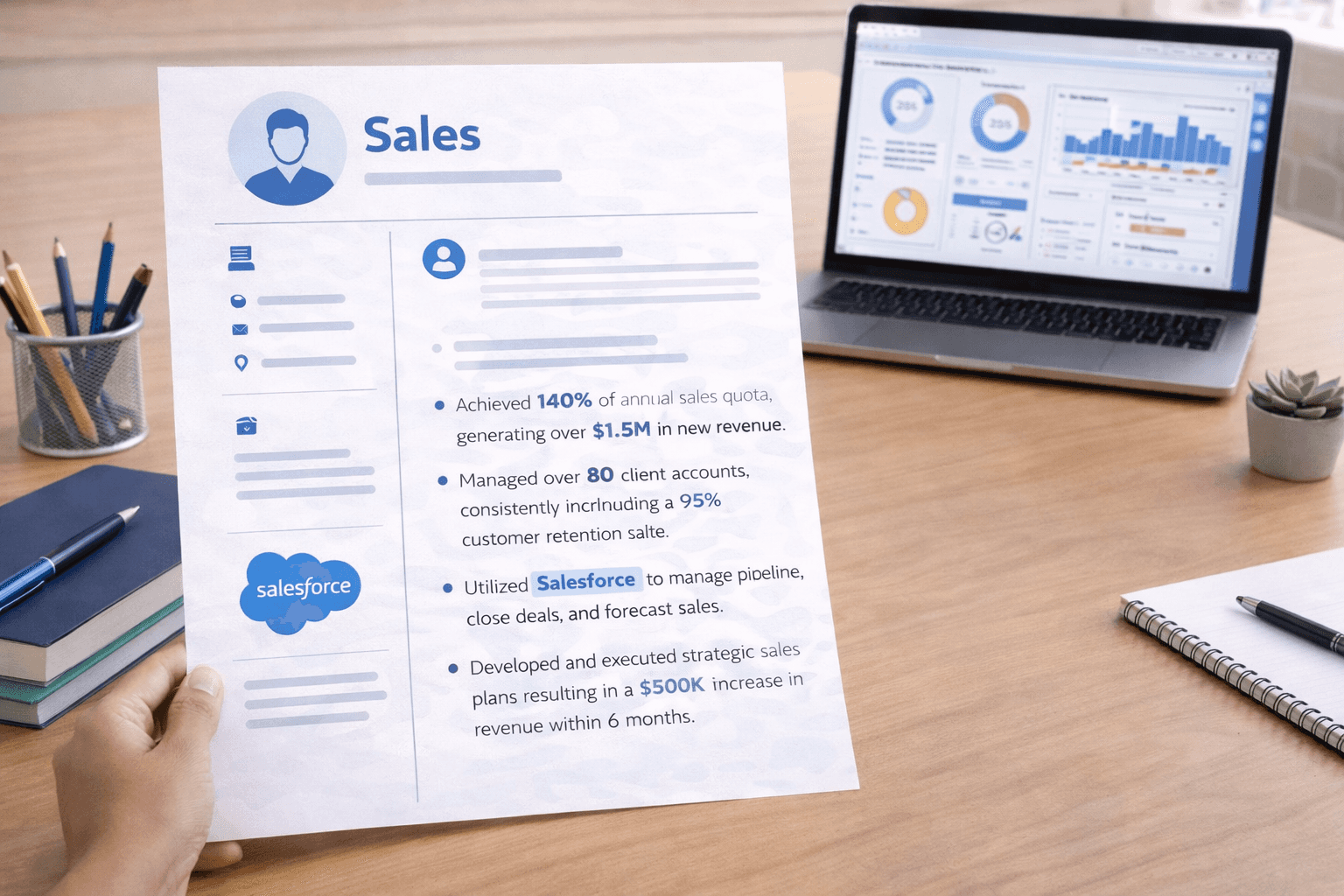
Sales resumes are different. When a hiring manager opens one, they're not just evaluating credentials — they're watching a sales pitch unfold. If your resume can't sell you in six seconds, how will you close a $200K deal?
In 2026, sales hiring has become more data-driven. Recruiters expect to see quota attainment percentages, revenue generated, pipeline metrics, and win rates — not vague claims about being a "motivated self-starter." ATS systems screen for industry-specific keywords like "Salesforce," "cold calling," "enterprise sales," and "account management[3]." And hiring managers increasingly filter candidates based on whether they can demonstrate measurable impact in their previous roles.
This guide shows you exactly how to build a sales resume that converts — whether you're in B2B SaaS, medical device sales, real estate, retail, or any other sales vertical.
What Makes a Sales Resume Different?
Sales resumes require a different structure than most other professions because sales is one of the few roles where your results are 100% measurable. A software engineer can't easily quantify how many bugs they prevented. A designer can't put an exact dollar figure on brand impact. But a sales professional? Every closed deal, every quota achievement, every account expansion — it's all trackable.
That's why the best sales resumes focus heavily on:
- Revenue metrics: Total sales, quota attainment %, year-over-year growth
- Deal size and volume: Average contract value, number of deals closed per quarter
- Ranking and recognition: Top 5% of team, President's Club, awards
- Process improvements: Changes you made that increased conversion rates or shortened sales cycles
Unlike other resumes where you might lead with responsibilities, sales resumes should lead with results. Don't say "Managed a portfolio of 50+ enterprise accounts." Say "Managed 50+ enterprise accounts generating $2.3M ARR, achieving 128% of quota for three consecutive quarters."
Resume Format: Reverse-Chronological is King
Sales hiring managers want to see your track record — how you've performed at each company, whether your numbers have grown over time, and if you've consistently hit quota. The reverse-chronological format (most recent job first) is the only format that makes sense for sales roles.
Avoid functional resumes (organized by skill rather than job) or hybrid formats. Sales managers will assume you're hiding poor performance or job-hopping issues. Stick to reverse-chronological and let your numbers tell the story.
Structure Overview
[Header: Name, Title, Contact Info, LinkedIn]
[Professional Summary: 3-4 lines with top achievements]
[Work Experience: Reverse-chronological with metrics]
[Skills: Sales tools, CRM platforms, industry knowledge]
[Education & Certifications]
Keep it to one page if you have less than 10 years of experience. Two pages is acceptable for senior sales leaders (VP of Sales, Director) or enterprise reps with 15+ years of complex deal history.
The Professional Summary: Your Elevator Pitch
The summary section at the top of your sales resume is your elevator pitch. You have 3-4 lines to make the case for why you're worth interviewing. This is where you highlight your most impressive metrics, your specialty, and the value you bring.
Bad example:
Experienced sales professional with excellent communication skills and a proven track record of exceeding goals. Passionate about building relationships and helping clients succeed.
This says nothing measurable. "Proven track record" without proof is a red flag. "Excellent communication skills" is table stakes for any sales role.
Good example:
Enterprise SaaS Account Executive with 6+ years driving $8M+ in annual revenue across mid-market and Fortune 500 accounts. Consistently ranked in top 10% of sales org (150+ reps), achieving 135% average quota attainment. Expertise in consultative selling, multi-threaded enterprise deals, and Salesforce pipeline management.
This version immediately establishes credibility with hard numbers, context (enterprise SaaS), and relevant skills (consultative selling, enterprise deals).
Summary Formula for Sales Resumes
- Role + Years: "Enterprise Account Executive with 6+ years..."
- Revenue or Impact: "...driving $8M+ in annual revenue..."
- Proof of Excellence: "...consistently ranked in top 10%, achieving 135% quota..."
- Relevant Skills/Specialization: "...expertise in consultative selling and multi-threaded enterprise deals."
Work Experience: Metrics, Metrics, Metrics
This is the most important section of your sales resume. Every bullet point should include a number. If you can't quantify it, it probably doesn't belong on a sales resume.
What to Include in Each Bullet
- Revenue generated: Total sales, ARR, ACV
- Quota attainment: Percentage of quota achieved each year
- Ranking: Where you placed relative to peers (top 5%, #2 out of 40 reps, etc.)
- Deal metrics: Number of deals closed, average deal size, largest deal closed
- Pipeline metrics: Pipeline value, conversion rates, sales cycle length
- Growth: Year-over-year revenue growth, territory expansion, account upsells
Examples by Sales Role:
Learn how to quantify achievements with numbers.
B2B SaaS Account Executive:
• Generated $2.1M in new ARR across 18 enterprise accounts, achieving 142% of $1.5M quota (FY 2025)
• Ranked #3 out of 45 AEs company-wide; promoted to Enterprise segment after 14 months
• Closed largest deal in company history: $385K ACV with Fortune 100 financial services firm
• Maintained 52% win rate on qualified opportunities, 15% above team average
Medical Device Sales Representative:
• Exceeded sales quota by 118% in FY 2025, generating $1.8M revenue across 85 hospital accounts
• Grew territory revenue 34% YoY by expanding into 12 new hospital systems
• Achieved 92% product adoption rate among existing accounts through clinical training programs
• Ranked Top 10 nationally out of 200+ field reps for Q3 and Q4 2025
Inside Sales Representative (SDR/BDR):
• Generated 220+ qualified opportunities for Enterprise AE team, 135% of annual target
• Maintained 28% meeting-set rate from cold outreach (18% team average)
• Sourced $4.2M in pipeline value through multi-channel prospecting (cold calls, email, LinkedIn)
• Promoted to Account Executive after 11 months (average tenure: 18 months)
Real Estate Agent:
• Closed $12.5M in residential sales across 32 transactions (2025)
• Averaged 45 days to close, 22% faster than market average
• Built buyer pipeline of 80+ qualified leads through referrals and digital marketing
• Consistently ranked in top 5% of agents at Keller Williams office (120+ agents)
The Formula for Strong Sales Bullets
[Action Verb] + [What You Did] + [Metric/Result] + [Context]
Example: "Generated $2.1M in new ARR across 18 enterprise accounts, achieving 142% of quota (FY 2025)"
- Action verb: Generated
- What you did: $2.1M in new ARR
- Metric: 142% of quota
- Context: 18 enterprise accounts, FY 2025
Skills Section: Tools, Techniques, and Industries
Sales skills fall into three categories on your resume:
1. Sales Tools & CRM Platforms
ATS systems scan for these tools heavily[2]. Include any you've used professionally:
- CRM: Salesforce, HubSpot, Microsoft Dynamics, Pipedrive, Zoho CRM
- Sales Engagement: Outreach, SalesLoft, Apollo, Gong, Chorus
- Prospecting: LinkedIn Sales Navigator, ZoomInfo, Clearbit, Hunter.io
- Presentation/Demo: Zoom, Demodesk, Vidyard
2. Sales Methodologies
If you've been formally trained or have experience with recognized sales frameworks, list them:
- MEDDIC / MEDDPICC
- Challenger Sale
- SPIN Selling
- Sandler Sales
- Solution Selling
- Consultative Selling
- Value-Based Selling
3. Industry or Product Knowledge
If you've sold in a specialized industry, list it. Hiring managers often filter for candidates who already know the space:
- B2B SaaS / Cloud Infrastructure
- Medical Devices / Healthcare IT
- Financial Services / Fintech
- Cybersecurity / Enterprise Software
- Manufacturing / Industrial Equipment
- Telecommunications
Education and Certifications
Sales is one of the few fields where formal education matters less than performance. You don't need an MBA to be a top sales rep. That said, include your degree if you have one — especially if it's from a well-known school — but keep it brief.
Example:
Bachelor of Business Administration
University of Texas at Austin | Graduated 2019
If you don't have a degree, skip this section entirely or replace it with relevant certifications:
- Salesforce Certified Administrator
- HubSpot Sales Software Certification
- Sandler Sales Training
- Challenger Sale Certified
ATS Optimization for Sales Resumes
Most companies use ATS software to screen sales resumes before a human ever sees them[1]. Here's how to get past the bots:
Use Keywords from the Job Description
If the job posting mentions "enterprise sales," "cold calling," "Salesforce," or "consultative selling," make sure those exact phrases appear in your resume — especially in the skills section and work experience bullets.
Avoid Tables, Images, and Graphics
ATS systems can't read tables, text boxes, or graphics. Stick to plain text with standard section headings (Work Experience, Skills, Education).
Use Standard Job Titles
If your official title was "Customer Success Ninja" or "Revenue Growth Specialist," translate it to something recognizable: "Account Executive" or "Sales Representative." You can add the official title in parentheses if needed.
Save as .docx or PDF
Most ATS systems handle .docx and PDF well. Avoid .pages, .txt, or image files.
Want to see how your resume scores before you apply? Run it through ResumeBold's free ATS checker to get a breakdown of keyword matches, formatting issues, and suggested improvements.
Common Sales Resume Mistakes
1. Listing Responsibilities Instead of Results
Wrong: "Responsible for managing a book of 40 accounts and conducting product demos."
Right: "Managed 40 mid-market accounts generating $1.2M ARR; delivered 80+ product demos with 38% conversion to close."
2. Using Vague Language
"Exceeded expectations," "consistently high performer," "proven track record" — these mean nothing without numbers. Always quantify.
3. Focusing on Activities Instead of Outcomes
Wrong: "Made 60+ cold calls per day."
Right: "Generated 15+ qualified meetings per month through cold outreach, contributing to $800K in closed revenue."
4. Ignoring Quota Context
Saying "Generated $1.5M in sales" sounds good — but if your quota was $2M, you underperformed. Always include quota attainment percentage.
5. Overloading with Jargon
Sales has a lot of internal lingo (land-and-expand, whitespace analysis, champion mapping). Use it sparingly. Stick to metrics that any hiring manager will understand: revenue, quota %, win rate, deals closed.
Sales Resume Checklist
Before you submit, verify:
- ☑ Every work experience bullet includes at least one number
- ☑ You've included quota attainment % for each role
- ☑ You've listed total revenue generated or pipeline sourced
- ☑ You've mentioned ranking or awards if applicable
- ☑ You've included relevant CRM tools (Salesforce, HubSpot, etc.)
- ☑ Your summary section leads with your most impressive metric
- ☑ You've matched keywords from the job description
- ☑ You've kept it to 1 page (or 2 pages if 10+ years experience)
- ☑ You've used a standard reverse-chronological format
- ☑ You've removed any vague language like "team player" or "hard worker"
Final Thought: Your Resume is Your First Deal
Think of your sales resume as your first sales pitch to the hiring manager. You're the product. The resume is the demo. The interview is the close.
If you can't sell yourself on paper — with clear value propositions, measurable results, and a compelling narrative — why would they trust you to sell their product?
Make every bullet count. Lead with numbers. Show progression. And remember: in sales, results speak louder than buzzwords.
Need help optimizing your sales resume for ATS? Try ResumeBold's AI resume builder — it's designed specifically for high-performance sales roles and automatically formats your achievements in the metrics-driven style that hiring managers expect.
References
- SHRM. (2024). Resume Keyword Matching in Applicant Tracking Systems. Retrieved from https://www.shrm.org/topics-tools/news/talent-acquisition
- SHRM. (2024). Resume Keyword Matching in Applicant Tracking Systems. Retrieved from https://www.shrm.org/topics-tools/news/talent-acquisition
- SHRM. (2024). Resume Keyword Matching in Applicant Tracking Systems. Retrieved from https://www.shrm.org/topics-tools/news/talent-acquisition
Ready to optimize your resume?
Check My ATS Score Free
Check My ATS Score Free