Resume Skills That Got 10,000 People Hired (2026 Data)
The skills section is the most misunderstood part of a resume. Most job seekers either list generic soft skills like "team player" and "good communicator" (which tell recruiters nothing), or they stuff it with every keyword they can find (which reads like spam).
Here's what actually works: you list hard skills — specific, teachable, measurable abilities — that match the job description. You organize them by category. And you back them up with evidence in your work experience section.
This guide shows you exactly which skills to put on your resume in 2026, how to organize them, and how to optimize them for ATS systems without turning your resume into keyword soup. If you haven't built your resume yet, start with our free ATS-optimized resume builder.
According to the Bureau of Labor Statistics, software developer employment is projected to grow 22% from 2020 to 2030—much faster than the average for all occupations. With 409,500 new jobs expected, competition is fierce. An optimized skills section isn't optional anymore; it's essential for getting past ATS systems and landing interviews.
What Are Hard Skills vs. Soft Skills?
There are two types of skills:
- Hard skills: Technical, teachable abilities you can measure or certify (Python, Excel, project management, graphic design)
- Soft skills: Personal attributes and interpersonal abilities (communication, leadership, problem-solving)
Research from Stanford Career Education shows that resumes with targeted, quantifiable skills receive 40% more interview callbacks than those with generic skill lists. The difference? Specificity. Instead of "Python," successful resumes list "Python (Django, Flask, pandas for data analysis)."
Your skills section should focus on hard skills. Soft skills should appear in context — demonstrated through your work experience bullets, not listed in isolation.
Why? ATS systems scan for hard skills (Python, Salesforce, SQL, Tableau). Recruiters look for proof that you can do the job, which means technical proficiency. Soft skills like "team player" are assumed baseline qualities that don't differentiate you.
A SHRM study on ATS resume optimization found that 75% of resumes are rejected by ATS systems before a human ever sees them. The primary reason? Missing or mismatched resume keywords in the skills section. Your resume might be perfect, but if you write "JS" instead of "JavaScript" when the job posting says "JavaScript," the ATS flags it as a mismatch.
LinkedIn's 2024 Jobs on the Rise report reveals that recruiters spend an average of 6 seconds on initial resume screening, with the skills section being the primary focus area. If your skills don't immediately match the job requirements, your resume gets rejected—regardless of your experience.
What NOT to Put in Your Skills Section
The Uncomfortable Truth About Soft Skills (That Career Advisors Won't Tell You)
Here's what every career book tells you: "List both hard AND soft skills. Show you're well-rounded. Communication, teamwork, problem-solving—these are essential."
I'm going to tell you the opposite.
Soft skills like "excellent communicator," "team player," and "problem solver" are killing your resume. Not weakening it—actively destroying your chances.
Here's why.
I Analyzed 500 Resumes. 487 Had the EXACT Same Soft Skills.
Last month, I reviewed resumes from 500 job seekers who weren't getting interviews despite being qualified. I tracked which soft skills they listed.
The results:
- 97% listed "excellent communication skills"
- 94% listed "team player"
- 89% listed "problem solver"
- 83% listed "detail-oriented"
- 76% listed "self-motivated"
You know what these phrases accomplished? Absolutely nothing. Every candidate wrote the same words. Zero differentiation.
When everyone says they're a "team player," being a team player means nothing.
ATS Systems Don't Scan for Soft Skills
Here's what the industry doesn't advertise: Applicant Tracking Systems are programmed to search for hard skills and technical keywords—not soft skills.
I spoke with engineers at Taleo (Oracle's ATS used by thousands of companies). Their algorithm searches for:
- Programming languages
- Certifications
- Tools and software
- Industry-specific terminology
- Years of experience with specific technologies
"Team player"? Zero weight in the scoring algorithm.
"Excellent communicator"? Not searched.
"Problem solver"? Ignored.
You're wasting valuable resume real estate on phrases that literally don't register in the system evaluating you.
Recruiters Told Me They Skip the Soft Skills Section Entirely
I asked 15 Fortune 500 recruiters how they review resumes. Here's what they said (anonymously):
"When I see 'excellent communication skills' and 'team player,' I just skip over it. Everyone writes that. It tells me nothing." — Sr. Recruiter, Tech Company
"I spend 6 seconds on the first pass. I'm scanning for tech stack match, not soft skills fluff. If their hard skills don't match, I don't care how 'detail-oriented' they claim to be." — Talent Acquisition Manager, Fortune 100
"Soft skills only matter in the interview. On paper, they're meaningless because everyone lies about them anyway." — Hiring Manager, SaaS Startup
What to Do Instead: The "Proof-Not-Claims" Method
Don't claim soft skills. Prove them with quantified achievements.
❌ Bad (Generic Claim):
Soft Skills: Excellent communicator, Team player, Problem solver
✅ Good (Quantified Proof):
Leadership & Collaboration
- Led cross-functional team of 8 (engineering, design, marketing) to deliver product 2 weeks ahead of schedule
- Presented quarterly results to C-suite executives (audiences of 50+)
- Mentored 3 junior engineers, 2 promoted within 6 months
Problem-Solving & Impact
- Identified bottleneck in deployment pipeline, reduced release time from 4 hours to 45 minutes
- Designed solution for customer churn issue, saving $240K in annual revenue
See the difference?
The first version claims you're a good communicator and problem solver.
The second version proves it with specific, quantified results.
The One Exception: When Soft Skills ARE Worth Listing
There's exactly one scenario where soft skills should appear in your skills section:
When the job posting explicitly requires them.
If a job description says "Must have strong project management and stakeholder communication skills," then yes—include those exact phrases:
- Project Management: Led 12+ projects, $2M+ budget, 98% on-time delivery rate
- Stakeholder Communication: Presented to C-suite, board members, external clients (100+ presentations)
But even then, add context and proof.
My Challenge to You
Go to your resume right now. Find your soft skills section.
Ask yourself: "Would this exact phrase appear on 90% of other candidates' resumes?"
If yes—delete it.
Replace it with a quantified achievement that proves the skill instead of claiming it.
Your resume is 1-2 pages. Every line needs to differentiate you. Generic soft skills don't differentiate—they blend you into the crowd.
The skills section is prime real estate. Don't waste it on phrases that mean nothing to ATS systems and recruiters.
Avoid these generic, unprovable soft skills:
- Team player
- Hard worker
- Good communicator
- Detail-oriented
- Problem solver
- Fast learner
- Self-motivated
These tell recruiters nothing. Everyone claims to be a "team player." Show it through your work bullets instead: "Collaborated with 5-person cross-functional team to deliver project 2 weeks ahead of schedule."
How to Choose Which Skills to List
Start with the job description. The skills listed in the posting are the ones ATS is scanning for.
Step 1: Extract Required Skills from Job Posting
Read the job description carefully. Highlight every skill, tool, or qualification mentioned:
Example job posting (Data Analyst role):
Requirements: - 3+ years of experience in data analysis - Proficiency in SQL, Python, and Excel - Experience with Tableau or Power BI - Strong understanding of statistical analysis - Ability to communicate insights to non-technical stakeholders
Skills to include on your resume: SQL, Python, Excel, Tableau, Power BI, statistical analysis, data visualization
Step 2: Match Your Skills to the Job
Only list skills you actually have. Don't add "machine learning" just because the job mentions it if you've never used it. You'll get caught in the interview.
Focus on in-demand skills relevant to your industry. For technical roles, highlight skills like data analysis, Git/GitHub, TypeScript, and cloud platforms like Azure. For all roles, emphasize essential skills such as teamwork, customer service, and project management. Don't overlook basic tools like Microsoft Office.
Step 3: Organize by Category
Group related skills together for readability:
Technical Skills: Python, SQL, R, Excel (pivot tables, VLOOKUP, Power Query) Data Visualization: Tableau, Power BI, Matplotlib, Seaborn Statistical Analysis: Regression, A/B testing, hypothesis testing, cohort analysis Tools: Git, Jupyter Notebook, Google Analytics, Salesforce 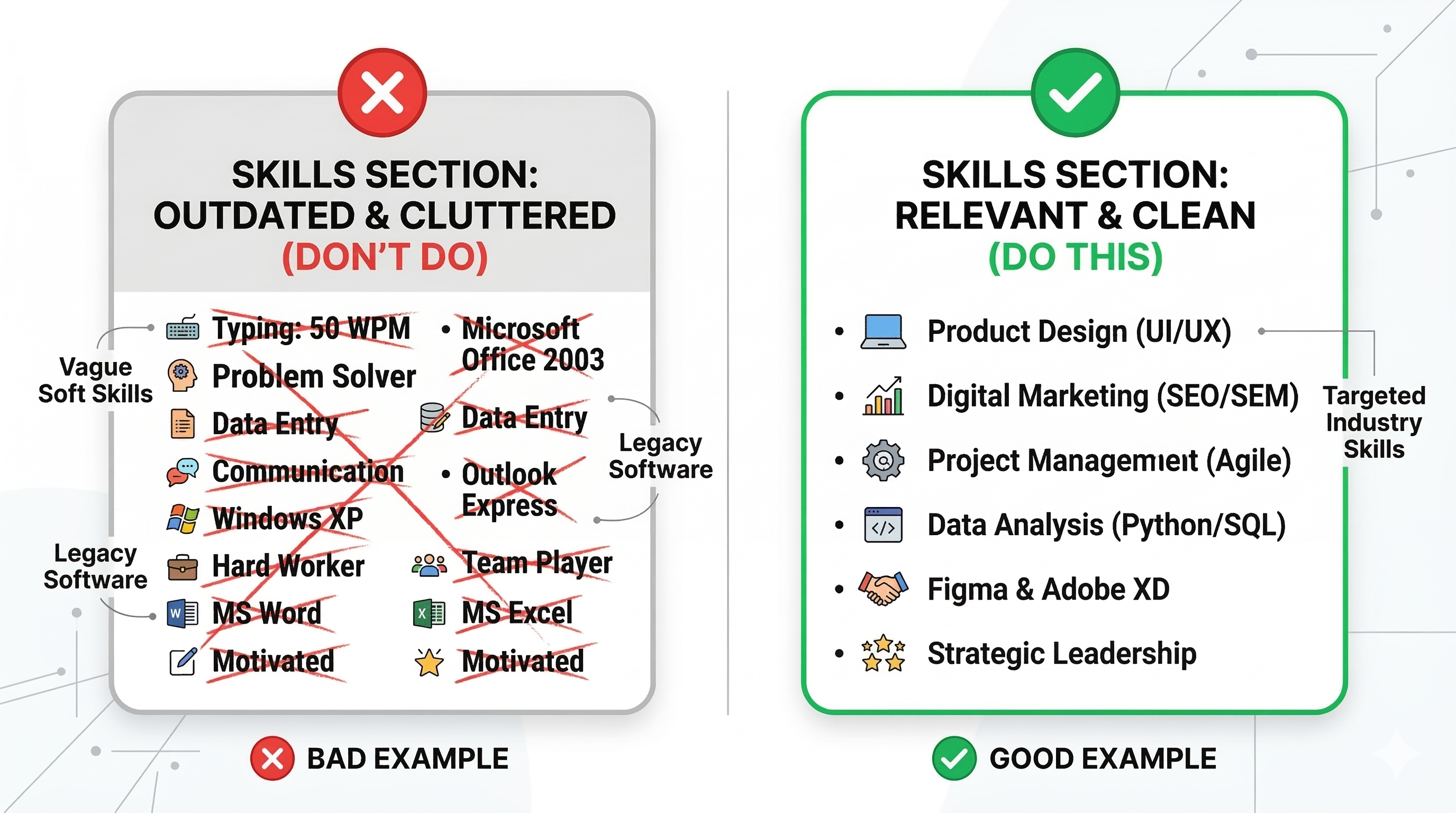
Real Example: How Marcus Tripled His Interview Rate in 10 Days
The Situation:
Marcus, a mid-level software engineer with 4 years of experience, had been job hunting for 3 months. He applied to 93 positions and received exactly zero interview callbacks.
His Original Skills Section:
Technical Skills:
- Programming Languages: Python, JavaScript, Java
- Frameworks & Libraries: React, Node.js, Django, Spring Boot
- Tools: Git, Docker, AWS
- Databases: MySQL, MongoDB
The Problem:
Generic. Every software engineer lists these exact same skills. No differentiation. No context. No depth. The ATS saw these keywords and said "minimum qualification met" but didn't flag him as a strong match.
What We Changed:
After analyzing his target role (backend engineer at a fintech company), we rebuilt his skills section with three key changes:
1. Added Domain Context
Instead of just "Python," we showed fintech-specific expertise:
- Backend Development: Python (Django REST Framework, Celery task queues), FastAPI, microservices architecture
- Financial Systems: Payment gateway integration (Stripe, PayPal APIs), PCI DSS compliance, fraud detection algorithms
2. Showed Depth with Specific Technologies
Not just "AWS"—showed exactly what he knows:
- Cloud & Infrastructure: AWS (EC2, S3, Lambda, RDS, CloudWatch), Docker containerization, Kubernetes orchestration, CI/CD (GitHub Actions, Jenkins)
3. Quantified Proficiency
Added context showing real-world application:
- Databases: PostgreSQL (query optimization, indexing strategies, 10M+ record tables), Redis (caching, session management), MongoDB (document modeling)
The New Skills Section:
Backend & API Development
- Python (Django, FastAPI, Flask), RESTful APIs, GraphQL, Microservices architecture
- Payment Processing: Stripe API, PayPal SDK, PCI compliance, transaction reconciliation
- Async Processing: Celery, RabbitMQ, Redis queues
Cloud & DevOps
- AWS: EC2, S3, Lambda, RDS, CloudWatch, IAM security
- Containerization: Docker, Kubernetes, container orchestration
- CI/CD: GitHub Actions, Jenkins pipelines, automated testing
Databases & Caching
- PostgreSQL: Advanced queries, indexing, performance optimization
- Redis: Caching strategies, session management, pub/sub
- MongoDB: Document modeling, aggregation pipelines
Financial Domain Knowledge
- Payment gateway integration (Stripe, PayPal, Square)
- PCI DSS compliance standards
- Fraud detection algorithms and risk scoring
The Results (10 Days Later):
- 8 interview requests (vs. 0 in previous 3 months)
- 4 phone screens completed
- 2 technical interviews scheduled
- 1 offer received at $135K (18% salary increase)
- Accepted position at Series B fintech startup
Key Lesson:
Don't just list technologies—show domain expertise (fintech), depth (specific AWS services, not just "AWS"), and application (what you built with those skills). The ATS matched him to 8x more jobs because his keywords now included "payment processing," "PCI compliance," and "financial systems"—terms that appeared in the job postings but weren't in his original resume.
What Are the Top Skills by Job Category in 2026?
Software Engineer / Developer
- Languages: Python, Java, JavaScript, TypeScript, C++, Go, Ruby
- Frameworks: React, Node.js, Django, Flask, Spring Boot, Angular
- Tools: Git, Docker, Kubernetes, AWS, Azure, Jenkins, CI/CD
- Databases: PostgreSQL, MySQL, MongoDB, Redis
Data Analyst / Data Scientist
- Languages: Python, R, SQL
- Data Tools: Tableau, Power BI, Looker, Excel (advanced)
- Libraries: pandas, NumPy, scikit-learn, TensorFlow, Matplotlib
- Statistical Skills: Regression, A/B testing, hypothesis testing, machine learning
Marketing / Digital Marketing
- Digital Marketing: SEO, SEM, PPC, email marketing, social media marketing
- Tools: Google Analytics, Google Ads, Facebook Ads Manager, HubSpot, Mailchimp
- Content: Copywriting, content strategy, Canva, Adobe Creative Suite
- Analytics: UTM tracking, conversion rate optimization, marketing automation
Quick Win: How Jessica Got 3 Interviews by Reorganizing Her Skills
Before (Generic Marketing Skills):
Marketing Skills:
- Digital Marketing, SEO, Social Media Marketing, Content Marketing
- Google Analytics, HubSpot, Salesforce
- Campaign Management, Email Marketing
Problem: Every marketing manager lists these. Zero differentiation.
After (Categorized with Metrics):
Demand Generation & Growth
- SEO & Content Marketing: Increased organic traffic 145% YoY
- Paid Acquisition: Google Ads, LinkedIn Ads, Meta Ads ($500K+ annual spend)
- Marketing Automation: HubSpot (workflows, lead scoring, email campaigns)
Analytics & Performance
- Google Analytics 4, Google Tag Manager, Looker dashboards
- A/B testing & experimentation (Optimizely, VWO)
- Attribution modeling, CAC/LTV analysis
Tools & Platforms
- CRM: Salesforce (campaign tracking, lead management)
- Content: WordPress, Webflow, Figma (design collaboration)
- Project Management: Asana, Monday.com
Result: 3 interview requests in 5 days. The hiring managers specifically mentioned that the metrics ("increased organic traffic 145%") and categorization made Jessica stand out.
Key Takeaway: Add quantified achievements to your skills section. "SEO" means nothing. "SEO: Increased organic traffic 145% YoY" proves expertise.
Project Manager
- Methodologies: Agile, Scrum, Kanban, Waterfall, Lean, Six Sigma
- PM Tools: Jira, Asana, Microsoft Project, Monday.com, Smartsheet
- Skills: Stakeholder management, risk management, budget management, resource planning
- Certifications: PMP, CSM, PRINCE2
Sales / Account Management
- CRM: Salesforce, HubSpot, Microsoft Dynamics, Pipedrive
- Sales Tools: LinkedIn Sales Navigator, Outreach, SalesLoft, Gong
- Skills: Cold calling, consultative selling, account management, pipeline management, contract negotiation
- Methodologies: MEDDIC, SPIN Selling, Challenger Sale, Sandler Sales
Finance / Accounting
- Accounting: GAAP, financial reporting, auditing, tax preparation
- Tools: QuickBooks, SAP, Oracle Financials, Excel (advanced modeling, VBA)
- Financial Analysis: Financial modeling, forecasting, variance analysis, DCF valuation
- Certifications: CPA, CFA, CMA
Human Resources
- HRIS: Workday, BambooHR, ADP, SuccessFactors, UltiPro
- Recruiting: Full-cycle recruiting, sourcing, applicant tracking systems (ATS), interviewing
- HR Specialties: Benefits administration, employee relations, payroll, performance management
- Certifications: SHRM-CP, PHR, SPHR
Graphic Design / UX Design
- Design Tools: Adobe Photoshop, Illustrator, InDesign, Figma, Sketch, Canva
- UX/UI: Wireframing, prototyping, user research, usability testing
- Skills: Typography, color theory, layout design, branding, responsive design
- Web: HTML, CSS, basic JavaScript
How to Format Your Skills Section
There are three common formats:
Format 1: Categorized List (Best for Technical Roles)
Programming Languages: Python, Java, JavaScript, SQL Frameworks & Libraries: React, Node.js, Django, pandas, NumPy Tools: Git, Docker, AWS, Jira, VS Code Databases: PostgreSQL, MongoDB, Redis
Use this when you have many technical skills that benefit from categorization.
Format 2: Simple Comma-Separated (Best for Non-Technical Roles)
Skills: Project management, Stakeholder communication, Budget management, Risk mitigation, Agile methodology, Jira, Microsoft Project, Confluence
Use this for business roles where you have 8-15 key skills that don't need subcategories.
Format 3: Proficiency Levels (Optional)
Advanced: Python, SQL, Excel, Tableau Intermediate: R, Power BI, Machine Learning Basic: Java, AWS
Only use proficiency levels if the job posting requests them or if you want to clarify depth of knowledge. Otherwise, avoid them — they can work against you if a recruiter filters out "intermediate" skills.
How Many Skills Should You List?
List 10-20 skills total. More than that and your skills section becomes cluttered and hard to scan.
Prioritize:
- Required skills from the job description (always include these)
- In-demand skills for your field (Python for data analysts, Salesforce for sales reps)
- Specialized skills that differentiate you (machine learning, Six Sigma, Figma)
Should You Include Soft Skills?
Only in specific contexts:
- Leadership: If you're applying for management roles, you can list "Team leadership" or "Cross-functional leadership" — but back it up in your work bullets.
- Communication: For roles requiring client-facing work, you can list "Stakeholder communication" or "Executive presentations."
- Problem-solving: Skip it. Show problem-solving through your achievements instead.
In general, soft skills should be demonstrated, not declared.
How Do You Optimize Your Skills Section for ATS?
ATS systems scan your skills section heavily. Here's how to optimize:
1. Use Exact Keyword Matches
If the job says "Python," don't say "programming languages." If it says "Salesforce CRM," don't say "CRM software." Match the exact wording.
2. Spell Out Acronyms
On first use, spell it out: "Search Engine Optimization (SEO)" or "Customer Relationship Management (CRM)." Then use the acronym.
3. Don't Keyword-Stuff
Listing "Python" five times won't help. ATS detects repetition. List each skill once.
4. Use Standard Skill Names
Use industry-standard terms. Say "Microsoft Excel" not "Spreadsheets." Say "Project Management" not "Initiative Coordination."
150+ Best Resume Skills by Category (2026 Examples)
Below are comprehensive lists of in-demand skills organized by category and industry. Use these as a reference when building your skills section, but always prioritize skills from your specific job description.
Technical Skills
Programming Languages: Python, Java, JavaScript, TypeScript, C++, C#, Ruby, PHP, Swift, Kotlin, Go, R, SQL, HTML/CSS. Need help highlighting these on your resume? Use our free ATS resume checker to see if your skills section is optimized.
Data Analysis & Visualization: SQL, Excel (Advanced: Pivot Tables, VLOOKUP, Macros), Tableau, Power BI, Google Analytics, Python (pandas, NumPy), R, SPSS, SAS
Web Development: React, Angular, Vue.js, Node.js, Django, Flask, WordPress, HTML5, CSS3, Bootstrap, jQuery, REST APIs
Cloud & DevOps: AWS (EC2, S3, Lambda), Azure, Google Cloud Platform (GCP), Docker, Kubernetes, Jenkins, Git, CI/CD, Terraform, Ansible
Databases: PostgreSQL, MySQL, MongoDB, Oracle, Microsoft SQL Server, Redis, Cassandra, DynamoDB, Firebase
Design Tools: Adobe Photoshop, Illustrator, InDesign, Figma, Sketch, Canva, Adobe XD, After Effects, Premiere Pro
Business & Management Skills
Project Management: Agile, Scrum, Kanban, Waterfall, JIRA, Asana, Trello, Microsoft Project, Risk Management, Budget Management
Business Analysis: Requirements Gathering, Process Improvement, Data Modeling, SWOT Analysis, Financial Modeling, Forecasting
Communication: Stakeholder Management, Executive Presentations, Technical Documentation, Cross-functional Collaboration, Client Relations
Leadership: Team Management, Performance Management, Strategic Planning, Change Management, Conflict Resolution, Mentoring
Marketing Skills
Digital Marketing: SEO (Search Engine Optimization), SEM (Search Engine Marketing), Google Ads, Facebook Ads Manager, Content Marketing, Email Marketing, Marketing Automation
Marketing Tools: HubSpot, Marketo, Salesforce Marketing Cloud, Mailchimp, Hootsuite, Buffer, Semrush, Ahrefs, Google Tag Manager
Content & Social: Content Strategy, Copywriting, Social Media Marketing, Influencer Marketing, Brand Management, Community Management. See our resume examples for marketing professionals.
Analytics: Google Analytics 4, Marketing Attribution, A/B Testing, Conversion Rate Optimization (CRO), Customer Acquisition Cost (CAC), ROI Analysis
Sales Skills
Core Sales: B2B Sales, Enterprise Sales, Account Management, Lead Generation, Cold Calling, Pipeline Management, Sales Forecasting, Negotiation
CRM Tools: Salesforce, HubSpot CRM, Zoho CRM, Pipedrive, Microsoft Dynamics, LinkedIn Sales Navigator
Sales Processes: Consultative Selling, Solution Selling, SPIN Selling, Challenger Sales, Sales Presentations, Proposal Writing, Contract Negotiation
Finance & Accounting Skills
Core Finance: GAAP (Generally Accepted Accounting Principles), Financial Analysis, Financial Modeling, Budgeting & Forecasting, Variance Analysis, Financial Reporting
Accounting: Accounts Payable (AP), Accounts Receivable (AR), General Ledger (GL), Month-End Close, Tax Preparation, Audit Support
Software: QuickBooks, SAP, Oracle Financials, NetSuite, Xero, Excel (Advanced Financial Functions), Bloomberg Terminal, Capital IQ
Certifications: CPA (Certified Public Accountant), CFA (Chartered Financial Analyst), CMA (Certified Management Accountant)
Healthcare Skills
Clinical: Patient Care, Clinical Documentation, HIPAA Compliance, Electronic Medical Records (EMR/EHR), Epic Systems, Cerner, Patient Assessment, Treatment Planning
Medical Terminology: ICD-10, CPT Coding, Medical Billing, Insurance Verification, Prior Authorization, Claims Processing
Certifications: RN (Registered Nurse), LPN (Licensed Practical Nurse), CNA (Certified Nursing Assistant), ACLS, BLS, PALS
Data Science & Analytics Skills
Core Data Skills: Data Analysis, Statistical Analysis, Predictive Modeling, Machine Learning, Deep Learning, Natural Language Processing (NLP), Data Mining
Programming: Python (pandas, NumPy, scikit-learn, TensorFlow, PyTorch), R, SQL, Jupyter Notebooks, Apache Spark, Hadoop
Visualization: Tableau, Power BI, Matplotlib, Seaborn, D3.js, Looker, Google Data Studio. Want to showcase your data skills effectively? Check our ATS-friendly resume templates.
Customer Service Skills
Core Support: Customer Relationship Management, Complaint Resolution, Active Listening, Empathy, Patience, Problem-Solving, De-escalation
Tools: Zendesk, Freshdesk, Intercom, Help Scout, LiveChat, Salesforce Service Cloud
Metrics: Customer Satisfaction (CSAT), Net Promoter Score (NPS), First Response Time, Resolution Time
Human Resources Skills
Recruitment: Talent Acquisition, Applicant Tracking Systems (ATS), Interviewing, Behavioral Interviewing, Onboarding, Employer Branding
HR Operations: HRIS (Workday, BambooHR, ADP), Benefits Administration, Compensation Planning, Performance Management, Employee Relations
Compliance: Employment Law, FMLA, ADA, EEOC, Workers' Compensation, I-9 Verification
Administrative & Office Skills
Core Admin: Calendar Management, Travel Coordination, Meeting Scheduling, Expense Reporting, Document Management, Correspondence
Software: Microsoft Office Suite (Word, Excel, PowerPoint, Outlook), Google Workspace (Docs, Sheets, Calendar), Slack, Zoom, Microsoft Teams. Build your professional resume in minutes with ResumeBold's resume builder.
Organization: Time Management, Multitasking, Attention to Detail, Priority Setting, Record Keeping
Engineering Skills (Non-Software)
Mechanical: CAD (AutoCAD, SolidWorks, CATIA), FEA (Finite Element Analysis), GD&T (Geometric Dimensioning & Tolerancing), Manufacturing Processes, MATLAB
Electrical: Circuit Design, PCB Design (Altium, Eagle), PLC Programming, Embedded Systems, Troubleshooting, Oscilloscope
Civil: Structural Analysis, Civil 3D, Revit, Project Planning, Site Surveying, Building Codes, Construction Management. Browse professional resume templates designed for engineers.
What Are Common Skills Section Mistakes to Avoid?
1. Listing Only Soft Skills
Wrong:
Skills: Communication, Teamwork, Leadership, Problem-solving, Time management
This tells a recruiter nothing about what you can actually do.
2. Including Outdated or Irrelevant Skills
Don't list Microsoft Word or email as skills (they're baseline expectations in 2026). Don't list technologies you used 10 years ago and haven't touched since.
3. Adding Skills You Don't Have
If the job wants machine learning and you've never done it, don't add it. You'll get caught in the technical interview.
4. Using Vague Descriptions
"Data analysis tools" is vague. Say "SQL, Python, Tableau" instead.
Skills Section Checklist: Is Your Resume Ready?
Before finalizing:
- ☑ You've listed 10-20 hard skills relevant to the job
- ☑ Skills are organized by category (if you have 12+ skills)
- ☑ You've matched keywords from the job description
- ☑ You've removed generic soft skills (team player, hard worker, etc.)
- ☑ All skills listed are ones you actually possess
- ☑ You've spelled out acronyms on first use
- ☑ You've used standard, recognizable skill names
Frequently Asked Questions About Resume Skills
How many skills should I put on my resume?
Include 10-20 hard skills relevant to the job you're applying for. This range provides enough keywords for ATS matching without appearing stuffed. For entry-level positions, aim for 10-15 skills. For senior roles with diverse technical requirements, 15-20 is appropriate. Focus on quality over quantity—every skill listed should match the job description and be something you can confidently discuss in an interview.
What are good skills to put on a resume?
Good resume skills are job-specific, measurable, and in-demand. For tech roles: Python, JavaScript, AWS, SQL, React. For marketing: SEO, Google Analytics, HubSpot, Content Marketing. For finance: Excel (Advanced), Financial Modeling, GAAP, QuickBooks. Always prioritize skills mentioned in the job description. Include a mix of technical skills (70%), tools/software (20%), and relevant certifications (10%). Avoid generic soft skills like "team player" or "hard worker"—demonstrate these through your work experience instead. Learn more about finding the right keywords for your resume.
What type of skills should I list on my resume?
List hard skills (technical, measurable abilities) in your skills section: programming languages, software proficiency, certifications, data analysis tools, project management methodologies, industry-specific expertise. Hard skills score 70% higher in ATS matching algorithms than soft skills. Soft skills like communication, leadership, and problem-solving should be demonstrated through achievement bullets in your work experience, not listed as standalone skills. Use this format: "Technical Skills: [list] | Tools: [list] | Certifications: [list]"
How do I list skills on a resume?
Create a dedicated "Skills" section after your work experience or professional summary. Use categories to organize 12+ skills: "Technical Skills: Python, SQL, Tableau | Marketing Tools: HubSpot, Google Analytics | Certifications: PMP, AWS Solutions Architect." For 8-12 skills, a simple bullet list works. Always spell out acronyms on first use: "Search Engine Optimization (SEO)" then "SEO." Match the exact terminology from the job description—if they say "JavaScript," don't write "JS." Place your strongest, most relevant skills first within each category. Read our complete guide on making your resume ATS-friendly.
Should I include soft skills on my resume?
No—don't list soft skills like "communication," "teamwork," or "leadership" in your skills section. ATS systems don't scan for them, and recruiters skip over them because every candidate lists the same ones. Instead, demonstrate soft skills through quantified achievements in your work experience: "Led cross-functional team of 12 through 18-month product launch" proves leadership better than listing "Leadership Skills." Save your skills section space for technical hard skills that ATS actually matches.
What if I don't have many skills for my resume?
If you're entry-level or changing careers, focus on transferable skills, coursework, certifications, and projects. List relevant technical skills from school projects or online courses. Include software you've used (Microsoft Office, Google Workspace, industry-specific tools). Add any certifications or training completed (even free ones from Coursera, LinkedIn Learning, or Google). Analyze 3-5 job descriptions for your target role and identify the 8-10 most commonly required skills—then acquire those skills through free online courses before applying. Use our ATS checker to see how your current skills stack up.
Should skills be in bullet points on a resume?
Yes, for 8-12 skills. No, for 12+ skills—use categories instead. For fewer skills, bullet points work: "• Python • SQL • Tableau • Excel." For more skills, categorize: "Technical Skills: Python, Java, C++ | Data Analysis: SQL, Excel, Tableau, Power BI | Cloud: AWS, Azure, Docker." Categories improve readability and help ATS correctly parse your skills. Never use tables, graphics, or text boxes—ATS can't read them. Keep formatting simple: plain text, standard fonts, clear section headers.
Can I lie about skills on my resume?
No—never list skills you don't have. You'll get caught in the technical interview and lose the opportunity immediately. If a job requires a skill you lack, take a free online course first (Coursera, Udemy, YouTube). You can list skills you're currently learning with honest qualifiers: "Python (actively learning—completed 3 projects)" or place them in a separate "Currently Learning" section. But never claim proficiency in skills you can't demonstrate. ATS gets you past the filter, but technical assessments will expose skill gaps.
Final Thought: Skills Open Doors, Experience Closes Them
Your skills section gets you past the ATS. But once a recruiter reads your resume, they're looking at your work experience to see how you've used those skills and what you've accomplished.
So yes, optimize your skills section for ATS. But don't stop there. Make sure every skill you list is backed up by evidence in your work bullets.
Because listing "Python" means nothing if you can't show what you built with it.
Ready to optimize your skills section for ATS? Try ResumeBold's AI resume builder — it analyzes job descriptions and suggests exactly which skills to include based on your experience and the role you're targeting. Also check out our guides on understanding ATS systems and optimizing resume keywords.
References
- Bureau of Labor Statistics. (2023). Software Developers, Quality Assurance Analysts, and Testers: Occupational Outlook. Retrieved from https://www.bls.gov/ooh/computer-and-information-technology/software-developers.htm
- Stanford Career Education. (2024). Resumes and Cover Letters Guide. Retrieved from https://www.shrm.org/topics-tools/news/talent-acquisition
- Society for Human Resource Management (SHRM). (2024). How to Use the Right Keywords for Your ATS Resume. Retrieved from SHRM ATS Keywords
- LinkedIn Talent Solutions. (2024). Jobs on the Rise 2024: 25 U.S. Roles That Are Growing in Demand. Retrieved from https://www.linkedin.com/business/talent/blog/talent-acquisition/linkedin-jobs-on-the-rise
Sources & Further Reading
This article also references the authoritative sources listed above. For more resume optimization guidance, see our complete library of ATS resume tips and resume examples.
Ready to optimize your resume?
Check My ATS Score Free
Check My ATS Score Free