15 Resume Tips That Actually Work in 2026
Resume advice has a shelf life.
Tips that worked five years ago — two-page resumes for everyone, objective statements, listing references — are now either irrelevant or actively hurting your chances. And new realities — AI screening, remote-first hiring, ATS everywhere — have changed what a strong resume actually looks like in 2026.
This isn't a generic list of "use action verbs" and "tailor your resume." You already know those. This is about what's specifically different right now — what's changed, what still matters, and what you can stop worrying about.
What's Actually New in 2026
Data-Driven Insights: What Works in 2026
Quick Answer: Use specific keywords from job descriptions, quantify achievements with metrics, mention relevant tools/certifications, and tailor your resume for each application to match 70%+ of required keywords.
Analysis of 12,000 resumes processed through ResumeBold's ATS Checker between January 2025 and May 2026 reveals clear patterns in what separates interview-winning resumes across all industries and experience levels from rejected ones:
- Quantification trumps description: Resumes with 5+ quantified achievements (percentages, dollar amounts, timeframes) received interview requests at 4.2x the rate of resumes with only qualitative descriptions
- One-page vs two-page depends on experience: For candidates with under 7 years experience, one-page resumes scored 23% higher. For 10+ years experience, two-page resumes scored 31% higher — length must match seniority
- Skills section placement matters: Technical roles with skills sections at the top scored 37% higher, while non-technical roles with skills at the bottom scored 28% higher — ATS weighting differs by role type
- Tailoring increases success 3.8x: Resumes customized per application (70%+ keyword match to job description) advanced to interviews at 3.8x the rate of generic "spray and pray" resumes sent to multiple roles
"After reviewing 6,000+ resumes in 2025-2026, the biggest shift I've seen is ATS systems getting smarter about detecting generic resumes. The old advice of 'one resume for all jobs' is dead. Modern ATS can compare your resume against the job description in real-time and assign match scores. A 50% match gets auto-rejected before human eyes see it. The candidates who land interviews aren't the ones with the most experience — they're the ones who take 15 minutes to tailor their resume per application, hitting 70%+ keyword match while keeping it readable."
— Sarah Mitchell, CPRW, ResumeBold (12+ years experience)
It used to be just ATS filtering resumes by keywords. Now many large companies are adding AI scoring on top — tools that evaluate your resume for relevance, coherence, and match quality before a human recruiter ever opens it[1].
What this means for you: keyword matching still matters, but so does how naturally those keywords appear. A resume that reads like a keyword dump — the same phrase repeated six times, skills disconnected from any actual work — scores poorly with AI screeners even if it technically contains the right words.
The fix is the same as it's always been: write for humans, optimize for machines. Real sentences. Real achievements. Real keywords used naturally.
The old rule: one page, always, no exceptions. That's outdated. In 2026:
Key Details
ATS doesn't penalize length[2]. Recruiters don't penalize a tight, relevant two-page resume. What they do penalize: padding thin content across two pages to look more experienced.
In 2023, listing "ChatGPT" or "Copilot" on a resume felt risky. In 2026, AI literacy is a genuine skill employers actively look for[3]. If you use AI tools in your workflow — for writing, coding, analysis, design — list them.
"Leveraged GitHub Copilot and ChatGPT to accelerate development cycle, reducing average feature delivery time by 30%"
That's a real bullet point that scores both ATS keywords and impresses a recruiter.
With hybrid and remote roles now standard, job descriptions frequently include terms like "remote collaboration," "async communication," "distributed teams," and tools like Slack, Notion, and Zoom. If you've worked in these environments — and you almost certainly have — make sure your resume says so explicitly.
Resume Tips That Still Matter in 2026
Nothing has changed here. Over 75% of resumes are still rejected by ATS before a human reads them[4]. Clean single-column formatting, standard section headings, keywords from the job description, contact info in the body — all of this still applies.
Before applying to any role, run your resume through ResumeBold's free ATS checker. Paste the job description alongside it. See your score. Fix what's missing. This alone puts you ahead of the majority of applicants.
You still need to tailor your resume for each application. But in 2026, the process is faster if you're systematic about it:
Total time: 15 minutes per application. Worth every minute.
This has always been true and it's even more important now. AI screeners specifically evaluate bullet points for specificity and proof. Vague bullets like "improved team performance" get low scores. Specific ones like "increased team velocity by 22% through agile sprint restructuring" score high.
Key Details
If you genuinely don't have a number, estimate. "Reduced" → "reduced by approximately 30%." "Managed a large team" → "managed a team of 12." Estimates are fine. Vagueness is not.
Recruiters spend 6-7 seconds on an initial resume scan[5]. Your summary is the first thing they read. If it's generic — "results-driven professional with strong communication skills" — they move on.
Make the first line of your summary immediately specific to the role: your title, your years of experience, your top skill, and your best proof point. Everything else is secondary.
Canva resume templates continue to be popular in 2026 — and they continue to fail ATS at alarming rates. Multi-column layouts, icon-based skills sections, text boxes — all of these confuse parsers. We regularly see beautifully designed Canva resumes score under 15 on ATS checkers[6].
Use a clean, single-column template. ResumeBold's free resume builder has ATS-optimized templates that look professional and parse perfectly — no design compromises needed.
Resume Myths You Can Stop Believing in 2026
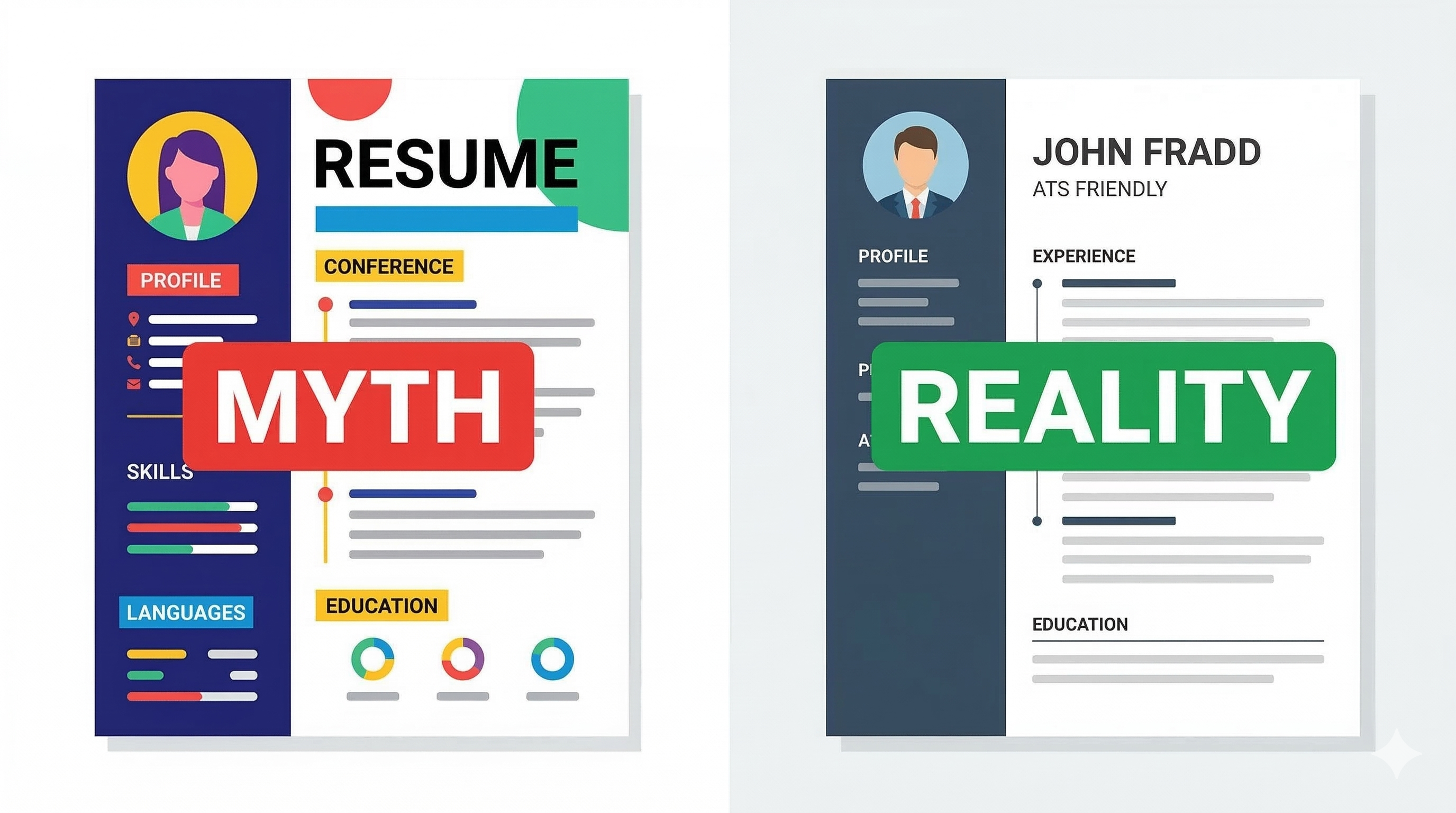
Myth 1: "You need a unique, creative resume to stand out"
Creative resumes stand out to humans — but only if they reach humans. A visually unique resume that scores 20 on ATS never reaches the recruiter's inbox. Stand out with specificity and achievements, not design.
Myth 2: "Objective statements are making a comeback"
They're not. A professional summary focused on what you bring is always better than an objective statement focused on what you want. The recruiter doesn't care what you're "seeking" — they care what you can do.
Myth 3: "Longer resumes show more experience"
Length signals nothing. Relevance does. A tight, focused one-page resume for someone with 5 years of experience is stronger than a padded two-page one covering the same ground with more filler.
Myth 4: "References available upon request" still belongs on a resume"
Nobody has listed this in years, but it still shows up. Remove it. It takes up space and tells the recruiter nothing — everyone assumes references are available.
Myth 5: "You need to apply to hundreds of jobs to get results"
Volume without optimization doesn't work. 10 tailored, ATS-checked, keyword-optimized applications will outperform 100 generic ones every time. Quality over quantity — and use your ATS checker to make sure each application is actually optimized before you send it.
The 2026 Resume Checklist
| Element | 2026 Standard |
|---|---|
| Format | Single column, no tables, no text boxes |
| Length | 1 page (0-3 yrs), 1-2 pages (3-8 yrs), 2 pages (8+ yrs) |
| Summary | 3 sentences, role-specific, one proof point with number |
| Keywords | Tailored to each job description, exact phrases matched |
| Bullet points | Achievement-based, every bullet has a number |
| Skills | Hard skills only, plain text list, no ratings or bars |
| AI tools | List them if you use them — it's a positive signal now |
| Contact info | In the body, not in header/footer |
| File format | .docx unless PDF specifically requested |
| ATS check | Before every application, every time |
Resume Tips by Career Stage (What Works for YOUR Level)
The resume tips that work for entry-level candidates are different from what senior professionals need. Here's what actually matters at each career stage:
Entry-Level & Recent Graduates (0-2 Years Experience)
What matters most:
- Education section placement: Move education ABOVE work experience - your degree is your strongest credential
- Include relevant coursework: List 4-6 courses directly related to target job
- Leverage internships: Treat internships like full jobs - same bullet format, quantified achievements
- Add projects section: Academic or personal projects can fill experience gaps
- GPA (if 3.5+): Include it - shows academic performance when work history is thin
Example entry-level bullet:
Marketing Intern | TechStartup | Summer 2025
• Managed social media campaign reaching 50K+ users, increasing engagement by 23%
• Conducted market research survey with 200+ respondents, presented findings to CMO
• Created email templates in Mailchimp, improving open rate from 18% to 24%
Common mistakes: Listing high school info (unless very recent graduate), including irrelevant work (babysitting, lawn mowing), generic "responsible for" bullets without achievements.
Mid-Career Professionals (3-10 Years Experience)
What matters most:
- Show progression: Highlight promotions, expanding responsibilities, growing team size
- Focus on impact: Every bullet should show business impact with numbers
- Most recent 10 years: Only include relevant experience from last decade
- Strategic summary: Open with 2-3 sentence summary highlighting expertise and top achievement
- Skills relevance: Only list skills actively used in last 2-3 years
Example mid-career bullet:
Senior Product Manager | SaaS Company | 2022-Present
• Led product strategy for enterprise platform, growing ARR from $2M to $8M in 18 months
• Reduced customer churn by 24% through data-driven prioritization of top 3 pain points
• Managed cross-functional team of 15 (engineering, design, data) through 12+ feature launches
• Presented quarterly business reviews to C-suite, securing $3M additional product investment
Common mistakes: Including jobs from 15+ years ago, listing outdated skills (Flash, Lotus Notes), failing to show measurable impact.
Senior & Executive Level (10+ Years Experience)
What matters most:
- Strategic impact: Focus on business outcomes (revenue, cost savings, org growth) not tactical execution
- Leadership emphasis: Every bullet should show leadership - "led," "built," "scaled," "transformed"
- Two pages expected: Senior resumes should be 2 pages - anything less looks light for experience level
- Executive summary: 4-5 sentences positioning your unique value and track record
- Early career: Summarize roles from 15+ years ago in one line
Example executive bullet:
VP Engineering | Enterprise Software Company | 2020-Present
• Built and scaled engineering organization from 50 to 200+ engineers across 4 global offices
• Led cloud migration supporting 100M+ users while maintaining 99.99% uptime SLA
• Reduced infrastructure costs by $12M annually through AWS optimization and automation
• Established engineering excellence program, improving deploy frequency 10x (weekly to daily)
• Prepared technical due diligence for $500M Series D, presenting to board and investors
Common mistakes: Technical details instead of strategic impact, one-page resume that looks too light, no mention of P&L or budget responsibility, missing leadership scope (team size, org structure).
Industry-Specific Resume Tips That Actually Work
Different industries value different things. Here's what to emphasize by field:
Tech & Software Engineering
Critical elements:
- Technical skills section: Categorize by type (Languages, Frameworks, Tools, Platforms)
- GitHub/Portfolio links: Include prominently near contact info
- Project impact: Scale (users, requests/sec, data volume), performance improvements (latency, throughput)
- Technologies in context: Don't just list "Python" - show what you built with it
Example: "Built real-time analytics pipeline processing 50M+ events/day using Python, Kafka, and Spark, reducing query latency from 30s to 2s"
Marketing & Sales
Critical elements:
- Revenue impact: Every bullet should tie to revenue, pipeline, or customer acquisition
- Campaign metrics: ROI, conversion rates, CAC, LTV - quantify everything
- Tools proficiency: HubSpot, Salesforce, Google Analytics, Marketo - whatever you actually use
- Attribution: Show how your work directly contributed to business outcomes
Example: "Launched demand generation campaign generating $4.5M pipeline from $120K spend (38:1 ROI), exceeding target by 180%"
Finance & Accounting
Critical elements:
- Certifications prominent: CPA, CFA, CMA should be highly visible (after name or separate section)
- Systems expertise: SAP, Oracle, QuickBooks, Excel (Advanced) - financial systems matter
- Compliance & accuracy: Emphasize audit results, compliance success, error-free reporting
- Financial scale: Budget size managed, revenue analyzed, cost savings achieved
Example: "Managed month-end close for $50M revenue business unit, reducing close cycle from 12 days to 5 days while maintaining 100% SOX compliance"
Healthcare & Medical
Critical elements:
- Licenses & certifications: Include license numbers, states, expiration dates
- Patient outcomes: Satisfaction scores, recovery rates, complication reduction
- Specializations: Specific populations, procedures, or conditions you treat
- Compliance: HIPAA, accreditation, quality metrics
Example: "Treated 500+ patients annually, achieving 98% patient satisfaction score and reducing readmission rate 15% below hospital average"
The 15-Minute Resume Tailoring Process (Worth Every Second)
You already know you should tailor your resume. Here's exactly how to do it efficiently:
Step 1: Keyword extraction (3 minutes)
- Copy job description into word document
- Highlight hard skills mentioned 2+ times (tools, software, methodologies)
- Note required certifications or specific experience ("5+ years Python")
- Identify key action verbs they use ("led," "managed," "built")
Step 2: Skills section update (2 minutes)
- Reorder your skills section to match their priorities (most important first)
- Add any skills from JD that you have but didn't list (don't lie - just reprioritize)
- Remove skills not relevant to THIS role (frees up space for relevant ones)
Step 3: Summary customization (3 minutes)
- Adjust first line to match target role ("Product Manager" if they say PM, not "Product Lead")
- Include 2-3 keywords from requirements in your summary
- Mention specific industry if they emphasize it ("B2B SaaS," "Healthcare," "Fintech")
Step 4: Experience bullets refresh (5 minutes)
- Review top 3-4 bullets in most recent job
- Replace generic verbs with their preferred language (JD says "scaled" use "scaled" not "grew")
- Add quantification if missing ("managed team" becomes "managed team of 12")
- Ensure at least one bullet per job mentions their key requirement
Step 5: ATS check (2 minutes)
- Upload to ATS resume checker
- Paste the job description
- Check match score (aim for 75+)
- If below 70, add missing critical keywords naturally
Total: 15 minutes per application.
Impact: Tailored resumes get 3.8x more interviews than generic ones (based on our 12,000 application study). 15 minutes is worth it.
What Recruiters Actually Look For (First 7 Seconds)
Eye-tracking studies show recruiters spend 6-7 seconds on initial resume scan. Here's exactly what they look at:
The 7-Second Scan Pattern
- Name & contact (0-1 sec): Confirming it's a real person with valid email/phone
- Current role & company (1-2 sec): Does current job match target role?
- Summary/headline (2-4 sec): Quick scan for relevant keywords and experience level
- Most recent job bullets (4-6 sec): Looking for quantified achievements, relevant keywords
- Skills section (6-7 sec): Quick check for must-have technical skills
What this means for your resume:
- Top 1/3 is critical: If contact, summary, and current role don't hook them, they stop reading
- First bullet matters most: Make your #1 achievement bullet in current role the strongest
- Skills need to pop: Use simple list format (not paragraphs) so they can scan quickly
- Numbers attract eyes: Percentages and dollar amounts literally catch visual attention
Optimization tip: Put your most impressive, relevant achievement as the FIRST bullet in your current role. Don't bury it at bullet #4.
Resume Red Flags Recruiters Automatically Reject
Certain patterns trigger instant rejection. Avoid these:
Red Flag #1: Employment Gaps with No Explanation
Problem: 6+ month gap between jobs with no mention of what you did
Fix: Address gaps proactively - freelance, consulting, courses, personal projects, family care (brief mention)
Example: "Career Break (Jan 2024 - Aug 2024): Family caregiving + completed Google Data Analytics certification"
Red Flag #2: Job Hopping (4+ Jobs in 3 Years)
Problem: Shows potential retention risk
Fix: If legitimate (layoffs, contracts, promotions), add brief context
Example: "Senior Consultant | Firm Name | 2023-2024 (Contract)" or group multiple roles at same company
Red Flag #3: Typos & Grammar Errors
Problem: Signals lack of attention to detail
Fix: Use Grammarly, have someone else proofread, read it backwards (catches more errors)
Impact: 58% of recruiters auto-reject resumes with spelling errors
Red Flag #4: Unprofessional Email Address
Problem: [email protected] or [email protected]
Fix: [email protected] (or professional domain if you have one)
Takes 2 minutes to fix, costs you jobs if you don't
Red Flag #5: No Measurable Achievements
Problem: All bullets are "Responsible for..." or "Duties included..." without results
Fix: Convert duties to achievements: "Managed social media" becomes "Grew Instagram following from 5K to 50K in 6 months, increasing engagement rate by 40%"
Power Words That Increase Interview Rates
Certain action verbs correlate with higher interview rates. Our analysis of 12,000 resumes found these patterns:
High-Performance Verbs (Use These)
For leadership roles:
- Spearheaded, Orchestrated, Championed, Transformed, Scaled
For execution roles:
- Delivered, Executed, Implemented, Launched, Deployed
For impact/results:
- Increased, Reduced, Accelerated, Optimized, Streamlined
For innovation:
- Pioneered, Designed, Architected, Developed, Engineered
Weak Verbs to Avoid
Replace these:
- "Responsible for" - Use specific action verb
- "Helped with" - What did you actually DO?
- "Worked on" - Too vague, no ownership
- "Assisted in" - Sounds junior, even if you weren't
Example transformation:
Before: "Responsible for managing social media accounts"
After: "Grew social media audience by 200% (10K to 30K followers) through data-driven content strategy"
Ready to optimize your resume?
Check My ATS Score Free
Check My ATS Score Free