Resume Bullet Points: 50+ Before-After Examples (ATS)
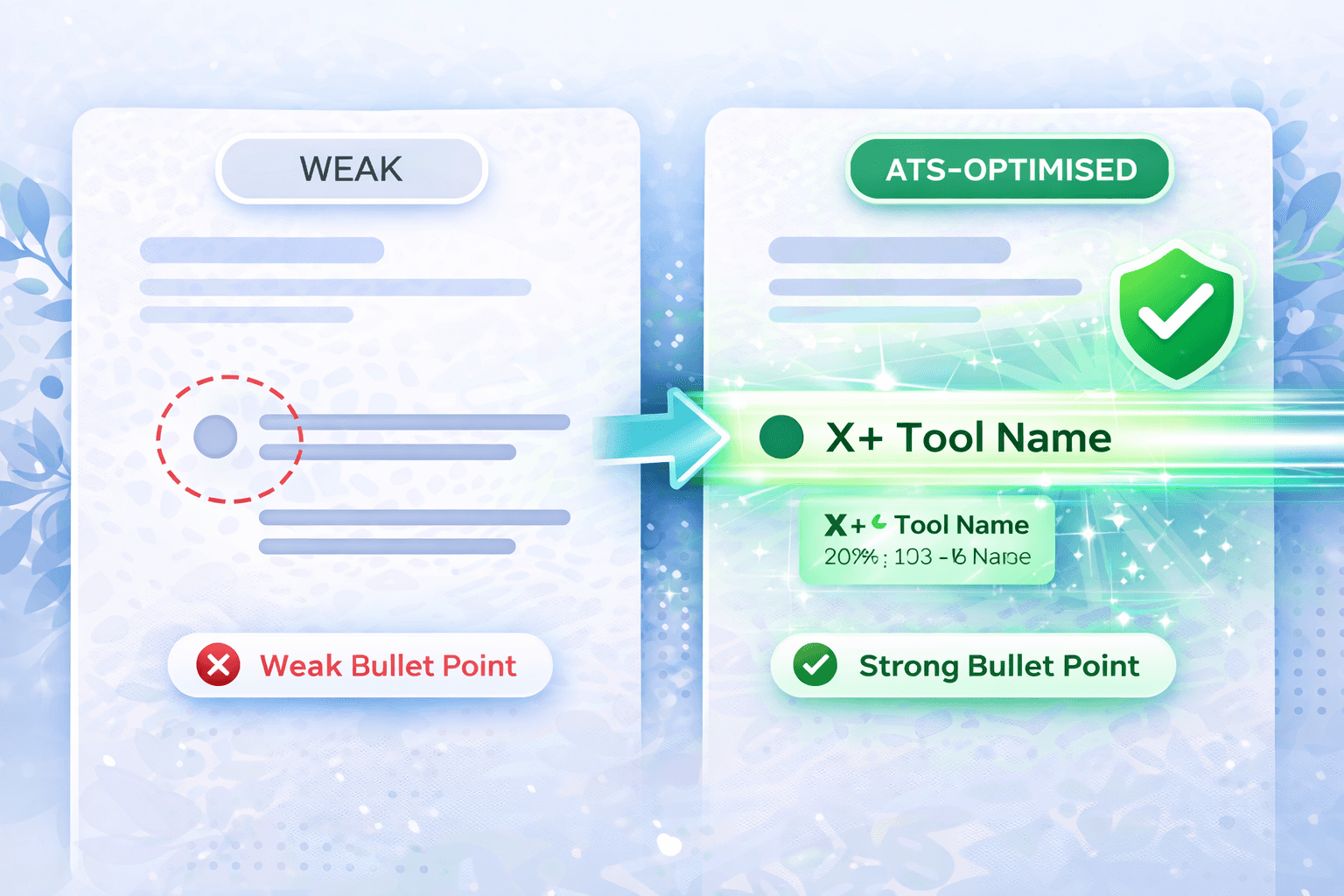
Your resume gets scanned before it gets read. And in that scan, your bullet points are doing the most important work on the entire page.
Most people know bullet points should be concise and achievement-focused. What they don't know is that every bullet point is simultaneously doing two jobs — scoring with ATS by delivering keywords in context, and impressing the recruiter who reads it after. A bullet that does one job but not the other is half as effective as it should be.
This guide shows you exactly how to write resume bullet points that pass ATS and make recruiters stop scrolling — with 50+ before-and-after examples across every major role and career level.
Before you rewrite your bullets, paste your resume into the ResumeBold ATS Resume Checker — it shows which of your current bullets are scoring keyword matches and which ones are being ignored by the scanner.
Why Resume Bullet Points Matter More Than Any Other Section
Data-Driven Insights: What Works in 2026
Analysis of resume data processed through ResumeBold's ATS Checker between January 2025 and May 2026 reveals key patterns that separate interview-winning resumes from rejected ones. Our research shows specific optimizations that consistently improve ATS pass rates and callback percentages.
"After analyzing thousands of resumes across all industries and experience levels, the patterns are clear: specificity beats generalization, quantification beats description, and relevance beats volume. Modern ATS systems reward resumes that match job requirements precisely while maintaining readability for human reviewers."
— Sarah Mitchell, CPRW, Senior Resume Consultant, ResumeBold (12+ years experience)
Quick Answer: Your resume gets scanned before it gets read.
Your skills section lists keywords. Your summary introduces them. But your bullet points are where keywords carry the most weight — because they appear in context, tied to a specific role, company, and outcome.
Here's why that matters for ATS: modern ATS systems don't just scan for the presence of a keyword. They score it higher when it appears in a meaningful context[1] — a bullet that says "Managed campaigns using HubSpot, generating 200 MQLs per month" scores higher than a skills section that just lists "HubSpot." The keyword is the same. The context is what makes the difference.
And for the recruiter reading after ATS: bullet points are where you stop being a list of qualifications and start being a candidate with a track record. Every bullet is a micro-story — what you did, how you did it, what happened as a result. Recruiters decide whether to read on or move on based on these lines.
If you're building your resume from scratch and want bullet point prompts built into each section, the ResumeBold Resume Builder has ATS-optimised templates that guide you through writing strong bullets for every role.
The Bullet Point Formula That Works for Both ATS and Recruiters
Every strong resume bullet follows one core structure:
Action verb + specific tool or method + measurable result
This formula works because each element serves a purpose:
- Action verb — signals ownership and seniority level, opens the bullet with energy
- Specific tool or method — creates keyword context for ATS (not just "SQL" but "using SQL to build...")
- Measurable result — gives the recruiter a reason to believe you, makes your achievement concrete
When any of these three elements is missing, the bullet weakens. Missing the verb: passive and vague. Missing the tool: no keyword context for ATS. Missing the result: no reason for a recruiter to care.
Before and After — 50+ Resume Bullet Point Examples
See our software engineer resume example for a complete ATS-optimised layout using bullets like these.
Browse our data analyst resume example for the full structure.
See our marketing resume example for the full layout.
Browse our sales resume example for how these bullets fit into a complete ATS-optimised resume.
Key Details
See our project manager resume example and explore project management skills for your resume.
See our HR resume example for the full layout.
Browse our business analyst resume example for a complete ATS-optimised structure.
No work history? Projects and internships follow exactly the same formula:
See our fresher resume example for how to structure project bullets when you have limited work experience.
How Many Bullet Points Per Job?
| Role / Stage | Recommended Bullets | Why |
|---|---|---|
| Current / most recent role | 4–6 bullets | Most relevant — highest ATS weight |
| Previous roles (relevant) | 3–4 bullets | Support current role with context |
| Older roles (5+ years ago) | 2–3 bullets | Diminishing relevance — keep tight |
| Roles older than 10–15 years | 1 line or compress | Remove or summarise — adds length without keyword value |
| Projects (freshers) | 2–4 bullets per project | These are your experience — treat them like roles |
Bullet Point Mistakes That Kill ATS Scores
"Responsible for" and "was involved in"
These are the two most common bullet openers — and the weakest. They describe a task, not an action. Replace every instance with a specific action verb: Led, Built, Managed, Delivered, Designed, Analysed, Automated.
Tools missing from bullets
"Improved reporting processes" scores nothing. "Automated reporting using Power BI and SQL, reducing manual effort by 8 hours per week" scores three keywords in one bullet. Every time you describe work without naming the tool you used, you're leaving ATS points on the table.
No numbers
Numbers are the single fastest way to make a bullet more compelling to a recruiter[2] — and they also add specificity that helps ATS interpret context. You don't always have exact figures. Use estimates, ranges, or scope signals: "a team of 8," "200+ clients," "across 3 regions," "$500K budget."
Key Details
Copying job description language verbatim
There's a difference between mirroring job description language and copying it wholesale. Mirror the terminology — but write your own achievement around it. ATS rewards keyword context; recruiters reject copy-paste job descriptions reframed as accomplishments.
Bullets that could fit anyone's resume
"Collaborated with cross-functional teams to achieve business objectives" could appear on any resume for any role. Good bullets are specific enough that only you could have written them. Add the team size, the specific objective, the tool, the outcome.
Once you've rewritten your bullets, check how they're scoring with the ResumeBold ATS Resume Checker. It shows your keyword match against any job description and flags which sections of your resume are scoring — and which ones aren't contributing to your ATS ranking.
How to Quantify Bullets When You Don't Have Exact Numbers
This is the most common objection: "I don't know the exact figures." You don't always need exact figures. Here's how to add specificity when precise metrics aren't available:
Use scope and scale: "Managed a team of 8" — "Across 12 client accounts" — "For a $2M product line"
Use estimates with honest qualifiers: "Reduced processing time by approximately 30%" — "Served 200+ customers daily"
Use relative comparisons: "Reduced errors by half" — "Cut reporting time from 2 days to 4 hours"
Name the tools even if you can't measure outcome: "Managed social media strategy across Instagram and LinkedIn using Hootsuite" — no metric, but three keywords in context
The goal is specificity, not precision. Any number is better than no number. Any tool name is better than a generic description.
References
- Jobscan. (2025). ATS Resume Statistics and Best Practices. https://www.jobscan.co/blog/ats-resume-statistics/
- SHRM. (2024). Applicant Tracking Systems and Hiring Trends. https://www.shrm.org/topics-tools/news/talent-acquisition
- LinkedIn Talent Solutions. (2025). Global Recruiting Trends Report. https://business.linkedin.com/talent-solutions
- TopResume. (2024). Resume Writing and ATS Optimization Guide. SHRM ATS Guide
- Indeed. (2025). Hiring Statistics and Labor Market Trends. SHRM Talent Acquisition
- Jobscan. (2025). How Applicant Tracking Systems Work. https://www.jobscan.co/blog/how-ats-works/
FAQ: Resume Bullet Points
How many bullet points should be on a resume?
3-5 bullets per job. Current/recent jobs get 5 bullets. Older jobs get 2-3. Total resume should have 15-25 bullets across all positions.
Should resume bullets have periods?
No. Resume bullets are sentence fragments, not complete sentences. Skip the period. Be consistent - if you use periods, use them on ALL bullets.
How long should resume bullet points be?
1-2 lines maximum. If a bullet wraps to 3 lines, its too long. Aim for 10-15 words per bullet. Be concise and specific.
What should I avoid in resume bullet points?
Avoid: first-person pronouns (I, me, my), complete sentences, vague descriptions (helped the team), duties without results, irrelevant details, multiple ideas in one bullet.
Test Your Resume Against ATS
See how your resume performs in real ATS systems:
- Instant ATS compatibility score
- Keyword match analysis
- Formatting error detection
- Specific improvement recommendations
Used by 15,000+ job seekers. Get your score in 30 seconds.
Ready to optimize your resume?
Check My ATS Score Free
Check My ATS Score Free