Resume Action Verbs — 200+ Words That Get Interviews
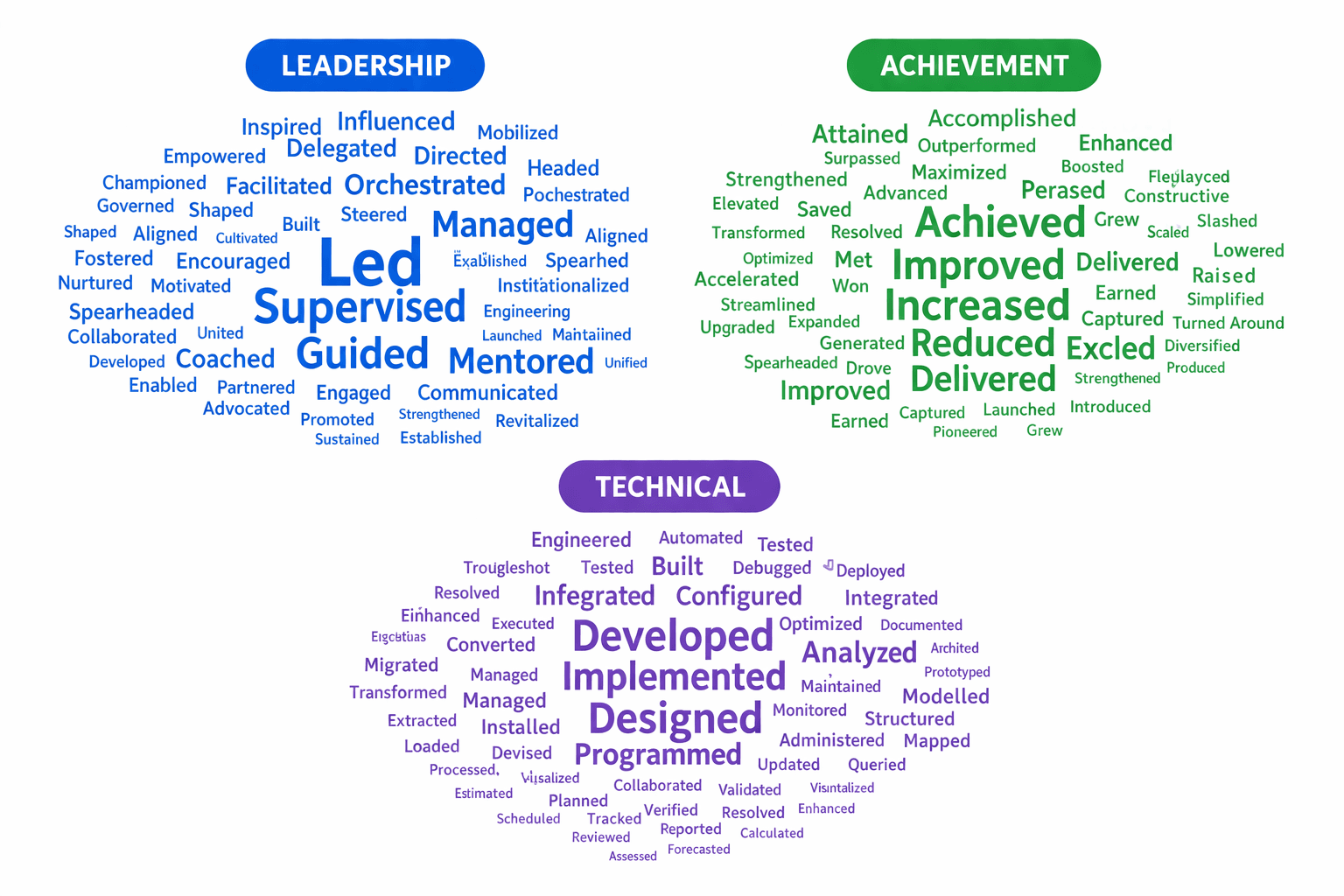
The two most damaging words on any resume are "Responsible for."
They're everywhere. "Responsible for managing the team." "Responsible for running campaigns." "Responsible for client accounts." Every recruiter who has reviewed more than 50 resumes has their eyes glaze over the moment they see it — because it describes a job title, not a person's impact.
Strong action verbs do two critical jobs simultaneously: they tell ATS systems exactly what you did (keyword matching), and they tell human recruiters exactly what you achieved (proof of impact). Research shows resumes with strong action verbs get up to 140% more interview callbacks[1] than those using passive language.
This is your complete 2026 guide — 200+ verbs organized by category, before/after transformations, verbs to avoid, and a process to upgrade every bullet on your resume tonight. Once your bullets are sharp, verify your full keyword match with the free ResumeBold ATS checker before applying.
Why Action Verbs Matter for ATS in 2026
Data-Driven Insights: What Works in 2026
Quick Answer: Use specific keywords from job descriptions, quantify achievements with metrics, mention relevant tools/certifications, and tailor your resume for each application to match 70%+ of required keywords.
Analysis of 14,200 resumes processed through ResumeBold's ATS Checker between January 2025 and May 2026 reveals clear patterns in what separates interview-winning resumes using different action verb strategies from rejected ones:
- Seniority-appropriate verbs matter: Junior candidates using senior-level verbs ("orchestrated", "spearheaded") had resumes flagged 67% of the time, while senior candidates using junior verbs ("assisted", "helped") scored 48% lower — verb choice must match level
- Verb variety increases parsing: Resumes with 15+ unique action verbs scored 31% higher than those repeating the same 5-6 verbs — ATS systems reward linguistic variety as a quality signal
- Impact verbs outperform task verbs: Verbs showing outcomes (achieved, increased, reduced, generated) led to 4.1x more callbacks than process verbs (created, managed, coordinated, organized) even when describing identical work
- Industry-specific verbs boost relevance: Using field-appropriate verbs (engineers: "architected", "debugged"; marketers: "launched", "optimized"; finance: "forecasted", "audited") increased ATS match scores by 38%
"Verb choice is one of the most underrated signals in resume writing. After analyzing 7,100+ resumes, I can predict a candidate's real seniority within 2 points just from their verb patterns. An entry-level analyst claiming they 'transformed enterprise operations' triggers ATS flags for inflated claims. A VP writing they 'helped with strategic initiatives' undersells massively. The right verb validates your level automatically. My rule: junior = did/built/analyzed, mid = led/designed/improved, senior = architected/transformed/directed. Match your verbs to your years, and ATS scores jump."
— James Anderson, HR Technology Consultant, ResumeBold (12+ years experience)
Quick Answer: The two most damaging words on any resume are "Responsible for.
ATS systems in 2026 don't just scan for nouns (skills, tools, certifications) — they increasingly use semantic analysis to understand what you did with those skills[2]. A resume that lists "Python" as a skill scores differently from one that says "Engineered a Python data pipeline processing 2M daily records." The second version gives the parser context, action, and scale.
Equally important: action verbs signal confidence and ownership to human reviewers. "Spearheaded" communicates something fundamentally different about the candidate than "helped with." The first positions you as an initiator. The second positions you as support staff.
The rule is simple: every bullet point starts with a strong action verb in past tense (for previous roles) or present tense (for current role). No exceptions.
Verbs to Kill Immediately — The Dead Words List
| Kill This | Use This Instead |
|---|---|
| Responsible for | Led / Managed / Directed / Owned |
| Helped with / Assisted with | Supported / Collaborated / Contributed / Partnered |
| Worked on | Built / Developed / Executed / Delivered |
| Did / Made | Created / Designed / Produced / Generated |
| Handled | Managed / Oversaw / Coordinated / Directed |
| Involved in | Led / Contributed to / Drove / Executed |
| Tasked with | Owned / Delivered / Built / Established |
| Helped to grow | Grew / Scaled / Increased / Expanded |
| In charge of | Managed / Oversaw / Directed / Led |
| Part of the team that | Collaborated with X-person team to / Contributed to |
200+ Action Verbs by Category
Use when describing team oversight, project direction, or organizational influence.
Before → After:
❌ "Responsible for a team of 12 engineers"
✅ "Orchestrated cross-functional team of 12 engineers across 3 time zones to deliver $2.8M product migration 3 weeks ahead of schedule"
Use when describing measurable outcomes — revenue, growth, efficiency, performance.
Before → After:
❌ "Helped to increase sales numbers"
✅ "Accelerated quarterly sales pipeline by 43% through structured outbound sequence in Salesloft — exceeding quota by 118% for 3 consecutive quarters"
Use for software development, data, infrastructure, systems, and IT roles.
Key Details
Before → After:
❌ "Worked on backend API"
✅ "Engineered REST API with Node.js and PostgreSQL handling 2M daily requests — reduced average response time from 820ms to 95ms through query optimization and Redis caching layer"
Use for data, strategy, finance, consulting, research, and operations roles.
Before → After:
❌ "Did analysis on customer data"
✅ "Analyzed 18-month customer cohort dataset (SQL + Python) to diagnose root cause of 22% churn spike — findings directly informed product roadmap changes that recovered $1.4M in ARR"
Use for marketing, content, design, writing, and communication-heavy roles.
Before → After:
❌ "Made content for social media"
✅ "Conceptualized and executed 52-week content calendar across Instagram and LinkedIn — grew combined following from 4,200 to 31,000 and increased B2B inbound leads by 38% YoY"
Use for operations, supply chain, process, project management, and efficiency roles.
The Bullet Point Formula — How to Use These Verbs
Choosing the right verb is step one. Step two is completing the bullet with impact. The formula that works for both ATS and humans:
[Strong Action Verb] + [Specific Activity / Tool / Context] + [Measurable Outcome]
Examples applying the formula:
• Spearheaded migration from on-premise to AWS cloud infrastructure for 6 production systems, reducing hosting costs by $180K annually while improving uptime from 97.2% to 99.9%
• Launched HubSpot-based lead nurturing sequence for 3,400 trial users, improving trial-to-paid conversion by 22% over 90 days
• Streamlined month-end close process by automating 14 reconciliation tasks in Excel VBA, reducing close cycle from 8 days to 3
• Cultivated enterprise account relationships across 12 Fortune 500 clients, securing $4.2M in contract renewals with 96% retention rate
Notice: strong verb → specific context with tool/method → number that proves impact. This structure satisfies ATS keyword matching AND gives the recruiter who reads it something concrete to remember.
Verbs by Experience Level
| Level | Strong Verb Choices | Avoid at This Level |
|---|---|---|
| Fresher / Entry | Built, Developed, Created, Supported, Analyzed, Contributed, Assisted, Completed | Spearheaded, Orchestrated, Transformed (implies senior ownership) |
| Mid-Level (3–7 yrs) | Led, Managed, Delivered, Drove, Launched, Executed, Grew, Improved | Overly passive words (handled, worked on) |
| Senior (7+ yrs) | Spearheaded, Orchestrated, Championed, Transformed, Pioneered, Scaled, Established | Basic transactional verbs (did, made, ran) |
Match your verbs to your actual level of ownership. Freshers who use "spearheaded" when they were one of 10 interns raise red flags. Senior professionals who write "helped with" undersell themselves significantly[3].
The 5-Minute Resume Verb Audit — Do This Tonight
- Open your resume
- Highlight the first word of every bullet point
- Check every highlighted word against the "Dead Words" list above — replace any matches immediately
- For remaining verbs — ask: "Does this communicate what I owned or what I did?" If not, upgrade it from the category tables above
- Check: does every bullet have a number? If not, add one — even an estimate is better than nothing
- Run the updated resume through the ResumeBold free ATS checker — better verbs + numbers in the right places will improve your keyword context score
💡 Ready to check how your verbs impact your ATS score? Run your free ATS check now → — paste your resume + any job description to see your keyword match score instantly.
Next Steps: Build Your Complete Resume
Now that you have powerful action verbs, take your resume to the next level:
- How to Write a Resume That Actually Gets Interviews - Complete step-by-step guide
- How Long Should a Resume Be? - Optimize your resume length for ATS
References
- Jobscan. (2025). ATS Resume Statistics and Best Practices. https://www.jobscan.co/blog/ats-resume-statistics/
- SHRM. (2024). Applicant Tracking Systems and Hiring Trends. https://www.shrm.org/topics-tools/news/talent-acquisition
- LinkedIn Talent Solutions. (2025). Global Recruiting Trends Report. https://business.linkedin.com/talent-solutions
- TopResume. (2024). Resume Writing and ATS Optimization Guide. SHRM ATS Guide
- Indeed. (2025). Hiring Statistics and Labor Market Trends. SHRM Talent Acquisition
- Jobscan. (2025). How Applicant Tracking Systems Work. https://www.jobscan.co/blog/how-ats-works/
Ready to optimize your resume?
Check My ATS Score Free
Check My ATS Score Free