Data Analyst Resume Examples That Work (2026)
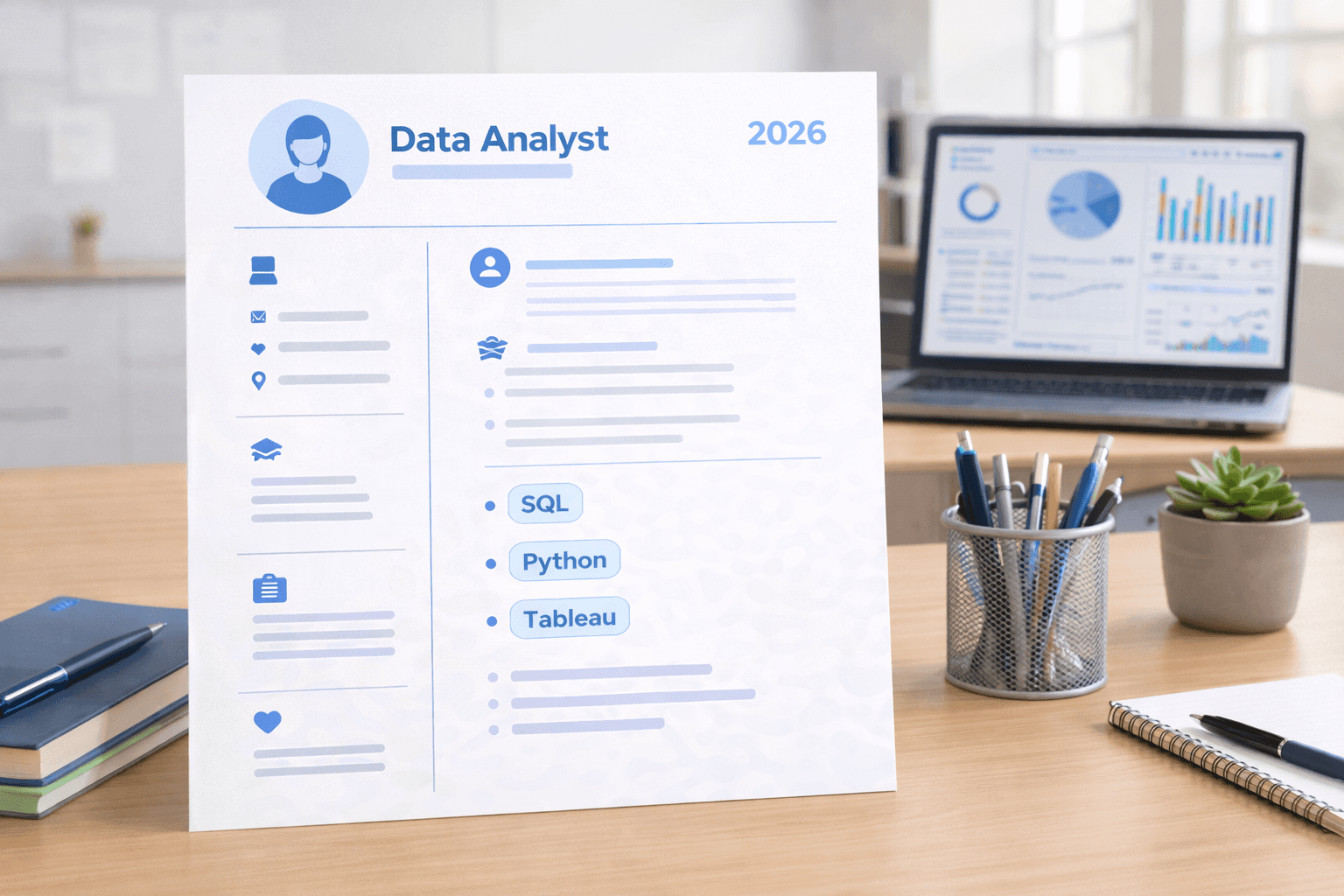
Data analyst resumes fail for one reason: they list tools and responsibilities instead of showing what those tools accomplished. Hiring managers don't care that you "used SQL and Python to analyze data." They care that you used SQL to identify $2.3M in cost savings or built Python models that improved forecast accuracy by 18%.
In 2026, data analyst hiring is more competitive than ever. Companies are drowning in data but starving for analysts who can turn that data into business decisions. Your resume needs to prove — with examples, metrics, and clear outcomes — that you're one of the analysts who delivers insights, not just dashboards.
This guide will show you exactly how to structure a data analyst resume that gets past ATS systems and lands interviews, whether you're entry-level, mid-career, or pivoting from another field.
What Hiring Managers Look For in Data Analyst Resumes
Data analyst roles vary wildly by company. At a startup, you might be the only analyst doing everything from SQL queries to executive presentations. At an enterprise company, you might specialize in marketing analytics, financial modeling, or operations reporting.
Despite the variation, hiring managers consistently look for three things:
- Technical proficiency: SQL, Python/R, Excel, visualization tools (Tableau, Power BI, Looker)
- Business impact: Did your analysis lead to decisions? Did it save money, increase revenue, improve efficiency?
- Communication ability: Can you translate complex analysis into insights that non-technical stakeholders understand and act on?
Your resume needs to address all three. Tools without impact = you're a button-pusher. Impact without technical detail = you're taking credit for someone else's work. Technical skills without communication = your insights sit unused in a Google Doc.
Resume Structure for Data Analysts
Use reverse-chronological format. ATS systems expect it, and hiring managers want to see your progression over time.
[Header: Name, Title, Contact, LinkedIn, Portfolio/GitHub if applicable] [Professional Summary: 2-3 lines highlighting specialty and top impact] [Work Experience: Reverse-chronological with project-based bullets] [Technical Skills: Tools, languages, platforms] [Education & Certifications]
One page if you have less than 5 years of experience. Two pages is acceptable if you're senior (7+ years) or have extensive project work that demonstrates clear business impact.
Professional Summary: Show Your Niche
Data analysts often make the mistake of writing generic summaries: "Detail-oriented data analyst with strong analytical skills and experience in SQL and Python."
This tells the hiring manager nothing. What kind of data? What industry? What kind of problems do you solve?
Bad example:
Analytical professional with 3 years of experience using data to drive business decisions. Proficient in SQL, Python, Tableau, and Excel. Strong communication skills and passion for turning data into insights.
Good example:
Marketing Data Analyst with 4+ years optimizing acquisition and retention strategies for B2C SaaS companies. Built attribution models that identified $1.8M in wasted ad spend and cohort analyses that increased LTV 22%. Expert in SQL, Python (pandas/scikit-learn), and Tableau.
The good version tells you: the domain (marketing analytics), the business context (B2C SaaS), two concrete results ($1.8M savings, 22% LTV lift), and the technical stack.
Summary Formula
- Role + Specialty: "Marketing Data Analyst with 4+ years optimizing acquisition..."
- Impact: "Built attribution models that identified $1.8M in wasted spend..."
- Technical Stack: "Expert in SQL, Python, Tableau"
Work Experience: Tell the Story of Your Analysis
This is where most data analyst resumes fall apart. Instead of storytelling (problem → analysis → result), they list vague responsibilities:
- "Analyzed sales data using SQL and Excel"
- "Created dashboards in Tableau for leadership team"
- "Performed ad-hoc analysis to support business decisions"
These bullets say what you did but not why it mattered.
The Analysis Story Formula
Every bullet should follow this structure:
[Business problem/question] → [Your analysis approach] → [Measurable outcome]
Example:
• Identified 18% churn spike in Q3 by building SQL cohort retention model; presented findings to product team, leading to UX changes that reduced churn to 12% within 60 days
- Problem: 18% churn spike
- Analysis: SQL cohort retention model
- Outcome: UX changes, churn reduced to 12%
Strong Data Analyst Resume Bullets by Domain
Marketing Analytics:
• Built multi-touch attribution model in Python to analyze $4M annual ad spend; identified underperforming channels, resulting in reallocation that improved CAC by 31% • Developed Tableau dashboard tracking campaign performance across 8 channels; used by marketing team daily to optimize $500K monthly budget • Analyzed email campaign A/B tests across 120K users; recommended subject line changes that increased open rates from 18% to 26%
Product Analytics:
• Designed SQL funnel analysis to identify dropoff points in checkout flow; findings led to redesign that increased conversion rate by 14% ($2.1M annual revenue impact) • Conducted user behavior analysis on 50K+ sessions using Mixpanel; surfaced feature usage patterns that informed product roadmap priorities • Built retention cohort model revealing 40% of users churned after first week; presented to PM team, triggering onboarding redesign that improved D30 retention from 22% to 34%
Financial/Operations Analytics:
See business analyst resume examples with quantified results.
• Created Excel financial model to forecast quarterly revenue within 3% accuracy, replacing legacy process that averaged 12% error • Analyzed supply chain data across 200+ vendors; identified $850K in cost savings through vendor consolidation and contract renegotiation • Built automated SQL reporting pipeline that reduced monthly close process from 8 days to 3 days, saving 120+ analyst hours per quarter
Sales Analytics:
• Analyzed win/loss data for 400+ deals using Salesforce data and Python; identified 3 pricing objections contributing to 35% loss rate, leading to pricing strategy update that improved win rate to 48% • Built Power BI sales performance dashboard tracking 50+ reps across 6 KPIs; enabled sales leadership to identify underperformers and replicate top-performer tactics • Developed territory analysis model that optimized account assignment, resulting in 18% increase in pipeline coverage
Technical Skills Section
ATS systems scan heavily for technical skills[1]. List every tool, language, and platform you've used professionally.
Organize by category for readability:
Languages & Databases:
- SQL (PostgreSQL, MySQL, BigQuery, Snowflake)
- Python (pandas, NumPy, scikit-learn, matplotlib)
- R (ggplot2, dplyr, tidyr)
Visualization & BI Tools:
- Tableau, Power BI, Looker, Google Data Studio, Mode Analytics
- Advanced Excel (pivot tables, VLOOKUP, Power Query, macros)
Analytics Platforms:
- Google Analytics, Mixpanel, Amplitude, Segment
- Salesforce, HubSpot, Marketo
Statistical & ML Techniques:
- Regression analysis, A/B testing, hypothesis testing
- Clustering, classification, time series forecasting
- Cohort analysis, funnel analysis, attribution modeling
Don't inflate your skill level. If you've only used a tool once in a training course, leave it off. Interviewers will test your knowledge.
Education and Certifications
For data analyst roles, education matters more than in some other fields — especially if you're entry-level. Include:
- Degree: Major, school, graduation year (or expected graduation if still enrolled)
- Relevant coursework: If you're a recent grad, list 3-5 relevant classes (Statistics, Database Systems, Data Mining, Machine Learning)
- GPA: Only if 3.5+ and you're within 3 years of graduation
Example:
Bachelor of Science in Statistics University of California, Berkeley | Graduated May 2023 Relevant Coursework: Statistical Modeling, Machine Learning, Database Systems, Econometrics
Certifications Worth Including
Certifications won't get you hired on their own, but they strengthen a resume — especially if you're self-taught or career-switching:
- Google Data Analytics Professional Certificate
- Microsoft Certified: Data Analyst Associate
- Tableau Desktop Specialist
- AWS Certified Data Analytics
- IBM Data Analyst Professional Certificate
Projects Section (Optional but Powerful)
If you're entry-level, career-switching, or have limited professional experience, add a Projects section to demonstrate skills:
Example:
Customer Churn Prediction Model • Built logistic regression model in Python using 50K+ customer records to predict churn with 82% accuracy • Performed feature engineering and hyperparameter tuning using scikit-learn • Visualized key churn drivers in Tableau; model currently used by retention team E-Commerce Sales Dashboard • Designed interactive Tableau dashboard analyzing $2M+ in transaction data from Kaggle dataset • Built SQL queries to aggregate data by product category, region, and time period • Published to Tableau Public with 500+ views
Include a link to your GitHub, portfolio site, or Tableau Public profile if you have public projects. Hiring managers love to see actual work.
ATS Optimization for Data Analyst Resumes
Most companies use ATS to filter resumes before human review. Here's how to get through:
Match Keywords from the Job Description
If the job posting lists "SQL, Python, Tableau, A/B testing," make sure those exact terms appear in your resume. Don't say "statistical software" when they want "Python." Don't say "data visualization" when they want "Tableau."
Use Standard Section Headings
Stick to: Work Experience, Technical Skills, Education, Certifications. Avoid creative headings like "My Journey" or "What I Bring to the Table."
Avoid Tables and Graphics
ATS can't parse tables, text boxes, or images. Use simple bullet points and standard fonts (Arial, Calibri, Times New Roman).
Save as .docx or PDF
Both formats work well with modern ATS. Avoid .pages, .txt, or image files.
Want to check how your resume scores? Run it through ResumeBold's free ATS checker to see keyword matches, formatting issues, and improvement suggestions.
Common Data Analyst Resume Mistakes
1. Listing Tools Without Outcomes
Wrong: "Used SQL to query databases and generate reports"
Right: "Wrote SQL queries analyzing 10M+ transaction records; identified pricing anomaly costing company $400K annually"
2. Vague Impact Statements
"Improved efficiency," "enhanced decision-making," "optimized processes" — these are meaningless without numbers.
3. Overloading with Technical Jargon
Yes, list technical skills. But when describing projects, translate the impact into business language. "Reduced MAPE by 8%" means nothing to most hiring managers. "Improved forecast accuracy from 85% to 93%" is clearer.
4. Ignoring Communication Skills
Data analysts must present findings. Include bullets about presenting to stakeholders, building dashboards for non-technical users, or translating analysis into recommendations.
5. Generic Responsibilities
Avoid: "Responsible for data analysis and reporting."
These say nothing about your work. Every data analyst does "analysis and reporting." What specific problems did you solve?
Entry-Level Data Analyst Resume Tips
If you're early-career or switching into data analytics, you can still build a strong resume:
- Emphasize internships and school projects: Treat them like professional experience with the same bullet structure (problem → analysis → result)
- Highlight transferable skills: If you were in finance, sales, or operations, you likely did analysis work — frame it that way
- Build a portfolio: Complete 2-3 public projects on Kaggle, GitHub, or Tableau Public and link them on your resume
- Get certified: Google Data Analytics or Microsoft Data Analyst certificates add credibility if you lack formal experience
- Quantify everything: Even if your project was on a public dataset, talk about the size of the data, the accuracy of your model, the complexity of the analysis
Data Analyst Resume Checklist
Before submitting, verify:
- ☑ Every work bullet includes a business outcome or measurable result
- ☑ You've listed SQL, Python/R, and at least one visualization tool
- ☑ You've matched keywords from the job description
- ☑ Your summary specifies your analytics domain (marketing, product, finance, etc.)
- ☑ You've included at least one bullet about presenting findings to stakeholders
- ☑ You've removed vague phrases like "detail-oriented" or "team player"
- ☑ You've used standard resume format (no tables, graphics, or unusual fonts)
- ☑ You've linked to GitHub, portfolio, or Tableau Public if you have public work
- ☑ Your technical skills section is organized by category
- ☑ You've kept it to 1 page (or 2 pages if 7+ years experience)
Final Thought: Analysis Alone Isn't Enough
The best data analysts don't just run queries and build dashboards — they solve problems. Your resume should tell the story of problems you've solved: revenue you've generated, costs you've cut, inefficiencies you've eliminated, decisions you've informed.
Every bullet should answer: "So what?" You analyzed churn data — so what? You built a dashboard — so what did it enable the business to do?
If you can connect your technical work to tangible business outcomes, you'll stand out in a crowded field of analysts who only list tools and tasks.
Ready to optimize your data analyst resume? Try ResumeBold's AI resume builder — it helps you structure your experience with the impact-driven format that data hiring managers expect.
References
- SHRM. (2024). Resume Keyword Matching in Applicant Tracking Systems. Retrieved from https://www.shrm.org/topics-tools/news/talent-acquisition
Ready to optimize your resume?
Check My ATS Score Free
Check My ATS Score Free